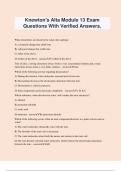
Knewton's Alta Module 13 Exam Questions With Verified Answers.
Knewton's Alta Module 13 Exam Questions With Verified Answers. When electrolytes are dissolved in water, they undergo: A) a chemical change that yields ions B) a physical change that yields ions C) either of the above D) neither of the above - answerC) either of the above True of false: a strong electrolyte always forms a very concentrated solution and a weak electrolyte always forms a very dilute solution. - answerFalse Which of the following are true regarding dissociation? A) During dissociation, water molecules surround and solvate ions. B) Dissociation decreases the electrostatic attractions between ions. C) Dissociation is a physical process. D) Ionic compounds rarely dissociate completely. - answerA, B, & C Which substance, when dissolved in water, will conduct the most electricity? A) ethanol B) potassium chloride C) acetic acid D) ammonia - answerB) potassium chloride Which of the following occurs when an ionic compound dissolves in a polar solvent such as water? A) The water molecules chemically react with the ions. B) The disorder of the ionic salt is decreased. C) The water molecules attract both the anions and cations in the ionic salt. D) The ions become solvated water molecules, which reduces the electrostatic attractions between the ions. - answerA&D Of the following, which are characteristics of weak electrolytes? A) They produce a low concentration of ions when dissolved in water. B) They are soluble in water. C) They exhibit no conductivity. D) They exhibit low conductivity. - answerA, B, and D If a compound undergoes a chemical reaction and the reaction is essentially 100% complete, the compound could have been a: (select all that apply) A) weak acid B) strong acid C) weak base D) strong base - answerB and D Which of the following are not true of covalent electrolytes? A) They contain only covalent bonds. B) They may contain ions. C) All soluble covalent compounds are covalent electrolytes. D) Solutions prepared from covalent compounds conduct electricity. - answerB and C Which of the following gives the definition of ion-dipole attraction? A) Ion-dipole attraction is attraction between an ion and the polar bond(s) in a nonpolar molecule. B) Ion-dipole attraction is a physical process accompanying the dissolution of an ionic compound in which the compound's constituent ions are solvated and dispersed throughout the solution. C) Ion-dipole attraction is the scattering of visible light by a solution. D) Ion-dipole attraction is the electrostatic attraction between an ion and a polar molecule. - answerD) Ion-dipole attraction is the electrostatic attraction between an ion and a polar molecule. Which of the following are true of ionic electrolytes? A) NH3 is an example of a ionic electrolyte. B) They must be ionic compounds. C) They yield ions by their dissociation in water.
Escuela, estudio y materia
- Institución
- Knewton
- Grado
- Knewton
Información del documento
- Subido en
- 20 de julio de 2024
- Número de páginas
- 17
- Escrito en
- 2023/2024
- Tipo
- Examen
- Contiene
- Preguntas y respuestas
Temas
-
knewtons alta module 13 exam questions with verif

Documento también disponible en un lote