Attachment 16 marker essay plans
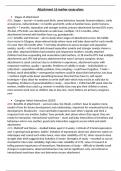
Stages of attachment
AO1: Stages – asocial = 6 weeks post birth, same behaviour towards humans/objects, smile
at everyone, indiscriminate = 6 months post birth, smile at familiar faces, prefer humans,
specific = 7 months, separation and stranger anxiety, primary attachment formed 65% mum,
3% dad, 27% both, use attachments as safe base, multiple = 8-11 months, other
attachments formed with familiar faces e.g. grandparents
AO3: Schaffer and Emerson – aim to study when stages of attachment occurs, 60 middle
class mums in Glasgow, observational study where mum and baby observed for each month
of a year then 18 months after, 7 everyday situations to assess stranger and separation
anxiety, results = 6-8 month olds showed separation anxiety and stranger anxiety shown a
year after, attached children had sensitive and responsive mothers, weakly attached
children had slow responding and unsensitive/cold mothers, at 18 months 87% had multiple
attachments and 39% had primary attachment that wasn’t primary caregiver, shows
attachment is social construct due to similarity in experience, attachment easier with
responsive mothers, quality > quantity. Problems of validity in study – individualistic vs
collectivist = population validity problem, time sampling = could have forgotten, 7 tasks =
limited, social desirability = unresponsive mothers could lie about their behaviour, too busy
= mothers might write down something because they feel they have to, self-report
technique = diary allow for mothers to write stuff later which may not be as valid due to
forgetting. Problems of generalisability in study – class/time = 1960s had diff social roles for
women, middle-class used e.g. women in wealthy class may give their children a nanny,
more women work now so children stay in day-care, more fathers are primary caregivers
now
Caregiver Infant Interactions (2020)
AO1: Benefits of attachment – survival value, bio (food), comfort, base to explore more,
model of love for future development and relationships, important for emotional/social cog
development. Reciprocity – mum and baby respond to each other’s signals and elicit a
response from one another, babies’ have periodic alert phase where they signal, they are
ready for interaction. Interactional synchrony – mum and baby interactions of emotions and
behaviour mirror one another, good early interaction suggests secure infant and adult
attachment
AO3: Meltzoff and Moore – studied babies aged 2-3 weeks, 4 stimuli of 3 facial expressions
and 1 opening hand gesture, babies’ imitation of expressions observed, observers watch on
videotapes and scored each video twice, inter-rater reliability of 0.92, other research done
straight after birth suggests that imitation is innate. Strengths of study – recorded so can be
checked for inter-rater reliability, high inter-rater reliability of 0.92, value of research in
telling parents importance of interactions, Weaknesses of study – difficult to identify small
changes in expressions, observed behaviour may not be significant, only correctional so
interactional synchrony does not determine secure attachment
, Role of the father
AO1: What is the role – typically minor parenting role, 25% of stay-at-home parents are
men, men can take on maternal role and become primary attachment as shown by Shaffer
and Emerson’s study. Benefits of attachment with father – less problem behaviour, better
peer relations, better emotional regulation. Distinctive role? – depends if research studies
the father as primary or secondary attachment figure, if role was distinctive then children
from 2 parent households would develop diff to 1 parent households but research does not
show this, may mean role of father is only distinctive in heterosexual families as lesbian
couples adapt to not having father by taking on role of father
AO3: Tiffany Field – filmed 4-month-old babies having face to face interactions with primary
caregiver mums, primary caregiver dads, and secondary caregiver dads, primary caregiver
dads had much more imitation, holding, and smiling than secondary caregiver dads, shows
gender does not matter but responsiveness does. Value of research – assures parents that
either parent can be a primary attachment figure which is useful for working
women/lesbian couples, shows parental expectations is due to socially constructed gender
roles and oestrogen levels in women, Weaknesses of research – research is correlational, so
parental sensitivity doesn’t necessarily lead to secure attachment, other factors such as age,
culture, marital intimacy, and how often father is away
Animal studies of attachment (2022)
AO1: Precocial – born at more advanced stage of development so animals. Altricial – born at
early stage of development so required attachment and nourishment so humans.
Attachment studies on animals – more ethical when research cannot be done on humans,
more practical as can see the change in development in generations. Imprinting – type of
attachment where offspring follow the first big moving thing they see. Lorenz – had half of
the gosling eggs hatch in natural enviro, other half in incubator where the first thing they
saw was Lorenz, chicks imprinted on Lorenz and followed him, Lorenz said imprinting was
evolutionary as chicks following their mothers mean they are safe and can survive. Supports
Bowlby’s idea of a critical period (a time period where imprinting/attachment must occur
and cannot happen after this – depending on species, few hours after birth) as it shows that
imprinting occurs during a specific time, Lorenz also studied sexual imprinting. Supports
Bowlby’s continuity hypothesis as geese made sexual advances on humans when they
became adults showing that behaviour during childhood influences later development.
Harlow – studied whether attachment occurs due to food as shown by LT, had 16 new born
monkeys isolated in cages and given 2 surrogate mothers: cloth vs wire/food mother,
observed time spent with each mother, which mother they’d go to when scared, and extent
of exploration with each mother, found that monkeys preferred cloth mother when
frightened and explored more in presence of cloth mother showing that emotional security
in attachment is more important than food.
AO3: Strengths of Lorenz – showed that imprinting occurs due to reasons beside food as
geese are precocial and food was not offered for imprinting = against LT, Weaknesses of
Lorenz – imprinting is one way process, but attachment is 2 way so difficult to generalise to
humans. Strengths of Harlow – important for research into maternal deprivation,
implemented in hospitals as showed how important emotional care is, monkeys have short
lifespan so easy to see change in development, Weaknesses of Harlow – ethical issues,
Stages of attachment
AO1: Stages – asocial = 6 weeks post birth, same behaviour towards humans/objects, smile
at everyone, indiscriminate = 6 months post birth, smile at familiar faces, prefer humans,
specific = 7 months, separation and stranger anxiety, primary attachment formed 65% mum,
3% dad, 27% both, use attachments as safe base, multiple = 8-11 months, other
attachments formed with familiar faces e.g. grandparents
AO3: Schaffer and Emerson – aim to study when stages of attachment occurs, 60 middle
class mums in Glasgow, observational study where mum and baby observed for each month
of a year then 18 months after, 7 everyday situations to assess stranger and separation
anxiety, results = 6-8 month olds showed separation anxiety and stranger anxiety shown a
year after, attached children had sensitive and responsive mothers, weakly attached
children had slow responding and unsensitive/cold mothers, at 18 months 87% had multiple
attachments and 39% had primary attachment that wasn’t primary caregiver, shows
attachment is social construct due to similarity in experience, attachment easier with
responsive mothers, quality > quantity. Problems of validity in study – individualistic vs
collectivist = population validity problem, time sampling = could have forgotten, 7 tasks =
limited, social desirability = unresponsive mothers could lie about their behaviour, too busy
= mothers might write down something because they feel they have to, self-report
technique = diary allow for mothers to write stuff later which may not be as valid due to
forgetting. Problems of generalisability in study – class/time = 1960s had diff social roles for
women, middle-class used e.g. women in wealthy class may give their children a nanny,
more women work now so children stay in day-care, more fathers are primary caregivers
now
Caregiver Infant Interactions (2020)
AO1: Benefits of attachment – survival value, bio (food), comfort, base to explore more,
model of love for future development and relationships, important for emotional/social cog
development. Reciprocity – mum and baby respond to each other’s signals and elicit a
response from one another, babies’ have periodic alert phase where they signal, they are
ready for interaction. Interactional synchrony – mum and baby interactions of emotions and
behaviour mirror one another, good early interaction suggests secure infant and adult
attachment
AO3: Meltzoff and Moore – studied babies aged 2-3 weeks, 4 stimuli of 3 facial expressions
and 1 opening hand gesture, babies’ imitation of expressions observed, observers watch on
videotapes and scored each video twice, inter-rater reliability of 0.92, other research done
straight after birth suggests that imitation is innate. Strengths of study – recorded so can be
checked for inter-rater reliability, high inter-rater reliability of 0.92, value of research in
telling parents importance of interactions, Weaknesses of study – difficult to identify small
changes in expressions, observed behaviour may not be significant, only correctional so
interactional synchrony does not determine secure attachment
, Role of the father
AO1: What is the role – typically minor parenting role, 25% of stay-at-home parents are
men, men can take on maternal role and become primary attachment as shown by Shaffer
and Emerson’s study. Benefits of attachment with father – less problem behaviour, better
peer relations, better emotional regulation. Distinctive role? – depends if research studies
the father as primary or secondary attachment figure, if role was distinctive then children
from 2 parent households would develop diff to 1 parent households but research does not
show this, may mean role of father is only distinctive in heterosexual families as lesbian
couples adapt to not having father by taking on role of father
AO3: Tiffany Field – filmed 4-month-old babies having face to face interactions with primary
caregiver mums, primary caregiver dads, and secondary caregiver dads, primary caregiver
dads had much more imitation, holding, and smiling than secondary caregiver dads, shows
gender does not matter but responsiveness does. Value of research – assures parents that
either parent can be a primary attachment figure which is useful for working
women/lesbian couples, shows parental expectations is due to socially constructed gender
roles and oestrogen levels in women, Weaknesses of research – research is correlational, so
parental sensitivity doesn’t necessarily lead to secure attachment, other factors such as age,
culture, marital intimacy, and how often father is away
Animal studies of attachment (2022)
AO1: Precocial – born at more advanced stage of development so animals. Altricial – born at
early stage of development so required attachment and nourishment so humans.
Attachment studies on animals – more ethical when research cannot be done on humans,
more practical as can see the change in development in generations. Imprinting – type of
attachment where offspring follow the first big moving thing they see. Lorenz – had half of
the gosling eggs hatch in natural enviro, other half in incubator where the first thing they
saw was Lorenz, chicks imprinted on Lorenz and followed him, Lorenz said imprinting was
evolutionary as chicks following their mothers mean they are safe and can survive. Supports
Bowlby’s idea of a critical period (a time period where imprinting/attachment must occur
and cannot happen after this – depending on species, few hours after birth) as it shows that
imprinting occurs during a specific time, Lorenz also studied sexual imprinting. Supports
Bowlby’s continuity hypothesis as geese made sexual advances on humans when they
became adults showing that behaviour during childhood influences later development.
Harlow – studied whether attachment occurs due to food as shown by LT, had 16 new born
monkeys isolated in cages and given 2 surrogate mothers: cloth vs wire/food mother,
observed time spent with each mother, which mother they’d go to when scared, and extent
of exploration with each mother, found that monkeys preferred cloth mother when
frightened and explored more in presence of cloth mother showing that emotional security
in attachment is more important than food.
AO3: Strengths of Lorenz – showed that imprinting occurs due to reasons beside food as
geese are precocial and food was not offered for imprinting = against LT, Weaknesses of
Lorenz – imprinting is one way process, but attachment is 2 way so difficult to generalise to
humans. Strengths of Harlow – important for research into maternal deprivation,
implemented in hospitals as showed how important emotional care is, monkeys have short
lifespan so easy to see change in development, Weaknesses of Harlow – ethical issues,