

MedSurg Final Practice Tests Exam Questions With Detailed Answers By Expert Newest 2024
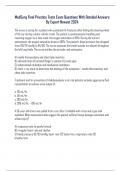
MedSurg Final Practice Tests Exam Questions With Detailed Answers By Expert Newest 2024 The nurse is caring for a patient who sustained rib fractures after hitting the steering wheel of the car during a motor vehicle crash. The patient is spontaneously breathing and receiving oxygen via a face mask; the oxygen saturation is 95%. During the nurse's assessment, the oxygen saturation drops to 80%. The patient's blood pressure has dropped from 128/76 mmHg to 84/60. The nurse assesses the breath sounds are absent throughout the left lung fields. The nurse notifies the provider and anticipates: A) needle thoracostomy and chest tube insertion B) administration of lactated Ringer's solution (1L) wide open C) endotracheal intubation and mechanical ventilation D) chest x-ray study to determine the etiology of the symptoms - needle thoracostomy and chest tube insertion Treatment and/or prevention of rhabdomyolysis in at-risk patients includes aggressive fluid resuscitation to achieve urine output of: a. 30 mL/hr. b. 50 mL/hr. c. 100 mL/hr. d. 300 mL/hr. - 100 mL/hr A 36-year-old driver was pulled from a car after it collided with a tree and a gas tank exploded. What assessment data suggest the patient suffered tissue damage consistent with a blast injury? A) responsive only to painful stimuli B) irregular heart rate and rhythm C) blood pressure 82/60 mmHg, heart rate 122 beats/min, respiratory rate 28 breaths/min. D) crackles (rales) on auscultation of bilateral lung fields - crackles (rales) on auscultation of bilateral lung fields The nurse is caring for a patient who has circumferential full-thickness burns of his forearm. A priority in the plan of care is: A) to splint the forearm B) active or passive-range of motion exercises every hour C) to keep the extremity in a dependent position D) to prepare for an escharotomy as a prophylactic measure - active or passive range of motion exercises every hour A critically ill patient has a living will in the chart. The patient's condition has deteriorated, but the spouse wants "everything done," regardless of the patient's wishes. Which ethical principle is the spouse violating? A) Nonmaleficence B) Justice C) Autonomy D) Beneficence - Autonomy The nurse is caring for a patient admitted with a traumatic brain injury following a motor vehicle crash. Several weeks later, the patient is still ventilator dependent and unresponsive to stimulation but occasionally takes a spontaneous breath. The physician explains to the family that the patient has severe neurological impairment and is not expected to recover consciousness. The nurse recognized that this patient is: A) brain dead B) in a persistent vegetative state C) terminally ill D) an organ donor - in a persistent vegetative state A nurse caring for a patient with neurological impairment often must use painful stimuli to elicit the patient's response. The nurse uses subtle measures of painful stimuli, such as nail bed pressure. She neither slaps the patient nor pinches the nipple to elicit a response to pain. In this scenario, the nurse is exemplifying the ethical principle of: A) veracity- obligation to tell the truth B) fidelity- moral duty to be faithful C) nonmaleficence- to not intentionally harm others D) beneficence- demonstrates actions intended to benefit others - nonmaleficence The critical care nurse wants a better understanding of when to initiate an ethics consult. After attending an educational program, the nurse understands that the following situation would require an ethics consultation: A) Patient with multiple trauma & is not responding to treatment. No family members are known, and the health care team is debating if care is futile. B) Family members disagree as to a patient's course of treatment. The pt has designated health care proxy & has written advance directive. C) Conflict has occurred between physician & family regarding txt decisions. Family conference is held. Family & physician agree to txt plan that includes aggressive treatment for 24 hrs. followed by reevaluations. D) Patient postop coronary artery bypass who sustained cardiopulm arrest in operating room. He was resuscitated, but now is not responding to txt. He has written advance directive & wife is present. - Patient with multiple trauma and is not responding to treatment. No family members are known, and the health care team is debating if care is futile. A postsurgical patient is on a ventilator in the critical care unit. The patient has been tolerating the ventilator well and has not required any sedation. On assessment, the nurse notes the patient is tachycardic and hypertensive with an increased respiratory rate of 28 breaths/min. The patient has been suctioned recently via the endotracheal tube, and the airway is clear. The patient responds appropriately to the nurse's commands. The nurse should: A) provide sedation as ordered B) suction the patient again C) assess the patient's level of pain D) decrease the ventilator rate - Assess the patient's level of pain In the trauma patient, symptoms of decreased cardiac output are most commonly caused by: A) hypovolemia B) cardiogenic shock C) pericardial tamponade D) cardiac contusion - hypolvemia
Información del documento
- Subido en
- 16 de julio de 2024
- Número de páginas
- 89
- Escrito en
- 2023/2024
- Tipo
- Examen
- Contiene
- Preguntas y respuestas

