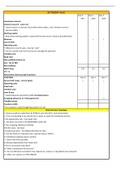
ECON 101 Final Exam 2024 Questions and Answers Solved 100%;AMU
ECON 101 Final Exam 2024 Questions and Answers Solved 100%;AMU Attempt 1 of 1 Written Apr 26, 2024 11:26 AM - Apr 26, 2024 11:37 AM Attempt Score 100 / 100 - 100 % Overall Grade (Highest Attempt) 100 / 100 - 100 % Question 1 6 / 6 points The representative firm in a purely competitive industry: Will always earn a profit in the short run May earn either an economic profit or a loss in the long run Will always earn an economic profit in the long run Will earn an economic profit of zero in the long run Hide question 1 feedback See page 240. Question 2 6 / 6 points An example of a monopolistically competitive industry would be: Steel Soybeans Electricity Retail clothing Hide question 2 feedback See page 275 - 276. Question 3 6 / 6 points Firms in an industry will not earn long-run economic profits if: Fixed costs are zero The number of firms in the industry is fixed There is free entry and exit of firms in the industry Production costs for a given level of output are minimized Hide question 3 feedback See page 240. Question 4 6 / 6 points Marginal product is: the increase in total output attributable to the employment of one more worker. the increase in total revenue attributable to the employment of one more worker. the increase in total cost attributable to the employment of one more worker. total product divided by the number of workers employed. Hide question 4 feedback See page 201. Question 5 6 / 6 points The law of diminishing returns indicates that: as extra units of a variable resource are added to a fixed resource, marginal product will decline beyond some point. because of economies and diseconomies of scale a competitive firm's long-run average total cost curve will be U-shaped. the demand for goods produced by purely competitive industries is downsloping. beyond some point the extra utility derived from additional units of a product will yield the consumer smaller and smaller extra amounts of satisfaction. Hide question 5 feedback See page 204. Question 6 6 / 6 points This studyIsfouarcve wears adogwneloatdoedtbay l10c00o00s88t80i1s37d08efrocmliCnouirnsegHe,onn ::46:15 GMT -05:00 marginal cost must be greater than average total cost. the average fixed cost curve must lie above the average variable cost curve. marginal cost must be less than average total cost. total cost must also be declining. Hide question 6 feedback See page 208. Question 7 3 / 3 points Average fixed costs diminish continuously as output increases. True False Hide question 7 feedback See page 208. Question 8 3 / 3 points Patents and copyrights were established by the government to reduce oligopoly and monopoly power. True False Hide question 8 feedback See page 246 - 247. Question 9 4 / 4 points A purely competitive firm is a price maker, but a monopolist is a price taker. True False Hide question 9 feedback See page 226. Question 10 6 / 6 points The profit-maximizing rule MC = MR is followed by firms under: monopolistic competition, but not perfect competition. perfect competition, but not monopolistic competition. either monopolistic competition or perfect competition, depending on the costs of production. both monopolistic competition and perfect competition. Hide question 10 feedback Great job. See page 277. Question 11 6 / 6 points A perfectly competitive firm will continue producing in the short run as long as it can cover its: total cost. average total cost. average variable cost. average fixed cost. Hide question 11 feedback Great work! See bottom of page 235. Question 12 6 / 6 points A perfectly competitive firm will earn a profit and will continue producing the profit-maximizing quantity of output in the short run if price is: greater than marginal cost. less than marginal cost. less than average variable cost. greater than average total cost. Hide question 12 feedback Great work! See page 233. Question 13 6 / 6 points Monopolistic competition is an industry characterized by: a product with many close substitutes. a horizontal demand curve. a small number of firms. barriers to entry and exit. Hide question 13 feedback Great work. See page 276. Question 14 6 / 6 points If a perfectly competitive firm increases production from 10 units to 11 units, and the market price is $20 per unit, total revenue for 10 units is: $10. $20 $200. $210. Hide question 14 feedback Very good. See page 230. Question 15 6 / 6 points The demand curve facing a monopolist is: horizontal, the same as that facing a perfectly competitive firm. downward sloping, the same as that facing a perfectly competitive firm. upward sloping, the same as that facing a perfectly competitive firm. downward sloping, unlike the horizontal demand curve facing a perfectly competitive firm. Hide question 15 feedback Good work. See page 259. Question 16 6 / 6 points Suppose that a monopolist increases production from 10 units to 11 units. If the market price declines from $30 per unit to $29 per unit, marginal revenue for the eleventh unit is: $1. $9. $19. $29. Hide question 16 feedback Good work. See page 260. Question 17 6 / 6 points Most electric, gas, and water companies are examples of: unregulated monopolies. natural monopolies. restricted-input monopolies. sunk-cost monopolies. Hide question 17 feedback Good job. See page 254. Question 18 6 / 6 points If a perfectly competitive firm is producing a quantity that generates P > MC, then profit: is maximized. can be increased by increasing the price. can be increased by decreasing the price. can be increased by increasing production. Hide question 18 feedback Great work! See page 233. Done
Escuela, estudio y materia
- Institución
- American Military University
- Grado
- ECON 101
Información del documento
- Subido en
- 10 de julio de 2024
- Número de páginas
- 13
- Escrito en
- 2023/2024
- Tipo
- Examen
- Contiene
- Preguntas y respuestas
Temas
-
econ 101 final exam 2024 questions and answers sol
-
the representative firm in a purely competitive in
-
an example of a monopolistically competitive indus
-
firms in an industry will not earn long run eco

Documento también disponible en un lote