Educational Psychology
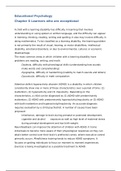
Chapter 6 Learners who are exceptional
A child with a learning disability has difficulty in learning that involves
understanding or using spoken or written language, and the difficulty can appear
in listening, thinking, reading, writing and spelling. It also may involve difficulty in
doing mathematics. To be classified as a learning disability, the learning problem
is not primarily the result of visual, hearing, or motor disabilities; intellectual
disability; emotional disorders; or due to environmental, cultural, or economic
disadvantage.
The most common areas in which children with a learning disability have
problems are reading, writing, and math:
Dyslexia, difficulty with phonological skills (understanding how sounds
make words and comprehending)
Dysgraphia, difficulty in handwriting (inability to match sounds and letters)
Dyscalculia, difficulty in math computation
Attention deficit hyperactivity disorder (ADHD) is a disability in which children
consistently show one or more of these characteristics over a period of time: (1)
inattention, (2) hyperactivity and (3) impulsivity. Depending on the
characteristics, a child can be diagnosed as (1) ADHD with predominantly
inattention, (2) ADHD with predominantly hyperactivity/impulsivity or (3) ADHD
with both inattention and hyperactivity/impulsivity. An accurate diagnosis
requires evaluation by a child psychiatrist. A number of causes have been
proposed:
Inheritance, damage to brain during prenatal or postnatal development,
cigarette and alcohol exposure as well as high level of maternal stress
during prenatal development and low birth weight.
Neurofeedback can improve the attention of children with ADHD. It trains
individuals to become more aware of their physiological responses so they can
attain better control over their brain’s prefrontal cortex, where executive control
primarily occurs. Mindfulness training tends to reduce ADHD symptoms. It
focuses on getting individuals to focus on moment to moment experiences.
Exercise is being investigated as a possible treatment to ADHD.
, Now a days numbers are assigned to children with an intellectual disability, IQ. It
made it possible to score the disability with mild, moderate, severe or profound.
This makes it able to make a good decision in which school a child is best to be
learning. Intellectual disability is a condition with an onset before age 18 that
involves low intelligence and difficulty in adapting to everyday life.
Because the categorization based on IQ ranges aren’t perfect predictors of
functioning, a newer classification system is based on the degree of support
children require to function at their highest level. The categories used are
intermittent, limited, extensive and pervasive.
Genetic factors, brain damage and environmental factors are key determinants of
intellectual disability. Genetic factors, most commonly down syndrome (due to an
extra chromosome) is genetically transmitted. Brain damage factors can result
from seizures, infections and environmental hazards. Environmental factors can
result from physical punishments, malnutrition, poisoning, birth injury and
alcoholism or heavy drinking while pregnant.
Physical disorders in children include orthopedic impairments. It requires special
education and related services. Orthopedic impairments involve restricted
movement or lack of control over movement due to muscle, bone or joint
problems. Cerebral palsy is a disorder that involves a lack of muscular
coordination, shaking or unclear speech. The most common cause is lack of
oxygen at birth.
Seizure disorders, the most common is epilepsy, a neurological disorder
characterized by recurring sensorimotor attacks or movement convulsions.
Sensory disorders, include visual and hearing impairments. Visual impairments
include the need for corrective lenses, low vision and being educationally blind
(vision cannot be used for learning, must rely on hearing and touch to learn).
Children who are hearing impaired can be born deaf or experience a loss of
hearing as they develop. Oral approaches are used, include lip reading, speech
reading and the hearing a student has. Manual approaches involve sign language
and finger spelling.
Speech and language disorder include a number of speech problems and
language problems.
Articulation disorder, problems in pronouncing sounds correctly.
Chapter 6 Learners who are exceptional
A child with a learning disability has difficulty in learning that involves
understanding or using spoken or written language, and the difficulty can appear
in listening, thinking, reading, writing and spelling. It also may involve difficulty in
doing mathematics. To be classified as a learning disability, the learning problem
is not primarily the result of visual, hearing, or motor disabilities; intellectual
disability; emotional disorders; or due to environmental, cultural, or economic
disadvantage.
The most common areas in which children with a learning disability have
problems are reading, writing, and math:
Dyslexia, difficulty with phonological skills (understanding how sounds
make words and comprehending)
Dysgraphia, difficulty in handwriting (inability to match sounds and letters)
Dyscalculia, difficulty in math computation
Attention deficit hyperactivity disorder (ADHD) is a disability in which children
consistently show one or more of these characteristics over a period of time: (1)
inattention, (2) hyperactivity and (3) impulsivity. Depending on the
characteristics, a child can be diagnosed as (1) ADHD with predominantly
inattention, (2) ADHD with predominantly hyperactivity/impulsivity or (3) ADHD
with both inattention and hyperactivity/impulsivity. An accurate diagnosis
requires evaluation by a child psychiatrist. A number of causes have been
proposed:
Inheritance, damage to brain during prenatal or postnatal development,
cigarette and alcohol exposure as well as high level of maternal stress
during prenatal development and low birth weight.
Neurofeedback can improve the attention of children with ADHD. It trains
individuals to become more aware of their physiological responses so they can
attain better control over their brain’s prefrontal cortex, where executive control
primarily occurs. Mindfulness training tends to reduce ADHD symptoms. It
focuses on getting individuals to focus on moment to moment experiences.
Exercise is being investigated as a possible treatment to ADHD.
, Now a days numbers are assigned to children with an intellectual disability, IQ. It
made it possible to score the disability with mild, moderate, severe or profound.
This makes it able to make a good decision in which school a child is best to be
learning. Intellectual disability is a condition with an onset before age 18 that
involves low intelligence and difficulty in adapting to everyday life.
Because the categorization based on IQ ranges aren’t perfect predictors of
functioning, a newer classification system is based on the degree of support
children require to function at their highest level. The categories used are
intermittent, limited, extensive and pervasive.
Genetic factors, brain damage and environmental factors are key determinants of
intellectual disability. Genetic factors, most commonly down syndrome (due to an
extra chromosome) is genetically transmitted. Brain damage factors can result
from seizures, infections and environmental hazards. Environmental factors can
result from physical punishments, malnutrition, poisoning, birth injury and
alcoholism or heavy drinking while pregnant.
Physical disorders in children include orthopedic impairments. It requires special
education and related services. Orthopedic impairments involve restricted
movement or lack of control over movement due to muscle, bone or joint
problems. Cerebral palsy is a disorder that involves a lack of muscular
coordination, shaking or unclear speech. The most common cause is lack of
oxygen at birth.
Seizure disorders, the most common is epilepsy, a neurological disorder
characterized by recurring sensorimotor attacks or movement convulsions.
Sensory disorders, include visual and hearing impairments. Visual impairments
include the need for corrective lenses, low vision and being educationally blind
(vision cannot be used for learning, must rely on hearing and touch to learn).
Children who are hearing impaired can be born deaf or experience a loss of
hearing as they develop. Oral approaches are used, include lip reading, speech
reading and the hearing a student has. Manual approaches involve sign language
and finger spelling.
Speech and language disorder include a number of speech problems and
language problems.
Articulation disorder, problems in pronouncing sounds correctly.