Educational Psychology
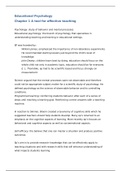
Chapter 1 A tool for effective teaching
Psychology: study of behavior and mental processes.
Educational psychology: the branch of psychology that specializes in
understanding teaching and learning in educational settings.
EP was founded by:
William James, emphasized the importance of non-laboratory experiments.
He recommended starting lessons just beyond the child’s level of
knowledge.
John Dewey, children learn best by doing, education should focus on the
whole child not only in academic topic, education should be for everyone.
E. L. Thorndike, ep had to be scientific based and focus strongly on
measurement.
Skinner argued that the mental processes were not observable and therefore
could not be appropriate subject matter for a scientific study of psychology. He
defined psychology as the science of observable behavior and its controlling
conditions.
Programmed learning: reinforcing students behavior after each of a series of
steps until reaching a learning goal. Reinforcing correct answers with a teaching
machine.
In reaction to Skinner, Bloom created a taxonomy of cognitive skills which he
suggested teachers should help students develop. Many ep’s returned to an
emphasis on the cognitive aspects of learning. More recently ep’s focuses on
behavioral and cognitive aspects as well as socioemotional aspects.
Self-efficacy: the believe that one can master a situation and produce positive
outcomes.
Ep’s aim is to provide research knowledge that can be effectively apply to
teaching situations and with research skills that will enhance understanding of
what impacts students learning.
Chapter 1 A tool for effective teaching
Psychology: study of behavior and mental processes.
Educational psychology: the branch of psychology that specializes in
understanding teaching and learning in educational settings.
EP was founded by:
William James, emphasized the importance of non-laboratory experiments.
He recommended starting lessons just beyond the child’s level of
knowledge.
John Dewey, children learn best by doing, education should focus on the
whole child not only in academic topic, education should be for everyone.
E. L. Thorndike, ep had to be scientific based and focus strongly on
measurement.
Skinner argued that the mental processes were not observable and therefore
could not be appropriate subject matter for a scientific study of psychology. He
defined psychology as the science of observable behavior and its controlling
conditions.
Programmed learning: reinforcing students behavior after each of a series of
steps until reaching a learning goal. Reinforcing correct answers with a teaching
machine.
In reaction to Skinner, Bloom created a taxonomy of cognitive skills which he
suggested teachers should help students develop. Many ep’s returned to an
emphasis on the cognitive aspects of learning. More recently ep’s focuses on
behavioral and cognitive aspects as well as socioemotional aspects.
Self-efficacy: the believe that one can master a situation and produce positive
outcomes.
Ep’s aim is to provide research knowledge that can be effectively apply to
teaching situations and with research skills that will enhance understanding of
what impacts students learning.