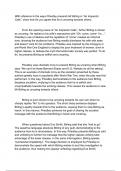
With reference to the ways Priestley presents Mr Birling in “An Inspector
Calls”, show how far you agree that he is uncaring towards others.
From the opening scene of “An Inspector Calls”, Arthur Birling is shown
as uncaring. He replies to his wife’s reproaches with “Oh- come, come- I’m…”.
Priestley’s use of dashes and the repetition of “come” creates an informal
tone, showing the audience how Birling readily dismisses his wife with ease
and doesn’t care for her problems. Priestley was inspired by the misogyny in
pre-World War One England to display the poor treatment of women, even in
higher classes, to debase the myth that aristocratic society was perfect. To do
thi, he presents Birling as selfish and uncaring.
Priestley uses dramatic irony to present Birling as uncaring when Birling
says “We can’t let these Bernard Shaws and H.G. Wellses do all the talking”.
This is an example of dramatic irony as the socialism preached by these
authors greatly rose in popularity after World War Two, when the play was first
performed. In this way, Priestley demonstrates to the audience how Birling
despises socialism, implying to the audience that he is selfish and
unsympathetic towards the working classes. This causes the audience to view
Mr Birling as uncaring towards others.
Birling is even shown to be uncaring towards his own son when he
sharply replies “No” to his question. The short sharp sentence displays
Birling’s apathy towards Eric to the audience, causing them to view Birling as
harsh. In this manner, Priestley achieves his goal of sharing his socialist
message with the audience that Birling is harsh and uncaring.
When questioned about Eva Smith, Birling said that she “had to go”.
The assertive language absolves Birling of any guilt, demonstrating to the
audience how he is remorseless. In this way, Priestley presents Birling as cold
and unfeeling to further his message that the higher classes unfairly take
advantage of the lower classes. In the same interrogation, Birling speaks
“(somewhat impatiently)”. The stage direction is employed by Priestley to
demonstrate the speed with which Birling wishes to end the investigation to
the audience, thus making him appear unfeeling regarding Eva Smith.
, Later, Birling defends Gerald’s unfaithfulness to his daughter by saying
“I’m not defending him. But you must understand…”. The negative modifier
“but” negates the first sentence and, in that way, Priestley highlights for the
audience how Birling supports Gerald instead of his daughter. The imperative
“must” places responsibility for Gerald’s infidelity on Sheila. In this manner,
Priestley displays to the audience how Birling doesn’t care for Sheila’s
happiness in her marriage causing the audience to view him as cold and
uncaring. This links back to the theme of misogyny in the play, and the
audience is caused to dislike Birling due to his ill treatment of women like his
daughter and Eva Smith.
Arthur Birling is also presented as uncaring through his role in the
dysfunctional Birling household, as shown when he shouts “Be quiet, Shiela”.
Priestley uses the exclamatory phrase and short sharp sentence to mimic the
harshness with which Birling dismisses his daughter. From this, the audience
can infer Birling’s need for power over his children, demonstrating how he
does not truly care for them, causing the audience to perceive Birling as
uncaring.
Priestley uses the rhetorical question “who here will suffer from that
more than I will?”. The rhetorical question, when paired with the personal
pronoun “I”, highlights Birling’s self-obsessed nature to the audience by
demonstrating how he only cares how he is impacted. Priestley presents
Birling in this way to display to his audience that the capitalist society we live
in, which is symbolised by Birling, is built on self-interest, conceitedness and
selfish greed. For this purpose of expressing his socialist ideals, Priestley
presents Birling as uncaring towards others.
Most damningly representative of Birling’s uncaring nature is how he
reacts to the possibility of the Inspector being an imposter. He is described as
“rather excited”. This stage direction is utilised by Priestley to accentuate how
Birling has learnt no moral lesson from his actions. The joyous connotations of
the adjective “excited” reveal Birling’s eagerness to escape responsibility for
his actions to the audience. From this, the audience receives Priestley’s
message that the aristocracy, particularly those that are from an older
generation, are uncaring towards the needs and sufferings of others.
Calls”, show how far you agree that he is uncaring towards others.
From the opening scene of “An Inspector Calls”, Arthur Birling is shown
as uncaring. He replies to his wife’s reproaches with “Oh- come, come- I’m…”.
Priestley’s use of dashes and the repetition of “come” creates an informal
tone, showing the audience how Birling readily dismisses his wife with ease
and doesn’t care for her problems. Priestley was inspired by the misogyny in
pre-World War One England to display the poor treatment of women, even in
higher classes, to debase the myth that aristocratic society was perfect. To do
thi, he presents Birling as selfish and uncaring.
Priestley uses dramatic irony to present Birling as uncaring when Birling
says “We can’t let these Bernard Shaws and H.G. Wellses do all the talking”.
This is an example of dramatic irony as the socialism preached by these
authors greatly rose in popularity after World War Two, when the play was first
performed. In this way, Priestley demonstrates to the audience how Birling
despises socialism, implying to the audience that he is selfish and
unsympathetic towards the working classes. This causes the audience to view
Mr Birling as uncaring towards others.
Birling is even shown to be uncaring towards his own son when he
sharply replies “No” to his question. The short sharp sentence displays
Birling’s apathy towards Eric to the audience, causing them to view Birling as
harsh. In this manner, Priestley achieves his goal of sharing his socialist
message with the audience that Birling is harsh and uncaring.
When questioned about Eva Smith, Birling said that she “had to go”.
The assertive language absolves Birling of any guilt, demonstrating to the
audience how he is remorseless. In this way, Priestley presents Birling as cold
and unfeeling to further his message that the higher classes unfairly take
advantage of the lower classes. In the same interrogation, Birling speaks
“(somewhat impatiently)”. The stage direction is employed by Priestley to
demonstrate the speed with which Birling wishes to end the investigation to
the audience, thus making him appear unfeeling regarding Eva Smith.
, Later, Birling defends Gerald’s unfaithfulness to his daughter by saying
“I’m not defending him. But you must understand…”. The negative modifier
“but” negates the first sentence and, in that way, Priestley highlights for the
audience how Birling supports Gerald instead of his daughter. The imperative
“must” places responsibility for Gerald’s infidelity on Sheila. In this manner,
Priestley displays to the audience how Birling doesn’t care for Sheila’s
happiness in her marriage causing the audience to view him as cold and
uncaring. This links back to the theme of misogyny in the play, and the
audience is caused to dislike Birling due to his ill treatment of women like his
daughter and Eva Smith.
Arthur Birling is also presented as uncaring through his role in the
dysfunctional Birling household, as shown when he shouts “Be quiet, Shiela”.
Priestley uses the exclamatory phrase and short sharp sentence to mimic the
harshness with which Birling dismisses his daughter. From this, the audience
can infer Birling’s need for power over his children, demonstrating how he
does not truly care for them, causing the audience to perceive Birling as
uncaring.
Priestley uses the rhetorical question “who here will suffer from that
more than I will?”. The rhetorical question, when paired with the personal
pronoun “I”, highlights Birling’s self-obsessed nature to the audience by
demonstrating how he only cares how he is impacted. Priestley presents
Birling in this way to display to his audience that the capitalist society we live
in, which is symbolised by Birling, is built on self-interest, conceitedness and
selfish greed. For this purpose of expressing his socialist ideals, Priestley
presents Birling as uncaring towards others.
Most damningly representative of Birling’s uncaring nature is how he
reacts to the possibility of the Inspector being an imposter. He is described as
“rather excited”. This stage direction is utilised by Priestley to accentuate how
Birling has learnt no moral lesson from his actions. The joyous connotations of
the adjective “excited” reveal Birling’s eagerness to escape responsibility for
his actions to the audience. From this, the audience receives Priestley’s
message that the aristocracy, particularly those that are from an older
generation, are uncaring towards the needs and sufferings of others.