Escrito por estudiantes que aprobaron Inmediatamente disponible después del pago Leer en línea o como PDF ¿Documento equivocado? Cámbialo gratis 4,6 TrustPilot
logo-home
Examen

BIOS 256: Case Study 1 Digestive system

Puntuación
-
Vendido
-
Páginas
3
Grado
A+
Subido en
07-07-2024
Escrito en
2023/2024

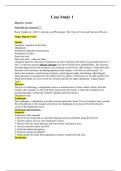
Upper digestive tract Mouth- Functions: Ingestion of the food. Deglutition Mechanical digestion (mastication) Production of saliva. Sense the food. Moist the food – make the bolus. Chemical digestion -Enzyme (Components in saliva help keep the pH in your mouth between 6.5 and 7 so that the enzyme salivary amylase can start to break down carbohydrates. The enzymes that help digest food in the stomach, such as pepsin, work best at a pH around 2, while those that function in the intestines, including peptidases and maltase, work best at a pH around 7.5) Saliva also contains a small amount of lipase, which digests lipids. Sometimes called lingual lipase because it is produced by the lingual salivary glands, it functions at a low pH and thus can break down lipids as it moves into the stomach and into the upper duodenum. Lingual lipase-lipids. Pharynx- The act of swallowing, or deglutition, moves a rounded mass of food, called a bolus, from the mouth to the stomach. As the food bolus passes from the mouth, it enters the oropharynx by passing through a constricted, archlike opening called the faucets. Deglutition only Esophagus- The esophagus, a collapsible, muscular, mucosa-lined tube about 25 cm (10 inches) long, extends from the pharynx to the stomach and pierces the diaphragm in its descent from the thoracic cavity to the abdominal cavity. Deglutition and Peristalsis Stomach- Functions of the stomach 1. Reservoir for food until it is partially digested and moved farther along the GI tract 2. Secretes gastric juice to aid in digestion of food 3. Breaks food into small particles and mixes them with gastric juice 4. Secretes intrinsic factor and HCL 5. Performs limited absorption 6. Produces gastrin and ghrelin 7. Helps protect the body from pathogenic bacteria swallowed with food Duodenum- The duodenum is the uppermost division and the part to which the pyloric end of the stomach attaches. It is about 25 cm (10 inches) long and is shaped roughly like the letter C. The name duodenum, meaning “12 fingerbreadths,” refers to the short length of this intestinal division. The duodenum is rich of absorbing enterocytes, mucus producing goblet cells and peptide hormone producing endocrine cells. The main functions of the duodenum are: • Neutralization of acidic gastric juice through production of alkaline secrets. • Mechanical processing and digestion of chyme. • Mixing bile and pancreatic enzymes. • Absorption of water, electrolytes and nutrients (especially water-soluble substances such as monosaccharides). • Produces CCK in the presence of fats. • Produces Secretin. The role of the duodenum is to absorb nutrients such as vitamins, minerals, carbohydrates, fats, proteins, and water. When pH levels in the duodenum become low, secretin is released.

Mostrar más Leer menos
Institución
Grado

Vista previa del contenido

Case Study 1
Digestive system:
Important key concepts.***
Book: Saladin, K. (2019). Anatomy and Physiology: The Unity of Form and Function (9th ed.).
Upper digestive tract

Mouth-
Functions: Ingestion of the food.
Deglutition
Mechanical digestion (mastication)
Production of saliva.
Sense the food.
Moist the food – make the bolus.
Chemical digestion -Enzyme (Components in saliva help keep the pH in your mouth between 6.5
and 7 so that the enzyme salivary amylase can start to break down carbohydrates. The enzymes
that help digest food in the stomach, such as pepsin, work best at a pH around 2, while those that
function in the intestines, including peptidases and maltase, work best at a pH around 7.5)
Saliva also contains a small amount of lipase, which digests lipids. Sometimes called lingual
lipase because it is produced by the lingual salivary glands, it functions at a low pH and thus can
break down lipids as it moves into the stomach and into the upper duodenum. Lingual lipase-
lipids.
Pharynx-
The act of swallowing, or deglutition, moves a rounded mass of food, called a bolus, from the
mouth to the stomach. As the food bolus passes from the mouth, it enters the oropharynx by
passing through a constricted, archlike opening called the faucets.
Deglutition only
Esophagus-
The esophagus, a collapsible, muscular, mucosa-lined tube about 25 cm (10 inches) long, extends
from the pharynx to the stomach and pierces the diaphragm in its descent from the thoracic
cavity to the abdominal cavity.
Deglutition and Peristalsis
Stomach-
Functions of the stomach
1. Reservoir for food until it is partially digested and moved farther along the GI tract
2. Secretes gastric juice to aid in digestion of food
3. Breaks food into small particles and mixes them with gastric juice
4. Secretes intrinsic factor and HCL
5. Performs limited absorption
6. Produces gastrin and ghrelin
7. Helps protect the body from pathogenic bacteria swallowed with food
Duodenum-

Escuela, estudio y materia

Grado

Información del documento

Subido en
7 de julio de 2024
Número de páginas
3
Escrito en
2023/2024
Tipo
Examen
Contiene
Preguntas y respuestas

Temas

$9.49
Accede al documento completo:

¿Documento equivocado? Cámbialo gratis Dentro de los 14 días posteriores a la compra y antes de descargarlo, puedes elegir otro documento. Puedes gastar el importe de nuevo.
Escrito por estudiantes que aprobaron
Inmediatamente disponible después del pago
Leer en línea o como PDF


Documento también disponible en un lote

Conoce al vendedor

Seller avatar
Los indicadores de reputación están sujetos a la cantidad de artículos vendidos por una tarifa y las reseñas que ha recibido por esos documentos. Hay tres niveles: Bronce, Plata y Oro. Cuanto mayor reputación, más podrás confiar en la calidad del trabajo del vendedor.
THEEXCELLENCELIBRARY Harvard University
Seguir Necesitas iniciar sesión para seguir a otros usuarios o asignaturas
Vendido
18
Miembro desde
2 año
Número de seguidores
6
Documentos
2641
Última venta
2 meses hace
THE EXCELLENCE LIBRARY

The Excellence Library Where Academic Success Begins. Welcome to The Excellence Library — your trusted marketplace for past and upcoming exam papers with verified answers, spanning all academic fields. Whether you're a med student, a future lawyer, a high schooler prepping for finals, or a researcher looking for model dissertations — we've got you covered. What We Offer Accurate & Complete Exam Papers From Medicine, Nursing, Law (Bar Exams), High School subjects, and more. Model Dissertations & Novels Top-tier academic references and full-text materials to guide your writing and study. Affordable & Fair Pricing Quality resources at a price that respects students' budgets. Why Choose Us? Thoroughly Reviewed Answers – Every paper includes clear, correct solutions. Massive Library – Thousands of documents, constantly updated. Academic Excellence, Delivered – We help you prepare smarter, not harder. Fast Delivery – Get what you need, when you need it. Our Goal To empower students and professionals by offering reliable, affordable academic materials — helping you succeed one paper at a time.

Lee mas Leer menos
2.5

2 reseñas

5
0
4
0
3
1
2
1
1
0

Documentos populares

Recientemente visto por ti

Por qué los estudiantes eligen Stuvia

Creado por compañeros estudiantes, verificado por reseñas

Calidad en la que puedes confiar: escrito por estudiantes que aprobaron y evaluado por otros que han usado estos resúmenes.

¿No estás satisfecho? Elige otro documento

¡No te preocupes! Puedes elegir directamente otro documento que se ajuste mejor a lo que buscas.

Paga como quieras, empieza a estudiar al instante

Sin suscripción, sin compromisos. Paga como estés acostumbrado con tarjeta de crédito y descarga tu documento PDF inmediatamente.

Student with book image

“Comprado, descargado y aprobado. Así de fácil puede ser.”

Alisha Student

Preguntas frecuentes