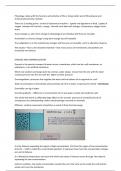
Physiology- deals wiith the funcions and activities of life or living matter and of tthe physical and
chemical phenomena involved
There are 2 starting points : animal is biochemical machine – uptake and digestionn of food , uptake of
oxygen, transport of nutrients , energy . Animals must deal with changes- temperature, oxygen, food ,
stress
Acute change is a short term change in physiology of an individual and they are revisable
Acclimation or chronic change is long term change but still revisable
True adaptation is on the evolutionary changes and they are not revisable and it is alteration of genes
The solutes—that is, the dissolved materials—that move across cell membranes and epithelia are
chemically very diverse
OSMOSIS AND OSMOREGULATION
Osmosis is the passive transport of water across a membrane, which can be a cell membrane, an
epithelium, or an artificial membrane.
When two solutions exchange water by osmosis, water always moves from the one with the lower
osmotic pressure into the one with the higher osmotic pressure.
Osmoregulation- processes that regulate the water and ion balance of an organism or a cell
Total concentrastion of osmotically active particles per litre of water is expressed in Osmol = Osmolarity
Osmolality- per kg of water
Osmotic gradients – difference in concentration of ion and water outside and inside the cells
Any solute that exerts a sufficiently large effect on the osmotic pressure of a body fluid to be of
consequence for understanding water–salt physiology is termed an osmolyte
Diffusion- random movements of particles as result of their thermal energy
X is the distance separating the region of high concentration (C1) from the region of low concentration
(C2), (C1 − C2)/X is called the concentration gradient. It expresses how much the concentration changes
per unit of distance
D is affected by temperature and ease with which the solute of interest moves through the material
separating the two concentrations
Isotonic condition- the solute concentration outside the cell is the same as the inside the celll and the
solute cant cross the membrane
,If you have the concentrattion of a solute iin a solutioon you can calculate the osmotic pressure of liquid
= Colligative
Isosmotic are two solutions that have similar osmotic pressure
Tonniccity- relates to the behaviour of cells in a solution
A solution is isotonic if a cell in it doesnt shrink or swell
If two solutions, A and B, have the same osmotic pressure, they are said to be isosmotic. If solution A
has a lower osmotic pressure than solution B, A is said to be hyposmotic to B, and B is said to be
hyperosmotic to A. If cells are placed in a hypotonic solution, they swell because of an osmotic influx of
water. In a hypertonic solution, they shrink because of osmotic water loss.—Shrinking is bad because it
leads to macromolecular crowding and folding errors in proteins
OSMOREGULATION
Three types of regulation of the composition of the blood plasma are possible: osmotic regulation, ionic
regulation, and volume regulation
Osmotic regulation (osmoregulation) is the maintenance of a constant or nearly constant osmotic
pressure in the blood plasma
---1000 mOsm is the approximate osmotic pressure of full-strength seawater for fresh water is lower
then 20
Animals osmoregulate intracellular fluid, interstitial fluid and blood plasma
Two principal types of body fluids are recognized in animals: the intracellular fluids inside cells and the
extracellular fluids outside cells. The extracellular fluids are divided into two subparts: the interstitial
fluids found between cells in ordinary tissues and the blood plasma, the part of the blood other than
the blood cells.
Water can cross cell membranes by osmosis, and ions can cross by diffusion
Ionic regulation of the blood plasma is the maintenance of a constant or nearly constant concentration
of an inorganic ion in the blood plasma
Volume regulation is the regulation of the total amount of water in a body fluid.
The osmotic U/P ratio is the osmotic pressure of the urine divided by the osmotic pressure of the blood
plasma. For example, if an animal’s urine osmotic pressure is 150 mOsm and its plasma osmotic
pressure is 300 mOsm, its osmotic U/P ratio is 0.5
, Book
Cell has 3 main ions : Cl, Na+ and K+ , A typical cell membrane is positively charged on the outside and
negatively charged on the inside. Cl ( chloride)is conncentrated more on the outside also Na+( sodium) ,
K+(potassium ) is inside
Passive-transport mechanisms, by definition, are capable of carrying material only in the direction of
equilibrium(osmosis). Active transport mechanisms, by contrast, can carry material in the direction
opposing equilibrium
Some solutes dissolve in he lipid interor and some molecules need ion channels that permit the
transport of inorganic ions by diffusion through a membrane . They are different channels
Voltage-gated channels open and close in response to changes in the voltage difference across a
membrane
Stretch-gated (tension-gated) channels open or close in response to stretching or pulling forces that
alter the physical tension on a membrane.
Phosphorylation-gated channels open or close according to whether the channel proteins are
phosphorylated
The permeability of a cell membrane to a solute is defined to be the ease with which the solute can
move through the membrane by diffusion
chemical phenomena involved
There are 2 starting points : animal is biochemical machine – uptake and digestionn of food , uptake of
oxygen, transport of nutrients , energy . Animals must deal with changes- temperature, oxygen, food ,
stress
Acute change is a short term change in physiology of an individual and they are revisable
Acclimation or chronic change is long term change but still revisable
True adaptation is on the evolutionary changes and they are not revisable and it is alteration of genes
The solutes—that is, the dissolved materials—that move across cell membranes and epithelia are
chemically very diverse
OSMOSIS AND OSMOREGULATION
Osmosis is the passive transport of water across a membrane, which can be a cell membrane, an
epithelium, or an artificial membrane.
When two solutions exchange water by osmosis, water always moves from the one with the lower
osmotic pressure into the one with the higher osmotic pressure.
Osmoregulation- processes that regulate the water and ion balance of an organism or a cell
Total concentrastion of osmotically active particles per litre of water is expressed in Osmol = Osmolarity
Osmolality- per kg of water
Osmotic gradients – difference in concentration of ion and water outside and inside the cells
Any solute that exerts a sufficiently large effect on the osmotic pressure of a body fluid to be of
consequence for understanding water–salt physiology is termed an osmolyte
Diffusion- random movements of particles as result of their thermal energy
X is the distance separating the region of high concentration (C1) from the region of low concentration
(C2), (C1 − C2)/X is called the concentration gradient. It expresses how much the concentration changes
per unit of distance
D is affected by temperature and ease with which the solute of interest moves through the material
separating the two concentrations
Isotonic condition- the solute concentration outside the cell is the same as the inside the celll and the
solute cant cross the membrane
,If you have the concentrattion of a solute iin a solutioon you can calculate the osmotic pressure of liquid
= Colligative
Isosmotic are two solutions that have similar osmotic pressure
Tonniccity- relates to the behaviour of cells in a solution
A solution is isotonic if a cell in it doesnt shrink or swell
If two solutions, A and B, have the same osmotic pressure, they are said to be isosmotic. If solution A
has a lower osmotic pressure than solution B, A is said to be hyposmotic to B, and B is said to be
hyperosmotic to A. If cells are placed in a hypotonic solution, they swell because of an osmotic influx of
water. In a hypertonic solution, they shrink because of osmotic water loss.—Shrinking is bad because it
leads to macromolecular crowding and folding errors in proteins
OSMOREGULATION
Three types of regulation of the composition of the blood plasma are possible: osmotic regulation, ionic
regulation, and volume regulation
Osmotic regulation (osmoregulation) is the maintenance of a constant or nearly constant osmotic
pressure in the blood plasma
---1000 mOsm is the approximate osmotic pressure of full-strength seawater for fresh water is lower
then 20
Animals osmoregulate intracellular fluid, interstitial fluid and blood plasma
Two principal types of body fluids are recognized in animals: the intracellular fluids inside cells and the
extracellular fluids outside cells. The extracellular fluids are divided into two subparts: the interstitial
fluids found between cells in ordinary tissues and the blood plasma, the part of the blood other than
the blood cells.
Water can cross cell membranes by osmosis, and ions can cross by diffusion
Ionic regulation of the blood plasma is the maintenance of a constant or nearly constant concentration
of an inorganic ion in the blood plasma
Volume regulation is the regulation of the total amount of water in a body fluid.
The osmotic U/P ratio is the osmotic pressure of the urine divided by the osmotic pressure of the blood
plasma. For example, if an animal’s urine osmotic pressure is 150 mOsm and its plasma osmotic
pressure is 300 mOsm, its osmotic U/P ratio is 0.5
, Book
Cell has 3 main ions : Cl, Na+ and K+ , A typical cell membrane is positively charged on the outside and
negatively charged on the inside. Cl ( chloride)is conncentrated more on the outside also Na+( sodium) ,
K+(potassium ) is inside
Passive-transport mechanisms, by definition, are capable of carrying material only in the direction of
equilibrium(osmosis). Active transport mechanisms, by contrast, can carry material in the direction
opposing equilibrium
Some solutes dissolve in he lipid interor and some molecules need ion channels that permit the
transport of inorganic ions by diffusion through a membrane . They are different channels
Voltage-gated channels open and close in response to changes in the voltage difference across a
membrane
Stretch-gated (tension-gated) channels open or close in response to stretching or pulling forces that
alter the physical tension on a membrane.
Phosphorylation-gated channels open or close according to whether the channel proteins are
phosphorylated
The permeability of a cell membrane to a solute is defined to be the ease with which the solute can
move through the membrane by diffusion