Osman Yousuf – Unit 4 - Assignment 2 – Synthesis of an Organic Liquid
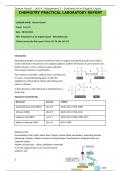
CHEMISTRY PRACTICAL LABORATORY REPORT
LEARNER NAME: Osman Yousuf
Group: A.A, E.H
Date: 28/03/2024
Title: Preparation of an Organic Liquid – Ethyl Ethanoate
Criteria covered by this report: Unit 4, P5, P6, M4, M5, D3
Introduction
Ethyl Ethanoate (EE) is an ester, formed from when an organic acid (ethanoic acid) reacts with an
alcohol (ethanol) in the presence of a catalyst (sulphuric acid) for 30 minutes. It can be used in nail
polish removers, and as a solvent in glues and paint.
This reaction is known as esterification.
The reaction is reversible, sulphuric acid is used because
it is also a strong dehydrating agent, it shifts the
equilibrium to the products side by eliminating water
when it is formed.
In the Laboratory, ethyl ethanoate is synthesised on a
small scale.
Equipment and Materials
Reactants Amount COSHH
Glacial Ethanoic Acid (100%) 25cm^3 H226, H314, P210, P280
Ethanol (100%) 25cm^3 H225, H319, P210, P241
Sulphuric Acid (98%) 5cm^3 H290, H314, H402, P280, P271
Sodium Carbonate (30%) 25cm^3 H319, P280
Equipment List:
Round-bottom flask, Retort Stand, Boss, Clamps, Conical Flasks and Beakers, Separating Funnels,
Measuring Cylinders, Pipettes, Funnels and Fluted Paper, Thermometers, Heating Mantle and
Collection bottle.
Majority of processes – reflux, distillations conducted
in a fume cupboard due to use of concentrated
sulphuric acid.
1
, Osman Yousuf – Unit 4 - Assignment 2 – Synthesis of an Organic Liquid
Other Materials:
Magnesium Sulphate – drying agent
Anti-bumping Granules
Method
1) 25cm^3 of glacial ethanoic acid and ethanol are measured and placed into a round bottom flask
with ice water cooling
2) Carefully measure 5cm^3 of sulphuric acid and add slowly to the mixture, ensure mixture is
homogenous, shake or swirl gently
3) Fit the flask with a reflux water-condenser, allow to boil for 30 minutes
4) Reposition the condenser for distillation, distil off two-thirds of the mixture.
5) Transfer distillate to a separating funnel, add 25cm^3 of sodium carbonate solution. Conduct
solvent-solvent extraction, stopper the funnel, invert apparatus, shake, and open stopcock
continuously until all carbon dioxide released.
6) Allow time for two layers to separate and reject the lower layer of sodium carbonate.
7) Repeat using deionised water and rejecting the lower layer, to ensure all sodium carbonate has
been rejected and separated from ethyl ethanoate
8) Open the tap, and allow for ethyl ethanoate to pour into a conical flask, add a dehydrating agent
(magnesium sulphate to eliminate water) swirl conical flask continuously until all water absorbed
9) Decant into clean and dry round bottom flask, set up for distillation again adding a thermometer,
add anti bumping granules. Heat and collect the liquid fraction that boils from 74-79 degrees Celsius
in a bottle and record mass.
Percentage Yield of Product
Weight of empty Bottle and Lid – 54.10g
Weight of bottle containing liquid – 65.17
65.17 - 54.10 = 11.07g (Mass of Product)
Density of Ethanoic Acid – 1.05 g/ml
Density of Ethanol – 0.78 g/ml
Moles = Density X Vol
Ethanol – 0.78 X 25 = 19. (RMM) = 0.424 Moles
Ethanoic Acid – 1.05 X 25 = 26. (RMM) = 0.44 Moles
1 Mol of Ethanoic Acid = 1 Mol of Ethyl Ethanoate
Theoretical Yield of EE = 0.44 (Moles) X 88 (RMM) = 38.72g
Percentage Yield = 11..72 X 100 = 28.6%
Techniques – Estimation of Purity
IR Spectra
Boiling Point
2
CHEMISTRY PRACTICAL LABORATORY REPORT
LEARNER NAME: Osman Yousuf
Group: A.A, E.H
Date: 28/03/2024
Title: Preparation of an Organic Liquid – Ethyl Ethanoate
Criteria covered by this report: Unit 4, P5, P6, M4, M5, D3
Introduction
Ethyl Ethanoate (EE) is an ester, formed from when an organic acid (ethanoic acid) reacts with an
alcohol (ethanol) in the presence of a catalyst (sulphuric acid) for 30 minutes. It can be used in nail
polish removers, and as a solvent in glues and paint.
This reaction is known as esterification.
The reaction is reversible, sulphuric acid is used because
it is also a strong dehydrating agent, it shifts the
equilibrium to the products side by eliminating water
when it is formed.
In the Laboratory, ethyl ethanoate is synthesised on a
small scale.
Equipment and Materials
Reactants Amount COSHH
Glacial Ethanoic Acid (100%) 25cm^3 H226, H314, P210, P280
Ethanol (100%) 25cm^3 H225, H319, P210, P241
Sulphuric Acid (98%) 5cm^3 H290, H314, H402, P280, P271
Sodium Carbonate (30%) 25cm^3 H319, P280
Equipment List:
Round-bottom flask, Retort Stand, Boss, Clamps, Conical Flasks and Beakers, Separating Funnels,
Measuring Cylinders, Pipettes, Funnels and Fluted Paper, Thermometers, Heating Mantle and
Collection bottle.
Majority of processes – reflux, distillations conducted
in a fume cupboard due to use of concentrated
sulphuric acid.
1
, Osman Yousuf – Unit 4 - Assignment 2 – Synthesis of an Organic Liquid
Other Materials:
Magnesium Sulphate – drying agent
Anti-bumping Granules
Method
1) 25cm^3 of glacial ethanoic acid and ethanol are measured and placed into a round bottom flask
with ice water cooling
2) Carefully measure 5cm^3 of sulphuric acid and add slowly to the mixture, ensure mixture is
homogenous, shake or swirl gently
3) Fit the flask with a reflux water-condenser, allow to boil for 30 minutes
4) Reposition the condenser for distillation, distil off two-thirds of the mixture.
5) Transfer distillate to a separating funnel, add 25cm^3 of sodium carbonate solution. Conduct
solvent-solvent extraction, stopper the funnel, invert apparatus, shake, and open stopcock
continuously until all carbon dioxide released.
6) Allow time for two layers to separate and reject the lower layer of sodium carbonate.
7) Repeat using deionised water and rejecting the lower layer, to ensure all sodium carbonate has
been rejected and separated from ethyl ethanoate
8) Open the tap, and allow for ethyl ethanoate to pour into a conical flask, add a dehydrating agent
(magnesium sulphate to eliminate water) swirl conical flask continuously until all water absorbed
9) Decant into clean and dry round bottom flask, set up for distillation again adding a thermometer,
add anti bumping granules. Heat and collect the liquid fraction that boils from 74-79 degrees Celsius
in a bottle and record mass.
Percentage Yield of Product
Weight of empty Bottle and Lid – 54.10g
Weight of bottle containing liquid – 65.17
65.17 - 54.10 = 11.07g (Mass of Product)
Density of Ethanoic Acid – 1.05 g/ml
Density of Ethanol – 0.78 g/ml
Moles = Density X Vol
Ethanol – 0.78 X 25 = 19. (RMM) = 0.424 Moles
Ethanoic Acid – 1.05 X 25 = 26. (RMM) = 0.44 Moles
1 Mol of Ethanoic Acid = 1 Mol of Ethyl Ethanoate
Theoretical Yield of EE = 0.44 (Moles) X 88 (RMM) = 38.72g
Percentage Yield = 11..72 X 100 = 28.6%
Techniques – Estimation of Purity
IR Spectra
Boiling Point
2