

PACKRAT Surgery 1. An 18-year-old patient has a tibia/fibula fracture following a motorcycle crash. Twelve hours later the patient presents with increased pain despite adequate doses of analgesics and immobilization. Which of the following isthe most likely diagnosis? A. avascular necrosis B. myositis ossificans C. compartment syndrome D. reflex sympathetic dystrophy: Answer EXPLANATIONS: (u) A. Avascular necrosis occurs primarily in muscles post- traumatically and may not arise for several months after an injury. (u) B. Myositis ossificans is a late complication of fracture resulting from disruption of the blood supply to the bone. (c) C. Compartment syndrome is characterized by a pathological increase of pressure within a closed space and results from edema or bleeding within the compartment. It may occur as an early local complication of fracture. (u) D. Reflex sympathetic dystrophy is characterizedby painful wasting of the hand muscles that may be secondary to injury and could occur as a late complication. 2. A patient presents to the Emergency Department with complaints of in - creasing pain in the right lower extremity. He has a history of a non -displacedproximal tibial fracture treated with application of a long leg cast 2 days prior.On exam there is marked swelling of the toes and the patient refuses to movethem secondary to pain. An injection of meperidine fails to relieve the patient'spain. Clinical intervention is needed to prevent what complication? A. osteomyelitis B. traumatic arthritis C. Volkmann's contracture D. malunion of fracture fragments: Answer EXPLANATIONS: (u) A. Osteomyelitis resultsfrom a source of infection that may include an open fracture, but not a closedfracture. (u) B. Traumatic arthritis only occurs as a result of fractures that involve the articularsurface. (c) C. This patient has classic findings of acute compartment syndrome. Volkmann's contracture may occur from an untreated compartment syndrome or an arterial injury. (u) D. Malunion of the fracture fragments occur when there is poor reduction of the fracture fragments. Non-displaced fractures do not require reduction. 3. A 38 year -old male sustained a fracture of the left distal tibia following a 25 -foot fall and is taken to the operating room for an open reduction internalfixation of the distal tibia. Sixteen hours post -op, the patient develops sustained pain, which is not relieved with narcotics. On passive range of motionof the toes the patient "yells" in agony. The patient also states that the top of his foot has decreased sensation. On physical examination the physician assistant notes that the leg is swollen and the foot is cool to touch. Basedupon this information what diagnostic testing should be done? A. X-ray of the lower leg and ankle. B. Doppler studies. C. Bone scan. D. Compartment pressure: Answer Explanations (u) A. X -rays of the lower leg and ankle will only determine bone placement. (u) B. Doppler studies will confirm the presenceof a decreased pulse. (u) C. A bone scan is not indicated in the evaluation of compartment syndrome. (c) D. Compartmental pressures should be obtained as soon as possible. If they are elevated this is a surgical emergency. 4. A 35 year -old male placed in a thumb spica cast for a scaphoid fracture presents complaining of forearm and hand pain that is not relieved with painmedication and elevation.Which of the following is the earliest physical examsign for his current condition? A. Slow capillary refill B. Loss of two-point discrimination C. Absent peripheral pulses D. Pain with passive stretch.: Answer (c) B. Loss of two-point discrimination can be the earliest sign of compartment syndrome. (u) C. Peripheral pulses are poor indicatorsof compartment syndrome as they remain intact until late. (a) D. Pain with passive stretch is a subjective finding early and must be differentiated from pain of the original injury. Although a reliable finding it may be difficult to reproduce in the cast. 5. 25 year-old male presents to the ED with left calf pain and cramping, as well as nausea and vomiting. He admits to "partying with cocaine all night".He describes his urine as a dark brown color. Serum creatinine kinase (CK)is 1325 IU/L (Normal Range 32 -267 IU/L). Which of the following is the initialmainstay of therapy for this condition? A. IV rehydration B. Fasciotomy C. Toradol (Ketorlac) D. Hydrotherapy: Answer Explanations (c) A. IV rehydration with crystalloids for 24 to 72 hours is the mainstay of therapy for rhabdomyolysis. (u) B. Fasciotomy is indicatedfor compartment syndrome. (h) C. NSAIDS, such as Toradol (Ketorlac), should notbe used due to the vasoconstrictive effects on the kidneys. (u) D. Hydrotherapy is not useful or indicated for Rhabdomyolysis 6. A 42 year -old male presents complaining of a sudden onset of a severe intermittent pain originating in the flank and radiating into the right testicle.He also complains of nausea and vomiting. On examination the patient is afebrile, but restless. Examination of the abdomen reveals tenderness to palpation along the right flank with no rebound or direct testicular tenderness.Urinalysis reveals a pH of 5.4 and microscopic hematuria, but is otherwise unremarkable. Which of the following is the most likely diagnosis? A. Bladder cancer B. Nephrolithiasis C. Acute appendicitis D. Acute epididymitis: Answer Explanations (u) A. While bladder cancer may have associated microscopic hematuria, it presents with painless hematuria orirritative voidingsymptoms. (c) B. A sudden onset of severe colicky flank pain associated with nauseaand vomiting as well as the absence of rebound or direct testicular tenderness makes nephrolithiasis the most likely diagnosis. This is further supported by the presence of hematuria on the urinalysis. (u) C. While an acute abdomen, such as acute appendicitis, is in the differential diagnosis, the absence of fever and peritoneal signs makes this diagnosis less likely. (u) D. The absence of fever as wellas non -tenderness to palpation of the testes suggests a renal rather than gonadal cause of the patient's symptoms. 7. Which of the following pathophysiological processes is believed to initiateacute appendicitis? A. Obstruction B. Perforation C. Hemorrhage D. Vascular compromise: Answer Explanations (c) A. Obstruction of the appendiceal lumenby lymphoid hyperplasia, a fecalith or foreign body initiates most cases of appendicitis. (u) B. See A for explanation. (u) C. See A for explanation. (u) D. See A for explanation. 8. What is the term for blue discoloration about the umbilicus? A. Cullen's sign B. Murphy's sign C. Rovsing's sign D. Turner sign: Answer Explanations (c) A. Cullen's sign is a blue discoloration about the umbilicus and can occur in hemorrhagic pancreatitis and results from hemoperitoneum. (u) B. Murphy's sign is seen in liver and gallbladder disease by which the patient abruptly halts deep inspiration due to pain in the right upper quadrant whilethe examiner's hand is keeping stable pressure to the area. (u) C. Rovsing's sign ispositive when the patient experiences right sided abdominal pain with palpation to the left side.This is generally seen in those with appendicitis. (u) D.Turner sign is alsoseen in severe, acute pancreatitis but is represented by a green -brown discolorationof bilateral flanks 9. A patient presents with abdominal pain in the right lower quadrant, examination reveals increased pain in the right lower quadrant on deep palpationof the left lower quadrant.This commonly known as which of the following? A. Psoas sign B. Murphy's sign C. Rovsing's sign D. Obturator sign: Answer Explanations (u) A. Psoas sign is right lower quadrant pain withright leg extension. (u) B. Murphy's sign is seen in liver and gallbladder disease in which the patient abruptly halts deep inspiration due to discomfort as the examinershand applies pressure to the right upper quadrant. (c) C. A positive Rovsing's signcan be elicited in a patient with appendicitis when increased pain occurs in the rightlower quadrant upon palpation of the left lower quadrant. (u) D. Obturator sign is right lower quadrant pain with internal rotation of the hip. 10. A 25 year -old female presents with right lower quadrant pain, right flank pain, nausea, and vomiting. Her temperature is 39.6 degrees C. There is rightCVA tenderness and RLQ tenderness. Pelvic exam is unremarkable. Urinalysisreveals pH 7.0, trace protein,
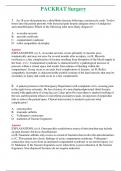
Vista previa 4 fuera de 63 páginas
Examen
2024 PACKRAT Surgery | Actual Questions and Verified Answers ( Included ) 100% Correct
Vista previa 4 fuera de 63 páginas
2024 PACKRAT Surgery | Actual Questions and Verified Answers ( Included ) 100% Correct
Vista previa del contenido
Información del documento
- Subido en
- 5 de julio de 2024
- Número de páginas
- 63
- Escrito en
- 2023/2024
- Tipo
- Examen
- Contiene
- Preguntas y respuestas
$10.99
¿Documento equivocado? Cámbialo gratis
Dentro de los 14 días posteriores a la compra y antes de descargarlo, puedes elegir otro documento. Puedes gastar el importe de nuevo.
Escrito por estudiantes que aprobaron
Inmediatamente disponible después del pago
Leer en línea o como PDF

Los indicadores de reputación están sujetos a la cantidad de artículos vendidos por una tarifa y las reseñas que ha recibido por esos documentos. Hay tres niveles: Bronce, Plata y Oro. Cuanto mayor reputación, más podrás confiar en la calidad del trabajo del vendedor.
