ACIDS AND BASES
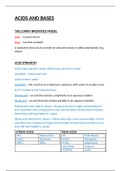
THE LOWRY-BRONSTED MODEL
Acid – a proton donor
Base – a proton acceptor
A substance that can act as both an acid and a base is called amphiprotic (e.g.
water)
ACID STRENGTH
Acids when placed in water will donate a proton to water
Ionisation = forms new ions
Acids ionise in water
Ionisation – the reaction of a molecular substance with water to produce ions
H3O+ is known as the hydronium ion
Strong acid – an acid that ionises completely in an aqueous solution
Weak acid – an acid that only ionises partially in an aqueous solution
Strong acids have high Ka values = Strong acids have a high concentration of
H3O+ and other ions compared to a low concentration of unionised reactants,
hence they will have higher Ka values
Weak acids have low Ka values = Weak acids have a low concentration of H3O+
and other ions compared to high concentration of unionised reactants, hence
they will have higher Ka values
STRONG ACIDS WEAK ACIDS
HCL Hydrochloric HF Hydrofluoric
H2SO4 Sulphuric H3PO4 Phosphoric
HNO3 Nitric H2SO3 Sulphurous
CH3COOH Ethanoic
(COOH)2 oxalic
, BASE STRENGTH
Bases when placed in water will accept protons from water
Dissociation = breaks up molecules into ions
Bases dissociate in water
Dissociation – the splitting of an ionic compound into its ions
OH- is known as the hydroxide ion
Strong base – a base that dissociates completely in an aqueous solution
Weak base – a base that only dissociates/ionises partially in an aqueous
solution
Strong bases = group 1 hydroxides
Weak bases = NH3 and NH4OH and carbonates
Strong bases have a high Kb value and weak bases have a low Kb values
CONCENTRATED AND DILUTE ACIDS AND BASES
n
c= v
There is a difference between strong/weak acids/bases and
concentrated/dilute acids/bases
Concentration is number of moles of the whole acid/base in the volume
POLYPROTIC ACIDS
Polyprotic acids can donate more than one proton
Monoprotic = HNO3
Diprotic = H2CO3
Triprotic = H3PO4
THE LOWRY-BRONSTED MODEL
Acid – a proton donor
Base – a proton acceptor
A substance that can act as both an acid and a base is called amphiprotic (e.g.
water)
ACID STRENGTH
Acids when placed in water will donate a proton to water
Ionisation = forms new ions
Acids ionise in water
Ionisation – the reaction of a molecular substance with water to produce ions
H3O+ is known as the hydronium ion
Strong acid – an acid that ionises completely in an aqueous solution
Weak acid – an acid that only ionises partially in an aqueous solution
Strong acids have high Ka values = Strong acids have a high concentration of
H3O+ and other ions compared to a low concentration of unionised reactants,
hence they will have higher Ka values
Weak acids have low Ka values = Weak acids have a low concentration of H3O+
and other ions compared to high concentration of unionised reactants, hence
they will have higher Ka values
STRONG ACIDS WEAK ACIDS
HCL Hydrochloric HF Hydrofluoric
H2SO4 Sulphuric H3PO4 Phosphoric
HNO3 Nitric H2SO3 Sulphurous
CH3COOH Ethanoic
(COOH)2 oxalic
, BASE STRENGTH
Bases when placed in water will accept protons from water
Dissociation = breaks up molecules into ions
Bases dissociate in water
Dissociation – the splitting of an ionic compound into its ions
OH- is known as the hydroxide ion
Strong base – a base that dissociates completely in an aqueous solution
Weak base – a base that only dissociates/ionises partially in an aqueous
solution
Strong bases = group 1 hydroxides
Weak bases = NH3 and NH4OH and carbonates
Strong bases have a high Kb value and weak bases have a low Kb values
CONCENTRATED AND DILUTE ACIDS AND BASES
n
c= v
There is a difference between strong/weak acids/bases and
concentrated/dilute acids/bases
Concentration is number of moles of the whole acid/base in the volume
POLYPROTIC ACIDS
Polyprotic acids can donate more than one proton
Monoprotic = HNO3
Diprotic = H2CO3
Triprotic = H3PO4