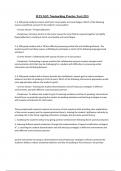
ILTS SLP: Nonteaching Practice T est (232) 1. A 10th grade student presents with harsh vocal quality and vocal fatigue. Which of the following reasons would best account for the student's vocal quality? - Correct Answer: VF hyperadduction. - Paraphrase: Excessive tension in t he larynx causes the vocal folds to squeeze together too tightly (hyperadduction), resulting in harsh vocal quality and vocal fatigue. 2. A 10th grade student with a TBI has difficulty processing verbal info and inhibiting behavior. The student would mo st likely require scaffolding to participate in which of the following language -based activities? - Correct Answer: Collaborating with a group of peers on a class project. - Paraphrase: Participating in group activities like collaborative p rojects involves complex social communication skills that may be challenging for a student with difficulties in processing verbal information and inhibiting behavior. 3. A 10th grade student with a fluency disorder has established a speech goal to reduc e avoidance behaviors and fear of speaking in front of peers. Which of the following intervention approaches would most appropriately address the student's goals? - Correct Answer: Teaching the student desensitization and self -advocacy strategies in different environments and with different communication partners. - Paraphrase: To address the student's goal of reducing avoidance and fear of speaking, interventions should focus on gradually exposing the student to speaking situations and teac hing strategies to cope with anxiety and advocate for themselves. These paraphrased responses capture the essence of each question while providing clear explanations of the correct answers and the reasoning behind them. b. treating the student's disfluency indirectly by providing info to the family regarding interaction strategies that promote sp eech fluency c. modifying the student's behavior by giving positive reinforcement following fluent speech production d. reducing disfluent speech production through the implementation of speech modification strategies ✔️a. teaching the student desensitiz ation and self advocacy strategies in different environments and with different communication partners speech intervention focusing on desensitization and self advocacy strategies is likely to promote the student's ability to reduce avoidance behaviors a nd fear of speaking in front of peers. the primary purpose of desensitization strategies is to systematically address a student's fear of disfluency whereas self advocacy strategies support a students ability to disclose their identity as an individual wit h a fluency disorder to communication partners. A 2nd grade student presents with highly unintelligible speech and a significant restricted speech sound repertoire. The SLP decides to use the complexity approach to address the students speech sound produc tion. which of the following student outcomes is most likely to result from this intervention approach? a. the student will produce speech sounds that are targeted in a developmental sequence b. the student will produce meaningful phrases with increased i ntelligibility to promote functional communication c. the student will develop increased phonological awareness which will indirectly improve speech sound production d. the student will more rapidly generalize phonological principles to other untreated sp eech sounds ✔️d. the student will more rapidly generalize phonological principles to other untreated speech sounds The complexity approach is an intervention that can be used to address functional phonological impairment. research indicated that more fea ture generalization is likely to occur when more complexity input is targeted. therefore the SLP is likely to use the approach to more rapidly affect phonological change within a students phonological system. A 3rd grade student with a language impairment has difficulty identifying and self correcting grammatical errors. The student is most likely to require support with which of the following classroom activities? a. sorting vocab words into categories b. sharing background knowledge with a peer c. work ing collaboratively in a small group d. using a checklist to edit written work ✔️d. using a checklist to edit written work because editing requires matelinguistic awareness of writing form and content as well as knowledge and use of grammatical structures a student who has difficulty with these skills would require additional support. A checklist is unlikely to promote a student's editing abilities especially if they struggle to identify grammatical errors. a 3rd grade student with cochlear implants hears speech through which of the following processes? a. sounds are converted into electrical signals and transmitted to the auditory nerve. b. sounds are collected and amplified. and then transmitted through the ear canal. c. sounds are conducted directly to the cochlea through bone conduction d. sounds are transmitted though a frequency modulation signal directly to a reciever ✔️a. sounds are converted into electrical signals and transmitted to the auditory nerve. cochlea r implants are digital signal processing devices that convert sounds into digital signals that are transmitted to electrodes in the inner ear. The electrodes deliver electrical stimulation to the auditory nerve, sending signals to the brain that are interp reted as sounds. A 3rd grade teacher reports that a student who is an ELL closely observes students in the classroom but infrequently engages in using language. Which of the following 2nd language processes is the student most likely demonstrating? a. lo sing language skills in the primary language b. switching between the 1st and 2nd language in a single utterance c. focusing on listening and comprehending in the 2nd language d. producing errors in English due to the influence of the 1st language ✔️c. focusing on listening and comprehending in the 2nd language children who are acquiring language frequently undergo typical processes of 2nd language acquisition. During the silent period of 2nd language acquisition, children are likely to appear quiet sinc e they are focusing on listening and comprehending the 2nd or new language. a 4th grade student with a language impairment impacting semantic knowledge would most likely experiences difficulties with which of the following literacy skills? a. reading com prehension b. decoding words phonetically c. reading fluency d. orthographic processing ✔️a. reading comprehension students w/ semantic language impairment are likely to experience reading comprehension difficulties since they do not have the prerequisi te oral vocab skills to understand content -area or grade level texts. vocab knowledge is critical for understanding the meaning of words within texts as well as activating and building background knowledge to make connections to the text. A 7th grade stud ent with social language impairment would most likely require additional supports in which of the following aspects of oral narrative language? a. using casual and temporal conjunctions b. producing elaborated noun phrases c. sequencing a series of actions or events d. identifying the internal responses of characters ✔️d. identifying the internal responses of characters In comparison to students who are typically developing, students with social language impairment produc e fewer emotion verbs, such as know, think, and believe, due to difficulty with social cognition. Identifying the internal responses of characters is a social cognitive task that draws upon perspective taking and inferencing. A child with low muscle tone is most likely to demonstrate which of the following characteristics of speech production? a. rapid rate of speech b. harsh vocal quality c. limited range of motion d. imprecise articulation ✔️d. imprecise articulation
Examen
ILTS SLP: Nonteaching Practice Test (232)
ILTS SLP: Nonteaching Practice Test (232) 1. A 10th grade student presents with harsh vocal quality and vocal fatigue. Which of the following reasons would best account for the student's vocal quality? - Correct Answer: VF hyperadduction. - Paraphrase: Excessive tension in the larynx causes the vocal folds to squeeze together too tightly (hyperadduction), resulting in harsh vocal quality and vocal fatigue. 2. A 10th grade student with a TBI has difficulty processing verbal info and inhibiting behavior. The student would most likely require scaffolding to participate in which of the following language-based activities? - Correct Answer: Collaborating with a group of peers on a class project. - Paraphrase: Participating in group activities like collaborative projects involves complex social communication skills that may be challenging for a student with difficulties in processing verbal information and inhibiting behavior. 3. A 10th grade student with a fluency disorder has established a speech goal to reduce avoidance behaviors and fear of speaking in front of peers. Which of the following intervention approaches would most appropriately address the student's goals? - Correct Answer: Teaching the student desensitization and self-advocacy strategies in different environments and with different communication partners. - Paraphrase: To address the student's goal of reducing avoidance and fear of speaking, interventions should focus on gradually exposing the student to speaking situations and teaching strategies to cope with anxiety and advocate for themselves. These paraphrased responses capture the essence of each question while providing clear explanations of the correct answers and the reasoning behind them.b. treating the student's disfluency indirectly by providing info to the family regarding interaction strategies that promote speech fluency c. modifying the student's behavior by giving positive reinforcement following fluent speech production d. reducing disfluent speech production through the implementation of speech modification strategies ️a. teaching the student desensitization and self advocacy strategies in different environments and with different communication partners speech intervention focusing on desensitization and self advocacy strategies is likely to promote the student's ability to reduce avoidance behaviors and fear of speaking in front of peers. the primary purpose of desensitization strategies is to systematically address a student's fear of disfluency whereas self advocacy strategies support a students ability to disclose their identity as an individual with a fluency disorder to communication partners. A 2nd grade student presents with highly unintelligible speech and a significant restricted speech sound repertoire. The SLP decides to use the complexity approach to address the students speech sound production. which of the following student outcomes is most likely to result from this intervention approach? a. the student will produce speech sounds that are targeted in a developmental sequence b. the student will produce meaningful phrases with increased intelligibility to promote functional communication c. the student will develop increased phonological awareness which will indirectly improve speech sound production d. the student will more rapidly generalize phonological principles to other untreated speech sounds ️d. the student will more rapidly generalize phonological principles to other untreated speech sounds The complexity approach is an intervention that can be used to address functional phonological impairment. research indicated that more feature generalization is likely to occur when more complexity input is targeted. therefore the SLP is likely to use the approach to more rapidly affect phonological change within a students phonological system. A 3rd grade student with a language impairment has difficulty identifying and self correcting grammatical errors. The student is most likely to require support with which of the following classroom activities? a. sorting vocab words into categories b. sharing background knowledge with a peer c. working collaboratively in a small group d. using a checklist to edit written work ️d. using a checklist to edit written work because editing requires matelinguistic awareness of writing form and content as well as knowledge and use of grammatical structures a student who has difficulty with these skills would require additional support. A checklist is unlikely to promote a student's editing abilities especially if they struggle to identify grammatical errors. a 3rd grade student with cochlear implants hears speech through which of the following processes? a. sounds are converted into electrical signals and transmitted to the auditory nerve. b. sounds are collected and amplified. and then transmitted through the ear canal. c. sounds are conducted directly to the cochlea through bone conduction d. sounds are transmitted though a frequency modulation signal directly to a reciever ️a. sounds are converted into electrical signals and transmitted to the auditory nerve. cochlear implants are digital signal processing devices that convert sounds into digital signals that are transmitted to electrodes in the inner ear. The electrodes deliver electrical stimulation to the auditory nerve, sending signals to the brain that are interpreted as sounds. A 3rd grade teacher reports that a student who is an ELL closely observes students i
Mostrar más
Leer menos
Institución
ILTS SLP: Nonteaching Practice
Grado
ILTS SLP: Nonteaching Practice
Ups! No podemos cargar tu documento ahora. Inténtalo de nuevo o contacta con soporte.
Escuela, estudio y materia
- Institución
- ILTS SLP: Nonteaching Practice
- Grado
- ILTS SLP: Nonteaching Practice
Información del documento
- Subido en
- 2 de julio de 2024
- Número de páginas
- 39
- Escrito en
- 2023/2024
- Tipo
- Examen
- Contiene
- Preguntas y respuestas
Temas
-
ilts slp nonteaching practice test 232
Vista previa del contenido
$10.99
Accede al documento completo:
100% de satisfacción garantizada
Inmediatamente disponible después del pago
Tanto en línea como en PDF
No estas atado a nada

Documento también disponible en un lote
Package deal
ILTS SLP Guaranteed Success
1
7
2024
$ 74.23
Más información