Definition of Abnormality
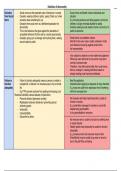
Deviation - Social norms are the expected rules of behaviour in society - Social norms are flexible: looks at individuals and
from Social - Example: wearing clothes in public, saying “thank you” when situation
Norm someone does something for you - E.g. throwing tantrums and hitting people is normal for
- Deviation from social norm is a definition/explanation for children, but sign of mental disorder for adults
abnormality - Similarly walking around naked at home is normal but in
- This is the behaviour that goes against the standards of public its abnormal
acceptable behaviour that are set by a social group/society
- Example: going up to a stranger and touching them, walking - Social norms vary between cultures
around naked in public - Normal to blow your nose in public, whereas in India
such behaviour would go against social norms
- Not representable
- Very subjective: depends on who makes the judgement
- What may seem abnormal to one person may seem
normal to someone else
- Therefore, if we define abnormality from social norms,
there is a danger in creating definitions based on
already existing social morals and attitudes
Failure to - Failure to function adequately means a person is unable to - Real life application
function navigate life, or behave in a necessary way to live a normal - Important when applying to diagnosis of many disorders
adequately life - E.g. those who suffer from depression find it interfering
- E.g FTFA prevent someone from getting and keeping a job with their everyday lives
Rosenhan identifies various features of dysfunction:
- Personal distress (depression anxiety) - Not everyone with ideal mental disorder is unable to
- Maladaptive behaviour (behaviour preventing person function in society
achieving goals) - E.g. serial killers managed to maintain a normal life
- Irrationality despite being psychopaths
- Unpredictability - Is not generalisable to everyone
- Discomfort to others
- Not everyone who is unable to function is suffering from
a mental disorder
- Healthy people may temporarily be unable to function
adequately
- E.g. someone who's lost someone close to them
(friend/family) may be unable to go work or have fun
due to the grief they are feeling
, Statistical - Defines abnormality as statistically rare characteristics and - Objective: data is collected about behaviour and
infrequency behaviours characteristics
- The further away away behaviour is from mathematical - Becomes an objective way of deciding who is abnormal
average, the more rare and abnormal it is - Data is not based on subjective opinions, useful as
- E.g. average IQ is 100, over 130 or below 70 is statistically relies on real and unbiased data to definite abnormality
infrequent, they would be considered abnormal
- Infrequency does not always mean abnormality
- E.g. having IQ over 130 is statistically infrequent, but it
is not a mental disorder and is quite desirable
- SI should not be the sole basis to define abnormality
- Not everyone benefits from labels
- Someone with lower than average IQ might be able to
live a normal life but label could negatively impact their
self-esteem
- Having labels doesn’t benefit people's lives
Deviation Jahod (1958) identified 6 features of ideal mental health: - Holistic: focuses on entire person and not specific parts
from ideal - Positive attitude towards oneself - Produces more effective and long lasting means of
mental - Self actualistaion treating mental disorder as it focuses on multiple factors
health - Autonomy (independency)
- Ability to resist stress - Has unrealistic high standards
- Acceptable perception of reality - Few people meet Jahoda’s criteria all the time, for
- Mastery of environment instance some people lack self esteem or self
actualisation
Someone with ideal mental health would tick all 6 boxes. Person who - According to the definition most people are seen as
fails to tick most of these boxes, would be classified as abnormal ‘abnormal’
according to DIMH definition
- Jahoda’s criteria is subjective
- Hard to assess how much a person is self-actualising
- There are methods to measure the characteristics, but
these may be unreliable as individuals are likely to have
different standards
Deviation - Social norms are the expected rules of behaviour in society - Social norms are flexible: looks at individuals and
from Social - Example: wearing clothes in public, saying “thank you” when situation
Norm someone does something for you - E.g. throwing tantrums and hitting people is normal for
- Deviation from social norm is a definition/explanation for children, but sign of mental disorder for adults
abnormality - Similarly walking around naked at home is normal but in
- This is the behaviour that goes against the standards of public its abnormal
acceptable behaviour that are set by a social group/society
- Example: going up to a stranger and touching them, walking - Social norms vary between cultures
around naked in public - Normal to blow your nose in public, whereas in India
such behaviour would go against social norms
- Not representable
- Very subjective: depends on who makes the judgement
- What may seem abnormal to one person may seem
normal to someone else
- Therefore, if we define abnormality from social norms,
there is a danger in creating definitions based on
already existing social morals and attitudes
Failure to - Failure to function adequately means a person is unable to - Real life application
function navigate life, or behave in a necessary way to live a normal - Important when applying to diagnosis of many disorders
adequately life - E.g. those who suffer from depression find it interfering
- E.g FTFA prevent someone from getting and keeping a job with their everyday lives
Rosenhan identifies various features of dysfunction:
- Personal distress (depression anxiety) - Not everyone with ideal mental disorder is unable to
- Maladaptive behaviour (behaviour preventing person function in society
achieving goals) - E.g. serial killers managed to maintain a normal life
- Irrationality despite being psychopaths
- Unpredictability - Is not generalisable to everyone
- Discomfort to others
- Not everyone who is unable to function is suffering from
a mental disorder
- Healthy people may temporarily be unable to function
adequately
- E.g. someone who's lost someone close to them
(friend/family) may be unable to go work or have fun
due to the grief they are feeling
, Statistical - Defines abnormality as statistically rare characteristics and - Objective: data is collected about behaviour and
infrequency behaviours characteristics
- The further away away behaviour is from mathematical - Becomes an objective way of deciding who is abnormal
average, the more rare and abnormal it is - Data is not based on subjective opinions, useful as
- E.g. average IQ is 100, over 130 or below 70 is statistically relies on real and unbiased data to definite abnormality
infrequent, they would be considered abnormal
- Infrequency does not always mean abnormality
- E.g. having IQ over 130 is statistically infrequent, but it
is not a mental disorder and is quite desirable
- SI should not be the sole basis to define abnormality
- Not everyone benefits from labels
- Someone with lower than average IQ might be able to
live a normal life but label could negatively impact their
self-esteem
- Having labels doesn’t benefit people's lives
Deviation Jahod (1958) identified 6 features of ideal mental health: - Holistic: focuses on entire person and not specific parts
from ideal - Positive attitude towards oneself - Produces more effective and long lasting means of
mental - Self actualistaion treating mental disorder as it focuses on multiple factors
health - Autonomy (independency)
- Ability to resist stress - Has unrealistic high standards
- Acceptable perception of reality - Few people meet Jahoda’s criteria all the time, for
- Mastery of environment instance some people lack self esteem or self
actualisation
Someone with ideal mental health would tick all 6 boxes. Person who - According to the definition most people are seen as
fails to tick most of these boxes, would be classified as abnormal ‘abnormal’
according to DIMH definition
- Jahoda’s criteria is subjective
- Hard to assess how much a person is self-actualising
- There are methods to measure the characteristics, but
these may be unreliable as individuals are likely to have
different standards