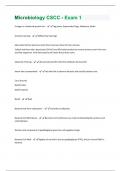
Microbiology CSCC - Exam 1 Questions And Answers | Updated Solutions | 100% Correct Answe
4 stages in a bacterial growth are: - Lag phase, Exponential (Log), Stationary, Death Acid-fast staining - (differential staining) Add carbol fuchsin (primary stain) then heat over flame for few minutes. 2.Wash and then add a decolorizer (5% HCl and 95% ethyl alcohol) to remove primary color from nonacid-fast organisms. Acid-fast bacteria will retain the primary color. Alexander Fleming - discovered penicillin (the first antibiotic discovered!) Anton Van Leeuwenhoek - was the first to observe bacteria and classify bacteria into: Cocci (round). Bacilli (rods). Spirilla (spiral). Bacilli - Rods Bacteria that form endospores - Clostridia and Bacillus Bacterial Cell Membrane - Bacterial cell membranes are made of phospholipids, proteins and carbohydrates. Teichoic acid component of peptidoglycan gives the cell negative charge. Bacterial Cell Wall - Rigidity of cell wall is due to peptidoglycan (PTG), which is found ONLY in bacteria.Penicillin acts on the peptidoglycan layer, therefore, it is more effective on Gram positive bacteria. Bacterial Growth - All bacteria are prokaryotic and divide by binary fission Bacterial movement - Active bacterial motion is regulated by flagella Beneficial Bacteria - The majority of the bacteria are beneficial. Only about 3% are harmful. Biofilms - important because pathogenic bacteria in a biofilm resist immune responses and antimicrobials. increase survival and attaching to surfaces. Bright-field Microscope - Uses visible light to observe objects, and produces a maximum magnification of a 1000x. Capsids - found on all viruses, are proteins that surround the nucleic acids. Capsids are made of identical unit proteins called capsomeres. Each virus has a specific number of capsids. Capsules - external viscous structures on surface of some made of sticky glycocalyx (polysaccharide) coating. Capsules contribute to virulence Capsules enhance bacterial adherence to surfaces.Chain and Florey - purified, tested and made production of penicillin in large amounts Chemically defined media - are composed of precise amounts of pure chemicals. Chemolithoautotrophs - use inorganic carbon for energy and CO2 as carbon source Chemoorganoheterotrophs - use organic compounds for energy and carbon source. This is the method used in humans and all other animals. Chronic infections - the virus is present at all times during the infection. Examples of chronic infections are; Hepatitis B and Hepatitis C. Classes of Microbiology - Bacteria, Fungi, Protozoa, Algae and "viruses." Cocci - Round Complex media - have no exact chemical formula of the ingredients in them. Examples include; Nutrient broth, Blood agar, Chocolate agar. Dark-field Microscope - In a dark-field microscope, the object will appear bright on a dark background. Death phase - stage where nutrients are depleted and more bacteria die than are generated. Differential media - contain substance that bacteria change in recognizable way e.g. Blood agar is sued to see hemolysis; MacConkey agar, is used to differentiate lactose fermenters and non fermenters.Diffusion - the process by which molecules move in and out freely across the cytoplasmic membrane (no energy required). DNA viruses - replicate and assemble in the nucleus of the host cell. Domain Archaea - They have similar shapes like bacteria. Cell walls of Archaea do not have peptidoglycan. Some Archaea can grow at 1210C. Archaea can grow in high salt concentration. Domain Bacteria - Are prokaryotes and have rigid cell walls. Have no membrane bound nucleus or organelles. The three most common bacterial shapes are; Cocci, Bacilli, Spiralla. Domain Eukarya - Domain eukarya includes; Algae, Fungi, Protozoa, Animals and Plants. •All Eukaryotes have true cells, i.e. have membrane bound nucleus and organelles. •Eukaryotic cells DO NOT have peptidoglycan. •Algae and fungi have rigid cells. •Algae perform 90% of all photosynthesis •Algae are aquatic, photosynthetic and free living. •Fungi and protozoa depend on other organisms for their energy source. •Protozoan cells do not have rigid cell walls.Edward Jenner - inoculated an 8 year old boy with cowpox and proved vaccine against small pox was effective. Endospores - Only 1 endospore per cell is produced. Bacterial endospores are the most resistant life forms. Endospores withstand extreme heat, drying, freezing, radiation, and chemicals. Essential elements and Trace elements required for bacterial growth: - •Essential elements required for growth are Carbon, oxygen, hydrogen, nitrogen, sulfur, phosphorus, potassium, magnesium, calcium and iron. •Trace elements are required for growth but are needed in small amounts e.g. Cobalt, Examples of benefits we get from bacteria and fungi include - Bacteria and fungi decay organic matter. Most antibiotics are made by bacteria and fungi. Normal flora contribute to health. Intestinal bacteria are involved in production of vitamins K & vitamin B. Bacteria are used to make ethanol, pesticides and dietary amino acids. Bacteria degrade oils, clean natural and artificial oil spills. More than 50% of photosynthesis is performed by microorganisms.Facultative anaerobes - can live in the presence or absence of oxygen. They catalase and superoxide desmutase. Their metabolism can occur by aerobic respiration or anaerobically by fermentation. Ferdinand Cohn - discovery of endospores fimbriae - used for attachment rather than for movement.
Escuela, estudio y materia
- Institución
- Microbiology CSCC
- Grado
- Microbiology CSCC
Información del documento
- Subido en
- 29 de junio de 2024
- Número de páginas
- 14
- Escrito en
- 2023/2024
- Tipo
- Examen
- Contiene
- Preguntas y respuestas
Temas
-
microbiology cscc

Documento también disponible en un lote