[Tut] In macro theory what determines the size of the inflation bias? Do models of the inflation bias
provide a useful basis for understanding reforms such as the delegation of monetary policy from the
UK Treasury to the Bank of England in 1997?
Refer to my HT2 tutorial sheet answer
Introduction
o Inflation bias when in equilibrium inflation is higher than π T, due to yT > ye.
First outline model explaining how inflation bias arise
o
Factors that increase inflation bias:
o Factors increasing yT:
political influence on monetary policy (high y as signal for economic competence
to win votes),
unintentional overestimation of ye (Orphanide's account of monetary policy in
1970s where policymakers failed to realise decreased productivity levels
lowered PS curve and ye)
Desire to achieve efficient employment given imperfect labour makrets
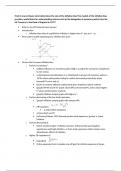
[graph] PS-WS and ES-ED graph: show effect of lowered PS, and to show higher
E* given perfect labour markets.
[graph] inflation-output graph with higher y T.
o Factors decreasing α like low trade openness
[graph] inflation-output graph with steeper MR
MR equation:
α and β affect steepness
α from short-run PC:
[reference] Romer 1993 showed greater trade openness, greater α, lower
inflation
o Factors decreasing β:
Extent of policymaker's inflation aversion, influenced by past negative
experiences with high inflation, or from trade openness which creates more
distortionary effects of inflation
o Higher CB impatience δ
[equation]
Policy expansion from A implies one-off gain for infinite sequence of losses
provide a useful basis for understanding reforms such as the delegation of monetary policy from the
UK Treasury to the Bank of England in 1997?
Refer to my HT2 tutorial sheet answer
Introduction
o Inflation bias when in equilibrium inflation is higher than π T, due to yT > ye.
First outline model explaining how inflation bias arise
o
Factors that increase inflation bias:
o Factors increasing yT:
political influence on monetary policy (high y as signal for economic competence
to win votes),
unintentional overestimation of ye (Orphanide's account of monetary policy in
1970s where policymakers failed to realise decreased productivity levels
lowered PS curve and ye)
Desire to achieve efficient employment given imperfect labour makrets
[graph] PS-WS and ES-ED graph: show effect of lowered PS, and to show higher
E* given perfect labour markets.
[graph] inflation-output graph with higher y T.
o Factors decreasing α like low trade openness
[graph] inflation-output graph with steeper MR
MR equation:
α and β affect steepness
α from short-run PC:
[reference] Romer 1993 showed greater trade openness, greater α, lower
inflation
o Factors decreasing β:
Extent of policymaker's inflation aversion, influenced by past negative
experiences with high inflation, or from trade openness which creates more
distortionary effects of inflation
o Higher CB impatience δ
[equation]
Policy expansion from A implies one-off gain for infinite sequence of losses