

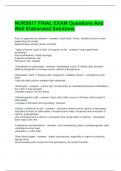
NURS617 FINAL EXAM Questions And Well Elaborated Solutions Axial vs appendicular skeleton - answers axial=skull, thorax, vertebral column (main supporting structures) Appendicular=ues/les, pelvis, shoulder Types of bones: long vs short vs irregular vs flat - answers long=upper/lower extremities Short=ankle/wrist; mostly spongey Irregular=vertebrae, jaw Flat=skull, ribs, scapula Osteoblasts vs osteoclasts - answers osteoblasts - bone *b*uilding cells; sec retes alkaline phosphate to increase serum calcium & phosphorus Osteoclasts - bone *c*hewing cells, phagocytic; releases calcium + phosphorus from bone -high pth=high calcium release=high osteoclast Osteocytes - answers -a bone cell, formed when an oste oblast becomes embedded in the matrix it has secreted -releases calcium into the blood Osteoprogenitor cells - answers bone stem ce lls; source of all bone cells except for osteoclasts -increase in activation during puberty, fractures Effects of calcit onin vs pth - answers -calcitonin=lowers serum calcium & decreases resorptive function of osteoclasts; increases bone mass, increased renal excretion of calcium & phosphates -pth=increases serum calcium; increased renal conservation of calcium , decreased bone mass over time Endosteum and periosteum - answers -two membranous sites of osteoprogenitor cells -endosteum=inner layer -periosteum= outer layer Bone blood supply - answers -highly vascularized, especially in regions containing spongy bone -blood vessels enter bones from the periosteum via nutrient foramen -haversian canals=blood vessels + nerves supplying osteon -blood vessels supply nutrients and oxygen required by cells and remove waste products from bone cells Hematopoiesis in children vs adults - answers -in fetus: hematopoiesis transfers from liver to long bones -children: red marrow replaced by yellow marrow in long bones; epiphysis separated by metaphysis by cartilaginous growth plate, fuses by puberty -adults: red marrow restricted to flat bones (pelvis, fibs, sternum) Red marrow=rbc production, yellow=adipose cells 3 types of cartilage - answers 1. Hyaline - most abundant, slightly flexible; ex=nose, ribs 2. Elastic - most flexible, 2nd abundant; ex=ear s 3. Fibrocartilage - least flexible; ex=knee, vertebrae -cartilage=more flexible than bone d/t increased extracellular substance that bone -no blood vessels; diffusion used for transport unless calcified by high calcium levels Production of d3 - answers -produced in liver by pth & prolactin; increases absorption of calcium -hypoparathyroidism=low d3, high calcium & phosphorus -hyper parathyroidism=high d3, low calcium & phosphorus What happens when serum calcium is low? - answers -pth released by para thyroid to stimulate osteoclasts to release calcium -kidneys activate vit d to increase calcium absorption by intestines -kidneys retain calcium & phosphorus What happens when serum calcium is high? - answers -pth inhibited , calcitonin released from thy roid to increase renal clearance of ca+ and phosphate -inhibits osteoclast activity & inhibits d3 production Sources of vitamin d - answers sunlight, fortified milk, fish, fish liver oils, eggs Tendons vs ligaments vs joint - answers tendons=connect muscle to bone Ligaments=connect bone to bo ne Joint/articulation=where bone meets bone Synarthrosis vs synovial/diarthrodial joints - answers -synarthrosis=absolutely no movement -synovial=freely moveable, most joints in body; have synovial fluid for lubrication of joint + prevent bone degradation. Most frequently effected by rheumatic dx (ex -fibro,ra) Synovial fluid - answers -secretion o f synovial membranes that lubricates joi nts and nourishes articular cartilage -normal=clear or pale yellow appearance, does not clot, less than <100cells/mm -used for diagnostics of rheumatic dx Bursa + bursitis - answers -fluid-filled sac that allows for easy movement of one part of a joint over another; not part of joint -prevents friction over tendons -bursitis=inflammation of a bursa Healing process of muscular/joint injuries - answers -via fibroblasts producing collagen; collagen accumulates to restrengthen -starts to heal ~2 weeks, no t fully until 2mo; can easily re -damage ligaments/tendon if not fully healed Strain vs sprain - answers strain=overstretching of muscle d/t mechanical overload Most common=lower back and cervical regions Sprain=overstretching of ligament resulting in tear or com plete rupture; d/t abnormal/excessive joint movements. Most common=ankle, wrist, knee (acl) Contusion - answers -soft tissue injury causing localized hemorrhaging -blood accumulation forms hematoma; can splint skin d/t increased pressure, incr ease risk of infection Most common site for shoulder dislocation - answers -anterior @ glenohumeral joint -causes bone end to be separate from joint, loss of articulation occurs Loose bodies (muscoloskeletal) - answers -small pieces of bone or cartil age within a joint space -d/t trauma or degradation of cartilage -can cause locking of the joint, pain, oa -common sites: hips, knees, ankles, elbows -tx: arthroscopy Meniscus tear - answers -tear in the meniscus which is the c -shaped cartilage that acts as a cushion for the joint between the femur + tibia -helps stabilize knee and absorb shock -s/s tear: extreme pain with quad extension/flexion -tx: repair, immobilization Hip fractures: ris k factors - answers -white woman -increase in age -low bmi , malnutrition -poor vision -lack of exercise -osteoporosis
Examen
NURS617 FINAL EXAM Questions And Well Elaborated Solutions
Puntuación
Vendido
-
Páginas
18
Grado
A+
Subido en
27-06-2024
Escrito en
2023/2024
NURS617 FINAL EXAM Questions And Well Elaborated Solutions Axial vs appendicular skeleton - answers axial=skull, thorax, vertebral column (main supporting structures) Appendicular=ues/les, pelvis, shoulder Types of bones: long vs short vs irregular vs flat - answers long=upper/lower extremities Short=ankle/wrist; mostly spongey Irregular=vertebrae, jaw Flat=skull, ribs, scapula Osteoblasts vs osteoclasts - answers osteoblasts- bone *b*uilding cells; secretes alkaline phosphate to increase serum calcium & phosphorus Osteoclasts- bone *c*hewing cells, phagocytic; releases calcium + phosphorus from bone -high pth=high calcium release=high osteoclast Osteocytes - answers -a bone cell, formed when an osteoblast becomes embedded in the matrix it has secreted -releases calcium into the blood Osteoprogenitor cells - answers bone stem cells; source of all bone cells except for osteoclasts -increase in activation during puberty, fractures Effects of calcitonin vs pth - answers -calcitonin=lowers serum calcium & decreases resorptive function of osteoclasts; increases bone mass, increased renal excretion of calcium & phosphates -pth=increases serum calcium; increased renal conservation of calcium , decreased bone mass over time Endosteum and periosteum - answers -two membranous sites of osteoprogenitor cells -endosteum=inner layer -periosteum= outer layer Bone blood supply - answers -highly vascularized, especially in regions containing spongy bone -blood vessels enter bones from the periosteum via nutrient foramen -haversian canals=blood vessels + nerves supplying osteon -blood vessels supply nutrients and oxygen required by cells and remove waste products from bone cells Hematopoiesis in children vs adults - answers -in fetus: hematopoiesis transfers from liver to long bones -children: red marrow replaced by yellow marrow in long bones; epiphysis separated by metaphysis by cartilaginous growth plate, fuses by puberty -adults: red marrow restricted to flat bones (pelvis, fibs, sternum) Red marrow=rbc production, yellow=adipose cells 3 types of cartilage - answers 1. Hyaline - most abundant, slightly flexible; ex=nose, ribs 2. Elastic - most flexible, 2nd abundant; ex=ears 3. Fibrocartilage - least flexible; ex=knee, vertebrae -cartilage=more flexible than bone d/t increased extracellular substance that bone -no blood vessels; diffusion used for transport unless calcified by high calcium levels Production of d3 - answers -produced in liver by pth & prolactin; increases absorption of calcium -hypoparathyroidism=low d3, high calcium & phosphorus -hyperparathyroidism=high d3, low calcium & phosphorus What happens when serum calcium is low? - answers -pth released by parathyroid to stimulate osteoclasts to release calcium -kidneys activate vit d to increase calcium absorption by intestines -kidneys retain calcium & phosphorus What happens when serum calcium is high? - answers -pth inhibited, calcitonin released from thyroid to increase renal clearance of ca+ and phosphate -inhibits osteoclast activity & inhibits d3 production Sources of vitamin d - answers sunlight, fortified milk, fish, fish liver oils, eggs Tendons vs ligaments vs joint - answers tendons=connect muscle to bone Ligaments=connect bone to bone Joint/articulation=where bone meets bone Synarthrosis vs synovial/diarthrodial joints - answers -synarthrosis=absolutely no movement -synovial=freely moveable, most joints in body; have synovial fluid for lubrication of joint + prevent bone degradation. Most frequently effected by rheumatic dx (ex-fibro,ra) Synovial fluid - answers -secretion of synovial membranes that lubricates joints and nourishes articular cartilage -normal=clear or pale yellow appearance, does not clot, less than 100cells/mm -used for diagnostics of rheumatic dx Bursa + bursitis - answers -fluid-filled sac that allows for easy movement of one part of a joint over another; not part of joint -prevents friction over tendons -bursitis=inflammation of a bursa Healing process of muscular/joint injuries - answers -via fibroblasts producing collagen; collagen accumulates to restrengthen -starts to heal ~2 weeks, not fully until 2mo; can easily re-damage ligaments/tendon if not fully healed Strain vs sprain - answers strain=overstretching of muscle d/t mechanical overload Most common=lower back and cervical regions Sprain=overstretching of ligament resulting in tear or complete rupture; d/t abnormal/excessive joint movements. Most common=ankle, wrist, knee (acl) Contusion - answers -soft tissue injury causing localized hemorrhaging -blood accumulation forms hematoma; can splint skin d/t increased pressure, increase risk of infection Most common site for shoulder dislocation - answers -anterior @ glenohumeral joint -causes bone end to be separate from joint, loss of articulation occurs Loose bodies (muscoloskeletal) - answers -small pieces of bone or cartilage within a joint space -d/t trauma or degradation of cartilage -can cause locking of the joint, pain, oa -common sites: hips, knees, ankles, elbows -tx: arthroscopy Meniscus tear - answers -tear in the meniscus which is the c-shaped cartilage that acts as a cushion for the joint between the femur + tibia -helps stabilize knee and absorb shock -s/s tear: extreme pain with quad extension/flexion -tx: repair, immobilization Hip fractures: risk factors - answers -white woman -increase in age -low bmi, malnutrition -poor vision -lack of exercise -osteoporosis
Mostrar más
Leer menos
Institución
NURS617
Grado
NURS617
Vista previa del contenido
Escuela, estudio y materia
- Institución
- NURS617
- Grado
- NURS617
Información del documento
- Subido en
- 27 de junio de 2024
- Número de páginas
- 18
- Escrito en
- 2023/2024
- Tipo
- Examen
- Contiene
- Preguntas y respuestas
Temas
-
nurs617 final exam questions and well ela
-
nurs617 final exam questions and well elaborated
$9.49
Accede al documento completo:
¿Documento equivocado? Cámbialo gratis
Dentro de los 14 días posteriores a la compra y antes de descargarlo, puedes elegir otro documento. Puedes gastar el importe de nuevo.
Escrito por estudiantes que aprobaron
Inmediatamente disponible después del pago
Leer en línea o como PDF

Documento también disponible en un lote
Package deal
NURS 617 EXAM
5
2024
$ 33.49
Más información
