NURS617 EXAM 7 Questions And Answers.Verified Answers Graded A
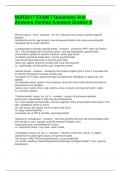
NURS617 EXAM 7 Questions And Answers.Verified Answers Graded A Normal vag ph + flora - answers -4.0-4.5; naturally more acidic to protect against bacteria -lactobacilli=normal vag bacteria; low=increased infection risk (abx=low lactobacilli, increased risk of yeast infection) Condylomata acuminata (genital warts) - answers -caused by HPV; high risk strains (16 + 18)=increased risk of cervical cancer, cervical hyperplasia, genital warts -prevented w/ gardisil & cervarix vaccines, yearly pap smear -incubation period=6 weeks-8mo, may be asymptomatic -can resolve spontaneously & reactive years later -warts can appear wherever contact with virus has occurred -tx: cryotherapy, trichloroacetic acid, imiquimod cream Genital herpes - answers -caused by the herpes simplex type II virus; F=increase risk of infection d/t greater mucosal surface area -incubation=2-10 days; spread through asymptomatic shedding (no warts=can still spread) -first episode=worst, painful, more vesicles; recurrent=more mild (remains dormant in sacral dorsal root ganglia) -lesions can involve cervix, vag, urethra, anus, scrotum, and inguinal lymph nodes -tx: antivirals (valtrex) Trichomoniasis: cause, s/s, dx, tx - answers -cause: trichomonas vaginalis (protozoan); associated w/ high risk sexual behaviors -s/s: men=usually asymptomatic, women=vaginitis, frothy green/yellow discharge w/ foul odor, strawberry spots on cervix -dx: wet-mount; ph usually more on basic side (6.0+) -tx: flagyl (metronidazole) -increased risk of PID & infertility, premature births Molluscum contagiosum - answers -wart-like growths that look like small pimples filled with kernels of corn; express curd-like material (infection risk) -cause=poxvirus; transmitted skin to skin -tx: imiquimod cream, cryo, laser, silver nitrate Candidiasis: cause, s/s, dx, tx - answers -infection of the skin, mouth, or vagina caused by the yeast-type fungus; not spread sexually -risk factors: ABX, HIV/immunodeficiency, uncontrolled DM -s/s: pruitis, swelling, thick/white/odorless discharge (cottage cheese!! Yum), dysuria, dyspareunia -dx: acidic ph (bacteria=more basic) -tx: fluconazole, antifungal creams (clotrimazole, -zole) Bacterial Vaginosis (BV): cause, s/s, dx, tx - answers -cause: d/t low lactobacillus (normal bacteria) and overgrowth of other organism(s) -s/s: more basic ph, thin, white discharge w/ foul fishy odor; lack of inflammation (not - itis)=no burning/pruitis -tx: flagyl PO or topical, clindamycin cream Chalmydia trachomatis: s/s, dx, tx - answers -chlamydia; causes nongonococcal urethritis in men, PID in women -s/s: M=urethritis + pruitis, meatal tenderness/erythema. F=mucopurulent clear/white discharge; both can be asymptomatic -reiter syndrome=if untreated, causes urethritis, conjuctivitis, arthritis -dx: urine NG/CT (NAAT) -tx: azithromycin or doxy Gonorrhea: cause, s/s, dx, tx - answers -cause= neisseria gonorrhoeae; can also cause conjuctivitis in newborns (Erythromycin ophthalmic ointment=prophylactic) -s/s: may be asymptomatic; discharge=THICKER THAN CHLAMYDIA -M=urethral pain, creamy yellow or bloody discharge, chronically effects prostate/epididymis/periurethral glands. -F=dysuria, dyspareunia, chronic scarring of GU resulting in sterility AND/OR PID -complications: disseminated gonococcal infections (conjuctivitis, heart valves, joint spaces) -dx: urine NG/CT (NAAT) -tx: ceftriaxone IM 3 stages of syphilis - answers 1. Primary: Painless chancre spontaneously gone w/i 8 wks; highly contagious during 1st stafe 2. Secondary: Condyloma lata, Maculopapular rash red-brown color (palms, soles of feet), LAD 6wks-18 months after infection - Latent phase (years) 3. Tertiary: granuloma-like lesions form d/t localized destruction; can cause dementia, blindness, ataxia, aortic valve insufficiency Syphilis: cause, risks, dx, tx - answers -cause: treponema pallidum (spirochete); spread d/t direct contact w/ moist lesion -risks: untreated in pregnancy after 16 weeks=increased chance of stillbirth, congential defects, active infection in utero -dx: serology (rapid plasma reagin) -tx: PCN IM, long term tetra/doxycycline 3 layers of uterus - answers 1. Perimetrium- serosa layer 2. Myometrium - major portion; contracts during period (cramps) 3. Endometrium - what sheds during period Role of estrogen in vaginal mucosa - answers -stimulates proliferation + maturation of vaginal mucosa; low estrogen=more dry, vaginitis, dyspareunia -low estrogen=retrogression of previously built endometrium + bleeding; causes much thicker layer w/ richer blood supply -missed period=thicker endo lining can lead to hyperplasia, can cause abnormal bleeding patterns -increases glycogen content; allows lactobacilli to convert into lactic acid & maintain acidic ph Menstrual cycle phases - answers 1. Follicular phase (as estrogen increases, FSH decreases and LH increases) 2. Ovulation (most fertile; high estrogen, high FSH/LH) 3. Luteal phase (progesterone slowly increasing, FSH/LH decrease, estrogen peaks half way through luteal phase; PMS/PMDD s/s occur during this phase) 4. Menstruation (progesterone slow decreases); towards end, increase of FSH and LH to re-enter follicular phase -on average-28 day cycle; 2 estrogen peaks=before ovulation, middle of luteal phase Puberty: development of first period - answers 1. FSH & LH released from anterior pituitary; stimulates development of mature graafian follicles (produce estrogen to stimulate thickening of uterus); as estrogen increases, FSH decreases and LH increases 2. As follicles mature & produce estrogen, most dominate follicles (1-2 reach full development) rupture to release mature ovum (ovulation) 3. Luteal phase - increase in LH from ovulation causes mature follicle to rupture; forms mass d/t blood & fluid accumulation, progesterone excreted from corpus luteum (what mass is called) 4. No fertilization=corpus albicans (white scar tissue); period occurs (high progesterone to shed endometrium) Corpus luteum - answers -endocrine tissue which produces hormones, estrogen, and progesterone which prepares the uterine lining for receiving an embryo -formed in luteal phase (after ovulation) Oogenesis in utero vs puberty - answers -begins @ 6 weeks; ovaries developed by 3 mo -@ birth: 1-2 mil oocytes -@ puberty: 200k -slowly diminishes throughout life Ovarian hormones: locations of origin + function - answers -estrogen, progesterone, androgens -released via stimulation by hypothalamic gonadotropin releasing hormones (gnrh); hypothalamus stimulates release of FSH & LH from anterior pituitary -FSH=stimulates estrogen
Escuela, estudio y materia
- Institución
- NURS617
- Grado
- NURS617
Información del documento
- Subido en
- 27 de junio de 2024
- Número de páginas
- 23
- Escrito en
- 2023/2024
- Tipo
- Examen
- Contiene
- Preguntas y respuestas
Temas
-
nurs617 exam 7 questions and answersverif
-
nurs617 exam 7 questions and answersverified ans

Documento también disponible en un lote