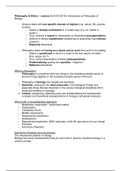
Philosophy & Ethics – Lecture 5 (23-05-2018): Introduction to Philosophy of
Biology
- Science deals with one specific domain of objects (e.g. nature, life, psyche,
society)
o Object is already understood in a certain way (e.g. as ‘matter in
motion’)
o Thus, science is based on necessarily on theoretical presuppositions.
o Science is always hypothetical (explaining by proposing (hypo)theses:
‘positive’)
o Empirical-theoretical
- Philosophy deals with being as a whole and as such (the world in its totality).
o Object is questioned in what it is (what is the true nature of matter,
time, space, etc.?)
o Thus, critical examination of these presuppositions
o Problematizing (putting into question: ‘negative’)
o Reflexive-theoretical
What is philosophy?
- Philosophy is concerned with how things in the broadest possible sense of
the term hang together in the broadest possible sense of the term
- Philosophy of biology has roughly two functions:
1. Synthetic: looking for the interconnection of all biological ‘things’ and
especially those that are theorized in the various biological disciplines (from
molecular genetics to ecology).
2. Critical: questioning, reflecting upon and problematizing the fundamental
concepts and theoretical presuppositions in biology (conceptual analysis).
What is life characteristics approach
- Metabolism (assimilate + dissimilate matter)
- Organization
- Complexity (form)
- Motility (movement)
- Responsivity (sensitivity)
- Development
- Reproduction/replication (DNA replicates, while life reproduces its own being)
- Evolution
- Autonomy (freedom)
Autonomy of biology vis-à-vis physics:
The reductionist position in biology
Biology has some characteristics that you don’t find in physics, therefore biology is a
unique concept.
, Vitalism <-> Mechanicism
Vitalism:
No essential difference between life and non-life
Life can be understood in a purely mechanical way laws of physics
There is no special principle of life, only inert matter and efficient causality
Reductionistic, causalistic
Mechanisism:
Essential difference between life and non-life
Life cannot be understood in a purely mechanical way, something more is ‘at work’
There is a special, immaterial principle of life: vital force, entelecheia, soul, etc.
Holistic, teleological
Holism <-> reductionism
Reductionism and holism:
Reductionism: the whole is no more than the sum of its parts the behavior of the
whole can be fully explained from the composing parts and is nothing more than the
sum of the behaviors of these individual parts.
Holism: the whole is more than the sum of its parts the whole cannot be fully
explained from the composing parts and is more than the sum of these parts.
- Emergent properties (properties that appear when parts are clicked together)
o All the properties of life are emerging properties.
- Downward causation
- Wholistic causation
The whole has a certain causal influence on its parts
Species problem:
What are species?
- Reproductive isolation; organisms that breed in nature and produce fertile
offspring
- Phylogenetic species concept
- Evolutionary species concept
Species are classes of things
In Darwinist: species are individuals that come up in evolution at a certain point in
time.
Teleology (goal-directedness):
Telos: projected end, purpose, goal, achievement, realization.
- How molecules interact is a non-teleological thing.
- When humans are attracted to each other teleological, because this is for
a goal and has reasons/purposes.
Distinguishes living from non-living.
Biology
- Science deals with one specific domain of objects (e.g. nature, life, psyche,
society)
o Object is already understood in a certain way (e.g. as ‘matter in
motion’)
o Thus, science is based on necessarily on theoretical presuppositions.
o Science is always hypothetical (explaining by proposing (hypo)theses:
‘positive’)
o Empirical-theoretical
- Philosophy deals with being as a whole and as such (the world in its totality).
o Object is questioned in what it is (what is the true nature of matter,
time, space, etc.?)
o Thus, critical examination of these presuppositions
o Problematizing (putting into question: ‘negative’)
o Reflexive-theoretical
What is philosophy?
- Philosophy is concerned with how things in the broadest possible sense of
the term hang together in the broadest possible sense of the term
- Philosophy of biology has roughly two functions:
1. Synthetic: looking for the interconnection of all biological ‘things’ and
especially those that are theorized in the various biological disciplines (from
molecular genetics to ecology).
2. Critical: questioning, reflecting upon and problematizing the fundamental
concepts and theoretical presuppositions in biology (conceptual analysis).
What is life characteristics approach
- Metabolism (assimilate + dissimilate matter)
- Organization
- Complexity (form)
- Motility (movement)
- Responsivity (sensitivity)
- Development
- Reproduction/replication (DNA replicates, while life reproduces its own being)
- Evolution
- Autonomy (freedom)
Autonomy of biology vis-à-vis physics:
The reductionist position in biology
Biology has some characteristics that you don’t find in physics, therefore biology is a
unique concept.
, Vitalism <-> Mechanicism
Vitalism:
No essential difference between life and non-life
Life can be understood in a purely mechanical way laws of physics
There is no special principle of life, only inert matter and efficient causality
Reductionistic, causalistic
Mechanisism:
Essential difference between life and non-life
Life cannot be understood in a purely mechanical way, something more is ‘at work’
There is a special, immaterial principle of life: vital force, entelecheia, soul, etc.
Holistic, teleological
Holism <-> reductionism
Reductionism and holism:
Reductionism: the whole is no more than the sum of its parts the behavior of the
whole can be fully explained from the composing parts and is nothing more than the
sum of the behaviors of these individual parts.
Holism: the whole is more than the sum of its parts the whole cannot be fully
explained from the composing parts and is more than the sum of these parts.
- Emergent properties (properties that appear when parts are clicked together)
o All the properties of life are emerging properties.
- Downward causation
- Wholistic causation
The whole has a certain causal influence on its parts
Species problem:
What are species?
- Reproductive isolation; organisms that breed in nature and produce fertile
offspring
- Phylogenetic species concept
- Evolutionary species concept
Species are classes of things
In Darwinist: species are individuals that come up in evolution at a certain point in
time.
Teleology (goal-directedness):
Telos: projected end, purpose, goal, achievement, realization.
- How molecules interact is a non-teleological thing.
- When humans are attracted to each other teleological, because this is for
a goal and has reasons/purposes.
Distinguishes living from non-living.