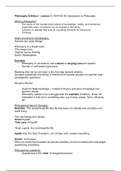
Philosophy & Ethics – Lecture 1 (18-04-2018): Introduction to Philosophy
What is philosophy?
- The study of the fundamental nature of knowledge, reality, and existence,
especially when considered as an academic discipline.
- A theory or attitude that acts as a guiding principle for behaviour.
- Thinking
Origin and drivers of philosophy:
Humans are ‘open beings’.
Philosophy is a Greek word;
*Filo means love
*Sophia means thinking.
Dutch: Wijsbegeerte
Socrates:
- Philosophy is not wisdom, but a desire or longing [eros] for wisdom.
- Socratic (= self-aware) ignorance.
Realizing that ‘we do not know’ is the first step towards wisdom.
Socrates questioned everything therefore he became popular, he was the most
paradigmatic questioner.
Pseudos=illusion
- Quest for true knowledge – instead of illusory (pseudos) knowledge and
opinions (doxa).
- Philosophy started of as a struggle with the sophists (‘bluffers’), those not
interested in truth but in something else, e.g. money, power, fame, influence,
etc.
Philosophical ideal of Socrates:
Socrates: ‘The unexamined life (the life that does not critically look at itself) is not
worth living.’
Two commands from Apollo:
‘Know thyself!’
‘Take care of thyself!’
*Goal: a good, true and beautiful life.
Apollo was ‘the God of wisdom’, son of Zeus who created everything.
Oracle: ‘truth-sayer’
When an oracle told Socrates he was the smartest, he did not believe this and began
questioning everything.
Philosophical questions:
- Questioning of the ‘what’ of things/phenomena:
, o What is truth?
o What is time?
o What is space?
o What is matter?
o What is life?
o What is humanity?
- Questioning the presuppositions of our thinking and reasoning, e.g.:
o Our senses are a reliable source of knowledge
o The world (cosmos) is intelligible (can be known)
o The human is a free creature (possesses free will)
The human:
Human: rational animal, animal rationale, zoon logon echon.
- Every human is a philosopher by nature?
- The human is a being that can put him- or herself and the world at large in
question.
- The human is a creature that wants more than it can do, and that can do more
than it may. (W. Wickler)
4 fundamental questions (Immanuel Kant):
1. What can I know? (science)
2. What must I do? (ethics)
3. What may I hope? (religion)
4. What is man? (anthropology)
Science vs. Philosophy:
Science:
- Always researches one specific domain of objects
- Object is already understood in a certain way
- Thus based necessarily on theoretical presuppositions
- Hypothetical
- Empirical-theoretical
Philosophy:
- Researches being in its totality and as such
- Object is questioned in its sway of being
- Critical examination of these theoretical presuppositions
- Problematizing
- Reflexive-theoretical
First philosophers (Presocratics):
- Asked for the unchanging foundations and regularities behind the permanent
change and changeability of the phenomena (phainomena).
- Looked for the first principles (archai) behind reality.
- The fundamental question was invariably: what is the original element or
principle? What constituted the world at its origin? And how have all the
various things come to be out of this origin?
What is philosophy?
- The study of the fundamental nature of knowledge, reality, and existence,
especially when considered as an academic discipline.
- A theory or attitude that acts as a guiding principle for behaviour.
- Thinking
Origin and drivers of philosophy:
Humans are ‘open beings’.
Philosophy is a Greek word;
*Filo means love
*Sophia means thinking.
Dutch: Wijsbegeerte
Socrates:
- Philosophy is not wisdom, but a desire or longing [eros] for wisdom.
- Socratic (= self-aware) ignorance.
Realizing that ‘we do not know’ is the first step towards wisdom.
Socrates questioned everything therefore he became popular, he was the most
paradigmatic questioner.
Pseudos=illusion
- Quest for true knowledge – instead of illusory (pseudos) knowledge and
opinions (doxa).
- Philosophy started of as a struggle with the sophists (‘bluffers’), those not
interested in truth but in something else, e.g. money, power, fame, influence,
etc.
Philosophical ideal of Socrates:
Socrates: ‘The unexamined life (the life that does not critically look at itself) is not
worth living.’
Two commands from Apollo:
‘Know thyself!’
‘Take care of thyself!’
*Goal: a good, true and beautiful life.
Apollo was ‘the God of wisdom’, son of Zeus who created everything.
Oracle: ‘truth-sayer’
When an oracle told Socrates he was the smartest, he did not believe this and began
questioning everything.
Philosophical questions:
- Questioning of the ‘what’ of things/phenomena:
, o What is truth?
o What is time?
o What is space?
o What is matter?
o What is life?
o What is humanity?
- Questioning the presuppositions of our thinking and reasoning, e.g.:
o Our senses are a reliable source of knowledge
o The world (cosmos) is intelligible (can be known)
o The human is a free creature (possesses free will)
The human:
Human: rational animal, animal rationale, zoon logon echon.
- Every human is a philosopher by nature?
- The human is a being that can put him- or herself and the world at large in
question.
- The human is a creature that wants more than it can do, and that can do more
than it may. (W. Wickler)
4 fundamental questions (Immanuel Kant):
1. What can I know? (science)
2. What must I do? (ethics)
3. What may I hope? (religion)
4. What is man? (anthropology)
Science vs. Philosophy:
Science:
- Always researches one specific domain of objects
- Object is already understood in a certain way
- Thus based necessarily on theoretical presuppositions
- Hypothetical
- Empirical-theoretical
Philosophy:
- Researches being in its totality and as such
- Object is questioned in its sway of being
- Critical examination of these theoretical presuppositions
- Problematizing
- Reflexive-theoretical
First philosophers (Presocratics):
- Asked for the unchanging foundations and regularities behind the permanent
change and changeability of the phenomena (phainomena).
- Looked for the first principles (archai) behind reality.
- The fundamental question was invariably: what is the original element or
principle? What constituted the world at its origin? And how have all the
various things come to be out of this origin?