

Boston Matrix and Product Life Cycle Research
Product Life Cycle
Definition:
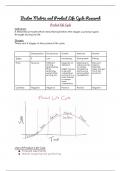
A theoretical model which describes/predicts the stages a product goes
through during its life.
Stages:
There are 5 stages in the product life cycle.
Development Introduction Growth Maturity Decline
Sales 0 Low Increasing Slow growth Falling
Price No price Different Depends on May have to Discount
pricing demand. reduce prices sales to
approaches- to remain maintain
Price Might choose competitive sales and get
skimming, to go with and survive rid of old
penetration competitive among other products
pricing, etc. pricing if in a competitors.
mass market
to remain
more
competitive
Cashflow Negative Negative Positive Positive Negative
Use of Product Life Cyle:
● Forecast sale trends
● Market targeting and positioning
, ● Analyse and manage a product portfolio
● Focus investments in products
Marketing Strategies:
Stage of Life Cycle Marketing Strategy
Development ● Market research to understand customer
needs and preferences
● Creating awareness through promotional
activities
● No pricing method set at this time
Introduction ● A lot of promotion to raise awareness:
advertising
● Limit distributions until customer reactions
gotten and fully understood
● Either price penetration or price skimming
depending on the type of product it is
● Encourage customer adoption
Growth ● Build loyalty
● Increase distribution channels to push the
product out to the market further
● Depending on demand and PED of product
● New features, improved styling
● Create more options(variety)
Maturity ● Might want to emphasise the USP and
differentiation of product/service
● Manage capacity and productions
● Adopt extension strategies
● Intensive distribution
Decline ● Maintain market share of what is left
● Cut prices to remain competitive
● Minimise marketing spend
Examples of products that PLC can be used for
● Smartphones
● Laptops
● Clothes
Below is an example of the product life cycle. The product life cycle of an
apple ipod is shown.
Product Life Cycle
Definition:
A theoretical model which describes/predicts the stages a product goes
through during its life.
Stages:
There are 5 stages in the product life cycle.
Development Introduction Growth Maturity Decline
Sales 0 Low Increasing Slow growth Falling
Price No price Different Depends on May have to Discount
pricing demand. reduce prices sales to
approaches- to remain maintain
Price Might choose competitive sales and get
skimming, to go with and survive rid of old
penetration competitive among other products
pricing, etc. pricing if in a competitors.
mass market
to remain
more
competitive
Cashflow Negative Negative Positive Positive Negative
Use of Product Life Cyle:
● Forecast sale trends
● Market targeting and positioning
, ● Analyse and manage a product portfolio
● Focus investments in products
Marketing Strategies:
Stage of Life Cycle Marketing Strategy
Development ● Market research to understand customer
needs and preferences
● Creating awareness through promotional
activities
● No pricing method set at this time
Introduction ● A lot of promotion to raise awareness:
advertising
● Limit distributions until customer reactions
gotten and fully understood
● Either price penetration or price skimming
depending on the type of product it is
● Encourage customer adoption
Growth ● Build loyalty
● Increase distribution channels to push the
product out to the market further
● Depending on demand and PED of product
● New features, improved styling
● Create more options(variety)
Maturity ● Might want to emphasise the USP and
differentiation of product/service
● Manage capacity and productions
● Adopt extension strategies
● Intensive distribution
Decline ● Maintain market share of what is left
● Cut prices to remain competitive
● Minimise marketing spend
Examples of products that PLC can be used for
● Smartphones
● Laptops
● Clothes
Below is an example of the product life cycle. The product life cycle of an
apple ipod is shown.

