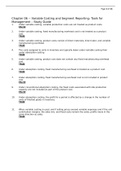
Project Scope Management grade A+
SOLUTIONS
1. Progressive elaboration of product characteristics on your project
must be coordinated carefully with the—
a. Project scope definition
b. Project stakeholders
c. Scope change control system
d. Custom er's strategic plan
a. Project scope definition - It elaborates the characteristics of
the product, service, or result as defined in the charter and
requirements documents. The scope statement describes the project's
scope, major deliverables and constraints which includes both project
and product scope.
2. You are examining multiple scope change requests and are assessing
the impact of these changes. You need to compare the requests to
which project document?
a. Preliminary scope statement
b. WBS
c. Change management plan
d. Scope management plan
b. WBS - Along with approved scope statement, defines the project's
scope baseline which provides the basis for any changes that may
occur on the project.
3. The first step in the Project Scope Management process is to...
a. Clearly distinguish between project scope and product scope
b. Prepare a scope management plan
c. Define and document your stakeholders' needs to meet the project's
objectives
d. Prepare your requirements documentation
b. Prepare a scope management plan - It documents how project scope
will be defined, developed, monitored, controlled and validated.
4. An example of an organizational process asset that could affect
how project scope is to be managed is—
a. Personnel administration
b. Marketplace conditions
c. Historical information
d. Organizational culture
, c. Historical information - Organizational process assets that can
influence Plan Scope Management include formal and informal policies,
procedures, and guidelines.
5. You must ensure that project work results in delivering the
project's scope. You should measure the completion of the product
scope against the...
a. Scope management plan
b. Business requirements
c. Solution requirements
d. Requirements management plan
d. Requirements management plan - Completion of the project scope is
measured against the project management plan. Completion of the
product scope is measured against the requirements.
6. A key tool and technique used in Define Scope is—
a. Templates, forms, and standards
b. Decomposition
c. Multi-criteria decision analysis
d. Project management methodology
c. Multi-criteria decision analysis - Utilizes a decision matrix to
provide a systematic analytical approach to establish criteria, and
it may include requirements, schedule, budget and resources. The
purpose is to help-refine the product and project scope.
7. You are working to define your project's scope, and have a large
team plus interested stakeholders. A tool and technique that may be
helpful is...
a. Sensitivity analysis
b. Decision trees
c. Facilitation
d. Lateral thinking
c. Facilitation - Helps obtain a cross functional and common
understanding between the large number of interested stakeholders who
may have different views on the project deliverables and boundaries.
8. Assume you and your team prepared your project's scope statement,
and it was approved by your sponsor and your governance committee.
However, you also need to update some project documents as an output
of the Define Scope process. One example is—
a. Value engineering
b. Assumptions log
c. WBS Dictionary
d. Change log
b. Assumptions log - Becomes and output after the scope is determined
as all the assumptions and constraints and reviewed and accepted.
9. The document to evaluate whether requests for changes or
additional work are contained within or outside the project's
SOLUTIONS
1. Progressive elaboration of product characteristics on your project
must be coordinated carefully with the—
a. Project scope definition
b. Project stakeholders
c. Scope change control system
d. Custom er's strategic plan
a. Project scope definition - It elaborates the characteristics of
the product, service, or result as defined in the charter and
requirements documents. The scope statement describes the project's
scope, major deliverables and constraints which includes both project
and product scope.
2. You are examining multiple scope change requests and are assessing
the impact of these changes. You need to compare the requests to
which project document?
a. Preliminary scope statement
b. WBS
c. Change management plan
d. Scope management plan
b. WBS - Along with approved scope statement, defines the project's
scope baseline which provides the basis for any changes that may
occur on the project.
3. The first step in the Project Scope Management process is to...
a. Clearly distinguish between project scope and product scope
b. Prepare a scope management plan
c. Define and document your stakeholders' needs to meet the project's
objectives
d. Prepare your requirements documentation
b. Prepare a scope management plan - It documents how project scope
will be defined, developed, monitored, controlled and validated.
4. An example of an organizational process asset that could affect
how project scope is to be managed is—
a. Personnel administration
b. Marketplace conditions
c. Historical information
d. Organizational culture
, c. Historical information - Organizational process assets that can
influence Plan Scope Management include formal and informal policies,
procedures, and guidelines.
5. You must ensure that project work results in delivering the
project's scope. You should measure the completion of the product
scope against the...
a. Scope management plan
b. Business requirements
c. Solution requirements
d. Requirements management plan
d. Requirements management plan - Completion of the project scope is
measured against the project management plan. Completion of the
product scope is measured against the requirements.
6. A key tool and technique used in Define Scope is—
a. Templates, forms, and standards
b. Decomposition
c. Multi-criteria decision analysis
d. Project management methodology
c. Multi-criteria decision analysis - Utilizes a decision matrix to
provide a systematic analytical approach to establish criteria, and
it may include requirements, schedule, budget and resources. The
purpose is to help-refine the product and project scope.
7. You are working to define your project's scope, and have a large
team plus interested stakeholders. A tool and technique that may be
helpful is...
a. Sensitivity analysis
b. Decision trees
c. Facilitation
d. Lateral thinking
c. Facilitation - Helps obtain a cross functional and common
understanding between the large number of interested stakeholders who
may have different views on the project deliverables and boundaries.
8. Assume you and your team prepared your project's scope statement,
and it was approved by your sponsor and your governance committee.
However, you also need to update some project documents as an output
of the Define Scope process. One example is—
a. Value engineering
b. Assumptions log
c. WBS Dictionary
d. Change log
b. Assumptions log - Becomes and output after the scope is determined
as all the assumptions and constraints and reviewed and accepted.
9. The document to evaluate whether requests for changes or
additional work are contained within or outside the project's