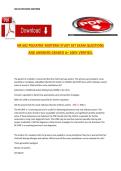
Test Bank - Medical-Surgical Nursing exam with 300 verified questions and answers
Test Bank - Medical-Surgical Nursing exam with 300 verified questions and answers A nurse is examining a client reporting right upper quadrant (RUQ) abdominal pain. What technique should the nurse use to assess this clients abdomen? a. Auscultate after palpating. b. Avoid any palpation. c. Palpate the RUQ first. d. Palpate the RUQ last. - D A client presents to the emergency department reporting severe abdominal pain. On assessment, the nurse finds a bulging, pulsating mass in the abdomen. What action by the nurse is the priority? a. Auscultate for bowel sounds. b. Notify the provider immediately. c. Order an abdominal flat-plate x-ray. d. Palpate the mass and measure its size - B A client presents to the family practice clinic reporting a week of watery, somewhat bloody diarrhea. The nurse assists the client to obtain a stool sample. What action by the nurse is most important? a. Ask the client about recent exposure to illness. b. Assess the clients stool for obvious food particles. c. Include the date and time on the specimen container. d. Put on gloves prior to collecting the sample. - D A client who has been taking antibiotics reports severe, watery diarrhea. About which test does the nurse teach the client? a. Colonoscopy b. Enzyme-linked immunosorbent assay (ELISA) toxin A+B c. Ova and parasites d. Stool culture - The nurse knows that a client with prolonged prothrombin time (PT) values (not related to medication) probably has dysfunction in which organ? a. Kidneys b. Liver c. Spleen d. Stomach - b A client is recovering from an esophagogastroduodenoscopy (EGD) and requests something to drink. What action by the nurse is best? a. Allow the client cool liquids only. b. Assess the clients gag reflex. c. Remind the client to remain NPO. d. Tell the client to wait 4 hours. - b The nurse is aware of the 2014 American Cancer Society Screening Guidelines for colon cancer, which include which testing modalities for people over the age of 50? (Select all that apply.) a. Colonoscopy every 10 years b. Colonoscopy every 5 years c. Computed tomography (CT) colonography every 5 years d. Double-contrast barium enema every 10 years e. Flexible sigmoidoscopy every 10 years - a,c A client had an endoscopic retrograde cholangiopancreatography (ERCP). The nurse instructs the client and family about the signs of potential complications, which include what problems? (Select all that apply.) a. Cholangitis b. Pancreatitis c. Perforation d. Renal lithiasis e. Sepsis - a,b,c,e The nurse working with older clients understands age-related changes in the gastrointestinal system. Which changes does this include? (Select all that apply.) a. Decreased hydrochloric acid production b. Diminished sensation that can lead to constipation c. Fat not digested as well in older adults d. Increased peristalsis in the large intestine e. Pancreatic vessels become calcified - a,b,c,e The nurse working in the gastrointestinal clinic sees clients who are anemic. What are common causes for which the nurse assesses in these clients? (Select all that apply.) a. Colon cancer b. Diverticulitis c. Inflammatory bowel disease d. Peptic ulcer disease e. Pernicious anemia - a,b,c,d The nurse working with clients who have gastrointestinal problems knows that which laboratory values are related to what organ dysfunctions? (Select all that apply.) a. Alanine aminotransferase: biliary system b. Ammonia: liver
Escuela, estudio y materia
- Institución
- Medical-Surgical Nursing 2019
- Grado
- Medical-Surgical Nursing 2019
Información del documento
- Subido en
- 20 de junio de 2024
- Número de páginas
- 37
- Escrito en
- 2023/2024
- Tipo
- Examen
- Contiene
- Preguntas y respuestas
Temas
-
test bank medical surgical nursing exam with 300
-
test bank medical surgical nursing exam with
-
test bank medical surgical nursing exam with 300
-
test bank medical surgical nursing exam with 300