Test Bank for Burns and Groves The
Practice of Nursing Research 9th Edition by
Gray. Verified Chapter's 1 - 29
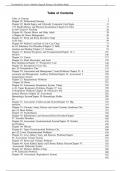
TABLE OF CONTENTS
Unit One: Introduction to Nursing Research
1. Discovering the World of Nursing Research
2. Evolution of Research in Building Evidence-Based Nursing Practice
3. Introduction to Quantitative Research
4. Introduction to Qualitative Research
Unit Two: The Research Process
5. Research Problem and Purpose
6. Objectives, Questions, Variables, and Hypotheses
7. Review of Relevant Literature
8. Frameworks
9. Ethics in Research
10. Quantitative Methodology: Noninterventional Designs and Methods
11. Quantitative Methodology: Interventional Designs and Methods
12. Qualitative Research Methods
13. Outcomes Research
14. Mixed Methods Research
15. Sampling
16. Measurement Concepts
17. Measurement Methods Used in Developing Evidence-Based Practice
Unit Three: Putting It All Together for Evidence-Based Health Care
18. Critical Appraisal of Nursing Studies
19. Evidence Synthesis and Strategies for Implementing Evidence-Based Practice
Unit Four: Analyzing Data, Determining Outcomes, and Disseminating Research
20. Collecting and Managing Data
21. Introduction to Statistical Analysis
22. Using Statistics to Describe Variables
23. Using Statistics to Examine Relationships
24. Using Statistics to Predict
25 Using Statistics to Determine Differences
26. Interpreting Research Outcomes
27. Disseminating Research Findings
Unit Five: Proposing and Seeking Funding for Research
28. Writing Research Proposals
29. Seeking Funding for Research
,Chapter 1: Discovering the World of Nursing Research Test
Bank
MULTIPLE
CHOICE
• Nurses with a bachelor’s degree in nursing can participate in the
implementation of evidence- based protocols in practice. This means that the BSN nurse
• Develops evidence-based guidelines
• Designs research studies, on which protocols may be based
• Evaluates and revises evidence-based protocols
• Contributes practice wisdom when applying protocols in patient settings
• Mentors PhD researchers in the clinical setting during protocol
development
ANSWER: D
Nurses with a BSN degree have knowledge of the research process and skills in reading and
critically appraising studies. They assist with the implementation of evidence-based
guidelines, protocols, algorithms, and policies in practice. This implies that nurses provide
their point of view, from the clinician’s vantage, when new protocols are being put into
practice, and continue to provide feedback, regarding the positive and negative aspects of
those protocols.
DIF: Cognitive Level: Analysis REF: Page 4
• Research is designed to test the idea of providing companion dogs to elders in a
major hospital, in order to determine the effect upon the elders’ level of orientation. (The
dogs’ level of orientation will not be a focus of the research.) This type of study can do which
of the following?
• Control
• Describe
• Explain
• Predict
ANSWER: A
Control is the ability to manipulate the situation to produce the desired outcome. Description
involves identifying and understanding the nature of nursing phenomena and, sometimes, the
relationships among them. Explanation clarifies the relationships among phenomena and
identifies the reasons why certain events occur. The ability to estimate the probability of a
specific outcome in a given situation in nursing practice is known as prediction. The
researcher’s focus is on predicting what is likely.
DIF: Cognitive Level: Application REF: Page 13
• A researcher wants to find out whether children with autism who are
hospitalized on a pediatric ward will require more hours of nursing care than average children
when the parents or caregivers are not present. What type of research outcome does this
provide?
• Control
• Description
• Explantation
• Prediction
ANSWER: D
,Control is the ability to manipulate the situation to produce the desired outcome. Description
involves identifying and understanding the nature of nursing phenomena and, sometimes, the
relationships among them. Explanation clarifies the relationships among phenomena and
identifies the reasons why certain events occur. The ability to estimate the probability of a
specific outcome in a given situation in nursing practice is known as prediction. The
researcher’s focus is on predicting what is likely.
DIF: Cognitive Level: Application REF: Page 16
• A researcher who desires to determine the cause-and-effect relationship
between requiring that all children under the age of 8 will ride in special care harnesses and
the subsequent rate of children’s spinal cord injury will consequently utilize which form of
nursing research?
• Descriptive research
• Outcomes research
• Qualitative research
• Quantitative research
ANSWER: D
Quantitative research, the most frequently used method, is a formal, objective, systematic
methodology to describe variables, test relationships, and examine cause-and-effect
interactions. Quantitative research includes experimental research, which is the method for
testing cause-and-effect relationships between and among specific variables. Qualitative
research methods are used for explaining meanings and describing experiences in context.
Descriptive research involves identifying and understanding the nature of phenomena and,
sometimes, the relationships among them. Outcomes research examines the end result of care
in huge populations, most often retrospectively, using a database.
DIF: Cognitive Level: Application REF: Page 3
• Despite the presence of an intraventricular drain, the intracranial pressure of an
ICU neuro patient remains increased. The nurse recalibrates the machine, makes sure the
monitor is on the same level as the drain, checks all connections, and then notifies the
physician, who comes to the unit and inserts a new drain. What type of reasoning prompts the
nurse to recalibrate, ensure proper placement, and check connections?
• Abstract reasoning
• Concrete thinking
• Logistic reasoning
• Reality testing
ANSWER: C
Logistic reasoning is used to break a whole into parts that can be carefully examined.
Concrete thinking is oriented toward and limited by tangible things or by events that are
observed and experienced in reality. Abstract reasoning is oriented toward the development of
an idea without application to, or association with, a particular instance. Reality testing is used
to validate what is observed in the empirical world.
DIF: Cognitive Level: Application REF: Page 6
• A nurse with considerable clinical expertise develops a policy for managing
agitated patients in the emergency department. The resultant policy emanates from
• Abstract reasoning
• Concrete thinking
• Logistic reasoning
, • Reality testing
ANSWER: A
Abstract reasoning is oriented toward the development of an idea without application to, or
association with, a particular instance. Concrete thinking is oriented toward and limited by
tangible things or by events that are observed and experienced in reality. Logistic reasoning is
used to break a whole into parts that can be carefully examined. Reality testing is used to
validate what is observed in the empirical world.
DIF: Cognitive Level: Application REF: Page 7
• A nurse with considerable clinical expertise develops a policy for managing
agitated patients in the emergency department. The type of reasoning the nurse uses to do
this is reasoning.
• Problematic
• Operational
• Logistic
• Inductive
ANSWER: D
Inductive reasoning involves reasoning that moves from the specific to the general, whereby
particular instances are observed and then combined into a larger whole or general statement.
Problematic reasoning involves (1) identifying a problem and factors influencing it, (2)
selecting solutions to the problem, and (3) resolving the problem. Operational reasoning
involves the identification of and discrimination among many alternatives and viewpoints.
Logistic reasoning is used to break the whole into parts that can be carefully examined, as the
relationships among the parts can also be.
DIF: Cognitive Level: Synthesis REF: Page 7
• What is the best explanation of intuition that forms a legitimate source of
knowledge in nursing?
• It is based on knowledge thoroughly incorporated into
thought but seldom articulated.
• It is based on a gift from the universe and should be honored when it
arrives.
• It is never inaccurate.
• It is a revisiting of old knowledge, accompanied by deep reflection.
ANSWER: A
Intuition is the revisiting of old knowledge accompanied by deep reflection.
DIF: Cognitive Level: Application REF: Page 5
• Why is operational reasoning necessary for research?
• Abstract concepts are of no use to nursing.
• Standard interventions are obtained from operational reasoning.
• It allows the researcher to measure the concepts studied.
• It facilitates the researcher’s rapport with families.
ANSWER: C
Operational reasoning involves the identification of and discrimination among many
alternatives and viewpoints. It focuses on the process (debating alternatives) rather than on the
resolution. Nurses use operational reasoning to develop realistic, measurable health goals.
Thus, operational reasoning takes abstract concepts and makes them focused, concrete, and,
therefore, researchable.
Practice of Nursing Research 9th Edition by
Gray. Verified Chapter's 1 - 29
TABLE OF CONTENTS
Unit One: Introduction to Nursing Research
1. Discovering the World of Nursing Research
2. Evolution of Research in Building Evidence-Based Nursing Practice
3. Introduction to Quantitative Research
4. Introduction to Qualitative Research
Unit Two: The Research Process
5. Research Problem and Purpose
6. Objectives, Questions, Variables, and Hypotheses
7. Review of Relevant Literature
8. Frameworks
9. Ethics in Research
10. Quantitative Methodology: Noninterventional Designs and Methods
11. Quantitative Methodology: Interventional Designs and Methods
12. Qualitative Research Methods
13. Outcomes Research
14. Mixed Methods Research
15. Sampling
16. Measurement Concepts
17. Measurement Methods Used in Developing Evidence-Based Practice
Unit Three: Putting It All Together for Evidence-Based Health Care
18. Critical Appraisal of Nursing Studies
19. Evidence Synthesis and Strategies for Implementing Evidence-Based Practice
Unit Four: Analyzing Data, Determining Outcomes, and Disseminating Research
20. Collecting and Managing Data
21. Introduction to Statistical Analysis
22. Using Statistics to Describe Variables
23. Using Statistics to Examine Relationships
24. Using Statistics to Predict
25 Using Statistics to Determine Differences
26. Interpreting Research Outcomes
27. Disseminating Research Findings
Unit Five: Proposing and Seeking Funding for Research
28. Writing Research Proposals
29. Seeking Funding for Research
,Chapter 1: Discovering the World of Nursing Research Test
Bank
MULTIPLE
CHOICE
• Nurses with a bachelor’s degree in nursing can participate in the
implementation of evidence- based protocols in practice. This means that the BSN nurse
• Develops evidence-based guidelines
• Designs research studies, on which protocols may be based
• Evaluates and revises evidence-based protocols
• Contributes practice wisdom when applying protocols in patient settings
• Mentors PhD researchers in the clinical setting during protocol
development
ANSWER: D
Nurses with a BSN degree have knowledge of the research process and skills in reading and
critically appraising studies. They assist with the implementation of evidence-based
guidelines, protocols, algorithms, and policies in practice. This implies that nurses provide
their point of view, from the clinician’s vantage, when new protocols are being put into
practice, and continue to provide feedback, regarding the positive and negative aspects of
those protocols.
DIF: Cognitive Level: Analysis REF: Page 4
• Research is designed to test the idea of providing companion dogs to elders in a
major hospital, in order to determine the effect upon the elders’ level of orientation. (The
dogs’ level of orientation will not be a focus of the research.) This type of study can do which
of the following?
• Control
• Describe
• Explain
• Predict
ANSWER: A
Control is the ability to manipulate the situation to produce the desired outcome. Description
involves identifying and understanding the nature of nursing phenomena and, sometimes, the
relationships among them. Explanation clarifies the relationships among phenomena and
identifies the reasons why certain events occur. The ability to estimate the probability of a
specific outcome in a given situation in nursing practice is known as prediction. The
researcher’s focus is on predicting what is likely.
DIF: Cognitive Level: Application REF: Page 13
• A researcher wants to find out whether children with autism who are
hospitalized on a pediatric ward will require more hours of nursing care than average children
when the parents or caregivers are not present. What type of research outcome does this
provide?
• Control
• Description
• Explantation
• Prediction
ANSWER: D
,Control is the ability to manipulate the situation to produce the desired outcome. Description
involves identifying and understanding the nature of nursing phenomena and, sometimes, the
relationships among them. Explanation clarifies the relationships among phenomena and
identifies the reasons why certain events occur. The ability to estimate the probability of a
specific outcome in a given situation in nursing practice is known as prediction. The
researcher’s focus is on predicting what is likely.
DIF: Cognitive Level: Application REF: Page 16
• A researcher who desires to determine the cause-and-effect relationship
between requiring that all children under the age of 8 will ride in special care harnesses and
the subsequent rate of children’s spinal cord injury will consequently utilize which form of
nursing research?
• Descriptive research
• Outcomes research
• Qualitative research
• Quantitative research
ANSWER: D
Quantitative research, the most frequently used method, is a formal, objective, systematic
methodology to describe variables, test relationships, and examine cause-and-effect
interactions. Quantitative research includes experimental research, which is the method for
testing cause-and-effect relationships between and among specific variables. Qualitative
research methods are used for explaining meanings and describing experiences in context.
Descriptive research involves identifying and understanding the nature of phenomena and,
sometimes, the relationships among them. Outcomes research examines the end result of care
in huge populations, most often retrospectively, using a database.
DIF: Cognitive Level: Application REF: Page 3
• Despite the presence of an intraventricular drain, the intracranial pressure of an
ICU neuro patient remains increased. The nurse recalibrates the machine, makes sure the
monitor is on the same level as the drain, checks all connections, and then notifies the
physician, who comes to the unit and inserts a new drain. What type of reasoning prompts the
nurse to recalibrate, ensure proper placement, and check connections?
• Abstract reasoning
• Concrete thinking
• Logistic reasoning
• Reality testing
ANSWER: C
Logistic reasoning is used to break a whole into parts that can be carefully examined.
Concrete thinking is oriented toward and limited by tangible things or by events that are
observed and experienced in reality. Abstract reasoning is oriented toward the development of
an idea without application to, or association with, a particular instance. Reality testing is used
to validate what is observed in the empirical world.
DIF: Cognitive Level: Application REF: Page 6
• A nurse with considerable clinical expertise develops a policy for managing
agitated patients in the emergency department. The resultant policy emanates from
• Abstract reasoning
• Concrete thinking
• Logistic reasoning
, • Reality testing
ANSWER: A
Abstract reasoning is oriented toward the development of an idea without application to, or
association with, a particular instance. Concrete thinking is oriented toward and limited by
tangible things or by events that are observed and experienced in reality. Logistic reasoning is
used to break a whole into parts that can be carefully examined. Reality testing is used to
validate what is observed in the empirical world.
DIF: Cognitive Level: Application REF: Page 7
• A nurse with considerable clinical expertise develops a policy for managing
agitated patients in the emergency department. The type of reasoning the nurse uses to do
this is reasoning.
• Problematic
• Operational
• Logistic
• Inductive
ANSWER: D
Inductive reasoning involves reasoning that moves from the specific to the general, whereby
particular instances are observed and then combined into a larger whole or general statement.
Problematic reasoning involves (1) identifying a problem and factors influencing it, (2)
selecting solutions to the problem, and (3) resolving the problem. Operational reasoning
involves the identification of and discrimination among many alternatives and viewpoints.
Logistic reasoning is used to break the whole into parts that can be carefully examined, as the
relationships among the parts can also be.
DIF: Cognitive Level: Synthesis REF: Page 7
• What is the best explanation of intuition that forms a legitimate source of
knowledge in nursing?
• It is based on knowledge thoroughly incorporated into
thought but seldom articulated.
• It is based on a gift from the universe and should be honored when it
arrives.
• It is never inaccurate.
• It is a revisiting of old knowledge, accompanied by deep reflection.
ANSWER: A
Intuition is the revisiting of old knowledge accompanied by deep reflection.
DIF: Cognitive Level: Application REF: Page 5
• Why is operational reasoning necessary for research?
• Abstract concepts are of no use to nursing.
• Standard interventions are obtained from operational reasoning.
• It allows the researcher to measure the concepts studied.
• It facilitates the researcher’s rapport with families.
ANSWER: C
Operational reasoning involves the identification of and discrimination among many
alternatives and viewpoints. It focuses on the process (debating alternatives) rather than on the
resolution. Nurses use operational reasoning to develop realistic, measurable health goals.
Thus, operational reasoning takes abstract concepts and makes them focused, concrete, and,
therefore, researchable.