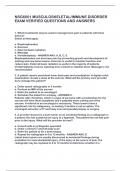
NSG6001 MUSCULOSKELETAL/IMMUNE DISORDER EXAM VERIFIED QUESTIONS AND ANSWERS
NSG6001 MUSCULOSKELETAL/IMMUNE DISORDER EXAM VERIFIED QUESTIONS AND ANSWERS 1. Which treatments may be used to manage bone pain in patients with bone tumors? Select all that apply. a. Bisphosphonates b. Exercise c. External beam radiation d. Massage e. Vertebralplasty - ANSWER-ANS: A, B, C, E Bisphosphonates can decrease pain by preventing growth and development of existing and new bone lesions. Exercise is useful to maintain function and reduce pain. External beam radiation is useful in the majority of patients. Vertebralplasty involves injecting bone cement to stabilize bone. Massage is not recommended. 2. A patient reports persistent lower back pain and constipation. A digital rectal examination reveals a mass at the sacrum. What will the primary care provider do to manage this patient? a. Order spinal radiographs in 3 months b. Perform an MRI of the sacrum c. Refer the patient to an oncologist d. Schedule the patient for a biopsy - ANSWER-C. Patients with chordoma, which is a type of sarcoma with a predilection for the sacrum will have these symptoms and a palpable mass coming out of the sacrum. A referral to an oncologist is necessary. These tumors have a significant risk for malignancy, so waiting 3 months is not an option. The oncologist will order a CT and body scan and possibly biopsy or surgery 3. A provider discovers a bone tumor as an incidental finding on a radiograph in a patient who has sustained an injury to a ligament. The patient has not had pain prior to the injury. What will the provider do next? a. Consult with an orthopedic specialist b. Order a chest CT and full body scan c. Refer the patient to for a bone biopsy d. Repeat the radiograph in 6 to 12 months - ANSWER-ANS: D Latent bone tumors are usually discovered as incidental findings during evaluation for musculoskeletal injury. If the injury is the source of pain, the radiograph may be repeated in 6 to 12 months to determine whether it is increasing in size. Consultation with an orthopedic specialist, referral for a biopsy, and further testing with chest CT or full body scanning are done if there is suspicion of an active tumor 4. A patient with shoulder pain is seen by an orthopedic specialist who notes erythema, warmth, and fluctuance of the shoulder joint. What is the next step in treatment for this patient? a. Admit to the hospital for intravenous antibiotics b. Inject lidocaine into the joint and reassess in 5 to 10 minutes c. Order a plain radiograph of the shoulder to identify possible fracture d. Perform a shoulder ultrasound to further evaluate the cause - ANSWER-ANS: A Immediate referral is indicated for patients who present with symptoms consistent with septic bursitis, such as with the symptoms above. Lidocaine is injected into a painful joint to evaluate for improvement to determine whether bursitis or tendonitis is present as a result of impingement. This exam is not consistent with fracture. An ultrasound is not indicated.REF: Shoulder Bursitis/Management 5. A patient has pain on the plantar aspect of the heel with weight bearing after rest. The pain is worsened with dorsiflexion of the foot. What is the initial treatment for this patient? a. A series of steroid injections b. Avoiding all high-impact activities c. Night splints d. Wearing flat shoes only - ANSWER-ANS: B This patient has signs of plantar fasciitis. The initial treatment includes avoiding all high-impact activities. A single steroid injection may be given with subsequent injections if no improvement. Night splints are part of second-tier treatment. Flat shoes should be avoided.REF: Plantar Fasciitis/Management
Escuela, estudio y materia
- Institución
- NSG6001
- Grado
- NSG6001
Información del documento
- Subido en
- 17 de junio de 2024
- Número de páginas
- 14
- Escrito en
- 2023/2024
- Tipo
- Examen
- Contiene
- Preguntas y respuestas
Temas
-
nsg6001 musculoskeletal
-
nsg6001
-
nsg6001 musculoskeletalimmune disorder exam veri
-
nsg6001 musculoskeletalimmune disorder
-
nsg6001 musculoskeletalimmune disorder exam

Documento también disponible en un lote