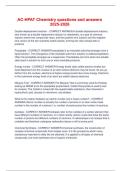
ECPI NUR 138 Pharmacology Exam 1 Questions and Answers Already Passed A 49 -year-old patient is in the clinic for a follow -up visit 6 months after starting a beta blocker for treatment of hypertension. During this visit, his blood pressure is 1 69/98 mm Hg, and he eventually confesses that he stopped taking this medicine 2 months ago because of an "embarrassing problem." What problem did the patient most likely experience with this medication that caused him to stop taking it? A. Excessive flat us B. Impotence C. Urge incontinence D. Dizziness when standing up ✔✔B. Impotence Rationale: Impotence is a potential adverse effect of beta blockers and may cause patients to stop taking the medication. The other options are not adverse effects of beta blockers. A cholinergic drug is prescribed for a patient with a new diagnosis of my asthenia gravis, and the nurse provides instructions to the patient about the medication. What is important to include in the teaching? A. Take the medication only if difficulty swallowing occurs during a meal. B. Give daytime doses close together for ma ximal therapeutic effect. C. Take the medication 30 minutes before eating to improve swallowing and chewing. D. Take the medication with meals to avoid gastrointestinal distress. ✔✔C. Take the medication 30 minutes before eating to improve swallowing and c hewing. Rationale: Taking the medication 30 minutes before meals allows time for the onset of action and therapeutic effects during the meal. The doses should be spaced evenly apart to optimize the effects of the medication. The other options are incorrec t. A cholinergic drug is prescribed for a patient. The nurse checks the patient's medical history, knowing that this drug is contraindicated in which disorders? (Select all that apply.) A. Alzheimer's disease B. Gastrointestinal obstruction C. Chronic obstructive pulmonary disease D. Bladder atony E. Hypotension F. Bradycardia ✔✔B. Gastrointestinal obstruction C. Chronic obstructive pulmonary disease E. Hypotension F. Bradycardia A patient arrives at the urgent care center complaining of leg pain after a fall when rock climbing. The x -rays show no broken bones, but he has a large bruise on his thigh. The patient says he drives a truck and does not want to take anything strong because he needs to stay awake. Which statement by the nurse is most appropria te? A. "It would be best for you not to take anything if you are planning to drive your truck." B. "You can take acetaminophen, also known as Tylenol, for pain, but no more than 3000 mg per day." C. "You can take acetaminophen, also known as Tylenol, for pain, but no more than 1000 mg per day." D. "We will discuss with your doctor about taking an opioid because that would work best for your pain." ✔✔B. "You can take acetaminophen, also known as Tylenol, for pain, but no more than 3000 mg per day." Rationale: Acetaminophen is indicated for mild -to-moderate pain and does not cause drowsiness, as an opioid would. Currently, the maximum daily amount of acetaminophen is 3000 mg/day. The 1000 -mg amount per day is too low. Telling the patient not to take a ny pain medications is incorrect. A patient has a new prescription for tamsulosin (Flomax) as treatment for benign prostatic hyperplasia. The nurse is checking his current medication list and will contact the prescriber regarding a potential interaction i f the patient is also taking which drug? A. Levothyroxine (Synthroid) for hypothyroidism B. Low -dose aspirin for stroke prevention C. Sildenafil (Viagra), an erectile dysfunction medication D. Omeprazole (Prilosec), a proton pump inhibitor ✔✔C. Sildenafi l (Viagra), an erectile dysfunction medication Rationale: Drugs that interact with alpha blockers such as tamsulosin include erectile dysfunction drugs: additive hypotensive effects may occur. The other drugs do not interact with tamsulosin. A patient ha s a new prescription for the transdermal form of scopolamine. The nurse knows that this form of scopolamine is used for which condition?
Examen
ECPI NUR 138 Pharmacology Exam 1 Questions and Answers Already Passed
ECPI NUR 138 Pharmacology Exam 1 Questions and Answers Already Passed A 49-year-old patient is in the clinic for a follow-up visit 6 months after starting a beta blocker for treatment of hypertension. During this visit, his blood pressure is 169/98 mm Hg, and he eventually confesses that he stopped taking this medicine 2 months ago because of an "embarrassing problem." What problem did the patient most likely experience with this medication that caused him to stop taking it? A. Excessive flatus B. Impotence C. Urge incontinence D. Dizziness when standing up B. Impotence Rationale: Impotence is a potential adverse effect of beta blockers and may cause patients to stop taking the medication. The other options are not adverse effects of beta blockers. A cholinergic drug is prescribed for a patient with a new diagnosis of myasthenia gravis, and the nurse provides instructions to the patient about the medication. What is important to include in the teaching? A. Take the medication only if difficulty swallowing occurs during a meal. B. Give daytime doses close together for maximal therapeutic effect. C. Take the medication 30 minutes before eating to improve swallowing and chewing. D. Take the medication with meals to avoid gastrointestinal distress. C. Take the medication 30 minutes before eating to improve swallowing and chewing. Rationale: Taking the medication 30 minutes before meals allows time for the onset of action and therapeutic effects during the meal. The doses should be spaced evenly apart to optimize the effects of the medication. The other options are incorrect. A cholinergic drug is prescribed for a patient. The nurse checks the patient's medical history, knowing that this drug is contraindicated in which disorders? (Select all that apply.) A. Alzheimer's disease B. Gastrointestinal obstruction C. Chronic obstructive pulmonary disease D. Bladder atony E. Hypotension F. Bradycardia B. Gastrointestinal obstruction C. Chronic obstructive pulmonary disease E. Hypotension F. Bradycardia A patient arrives at the urgent care center complaining of leg pain after a fall when rock climbing. The x-rays show no broken bones, but he has a large bruise on his thigh. The patient says he drives a truck and does not want to take anything strong because he needs to stay awake. Which statement by the nurse is most appropriate? A. "It would be best for you not to take anything if you are planning to drive your truck." B. "You can take acetaminophen, also known as Tylenol, for pain, but no more than 3000 mg per day." C. "You can take acetaminophen, also known as Tylenol, for pain, but no more than 1000 mg per day." D. "We will discuss with your doctor about taking an opioid because that would work best for your pain." B. "You can take acetaminophen, also known as Tylenol, for pain, but no more than 3000 mg per day." Rationale: Acetaminophen is indicated for mild-to-moderate pain and does not cause drowsiness, as an opioid would. Currently, the maximum daily amount of acetaminophen is 3000 mg/day. The 1000-mg amount per day is too low. Telling the patient not to take any pain medications is incorrect. A patient has a new prescription for tamsulosin (Flomax) as treatment for benign prostatic hyperplasia. The nurse is checking his current medication list and will contact the prescriber regarding a potential interaction if the patient is also taking
Mostrar más
Leer menos
Institución
ECPI NUR 138 Pharmacology
Grado
ECPI NUR 138 Pharmacology
Ups! No podemos cargar tu documento ahora. Inténtalo de nuevo o contacta con soporte.
Escuela, estudio y materia
- Institución
- ECPI NUR 138 Pharmacology
- Grado
- ECPI NUR 138 Pharmacology
Información del documento
- Subido en
- 13 de junio de 2024
- Número de páginas
- 35
- Escrito en
- 2023/2024
- Tipo
- Examen
- Contiene
- Preguntas y respuestas
Temas
-
ecpi nur 138 pharmacology exam 1 questions and ans
Vista previa del contenido
$11.49
Accede al documento completo:
100% de satisfacción garantizada
Inmediatamente disponible después del pago
Tanto en línea como en PDF
No estas atado a nada

Documento también disponible en un lote
Package deal
NUR 138 Bundled Exams Questions and Answers Latest Versions (2024/2025) (Complete and Accurate)
11
2024
$ 117.39
Más información