Summary #4 two is better than one
Definitions
Group
= 2+ people in face-to-face interaction, all aware of their group membership &
interdependence as they strive to achieve their goals.
- Identifiable unit
- Relate to one another in a meaningful way
- Share dispositions collective identity
Aggregate
= a collection of unrelated people who are in close proximity in an unmeaningful way & for
only a short period of time
Group dynamics
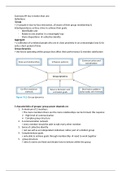
= the forces operating within groups that affect their performance & member satisfaction
5 characteristics of groups/ group power depends on:
1. A minimum of 2 members
= The more members there are the more relationships can be formed; this requires:
High level of communication
Complex group structure
2. A communication network
= every member should be able to talk every other member
3. Sense of collective identity
= not see self as an independent individual, rather part of a distinct group
4. Complementary goals
= only able to achieve goals through membership need to work together
5. group structure
= roles & norms are fixed and dictate how to behave within the group
, Benefits of working in a group:
Tasks can be fulfilled cost-effectively
Effective learning within the organization
Promote improved quality management
Promote process re-engineering
Reduce production time
Cross-fertilization of ideas innovation
Groups can better be monitored, coordinated, directed
Groups can better cope with increasing complexity
Types of group tasks:
1. Additive
= all group members perform the same task & the sum of all inputs is the final
outcome, this means there is low interdependency.
e.g.; giving a car a push start
2. Conjunctive
= the final outcome of the task is dependent of the performance of the least talented
member. In this sort of task there is high interdependency. All elements are equally
important to success.
e.g.; relay races
3. Disjunctive
= the final outcome of the task is dependent of the most talented member in the
group. Average performance is higher than the groups average member. There is
high interdependency. In disjunctive tasks groups tend to outperform aggregates.
- specific subgroup: Eureka task
only one correct solution, members have immediate insight/knowledge about the correct
answer. Performance is dependent on the most talented member.
Group development
1. Forming
= orientation stage;
Gather information about team members
Establish ground rules
Make a personal impression on group members
2. Storming
= conflict stage
Hostility; struggle for leadership
Need to resolve conflict
3. Norming
= rules are established; leadership is accepted,
4. Performing
= effective group structure has been established
Not all groups are able to reach this stage & remain ineffective
5. Adjourning
= aftermath of group formation ( after task has been completed)
Reflection
Definitions
Group
= 2+ people in face-to-face interaction, all aware of their group membership &
interdependence as they strive to achieve their goals.
- Identifiable unit
- Relate to one another in a meaningful way
- Share dispositions collective identity
Aggregate
= a collection of unrelated people who are in close proximity in an unmeaningful way & for
only a short period of time
Group dynamics
= the forces operating within groups that affect their performance & member satisfaction
5 characteristics of groups/ group power depends on:
1. A minimum of 2 members
= The more members there are the more relationships can be formed; this requires:
High level of communication
Complex group structure
2. A communication network
= every member should be able to talk every other member
3. Sense of collective identity
= not see self as an independent individual, rather part of a distinct group
4. Complementary goals
= only able to achieve goals through membership need to work together
5. group structure
= roles & norms are fixed and dictate how to behave within the group
, Benefits of working in a group:
Tasks can be fulfilled cost-effectively
Effective learning within the organization
Promote improved quality management
Promote process re-engineering
Reduce production time
Cross-fertilization of ideas innovation
Groups can better be monitored, coordinated, directed
Groups can better cope with increasing complexity
Types of group tasks:
1. Additive
= all group members perform the same task & the sum of all inputs is the final
outcome, this means there is low interdependency.
e.g.; giving a car a push start
2. Conjunctive
= the final outcome of the task is dependent of the performance of the least talented
member. In this sort of task there is high interdependency. All elements are equally
important to success.
e.g.; relay races
3. Disjunctive
= the final outcome of the task is dependent of the most talented member in the
group. Average performance is higher than the groups average member. There is
high interdependency. In disjunctive tasks groups tend to outperform aggregates.
- specific subgroup: Eureka task
only one correct solution, members have immediate insight/knowledge about the correct
answer. Performance is dependent on the most talented member.
Group development
1. Forming
= orientation stage;
Gather information about team members
Establish ground rules
Make a personal impression on group members
2. Storming
= conflict stage
Hostility; struggle for leadership
Need to resolve conflict
3. Norming
= rules are established; leadership is accepted,
4. Performing
= effective group structure has been established
Not all groups are able to reach this stage & remain ineffective
5. Adjourning
= aftermath of group formation ( after task has been completed)
Reflection