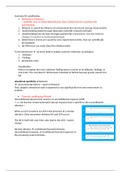
Summary #2 conditioning
Behaviorism (Watson)
= scientific view on observable behavior that is believed to be caused by the
environment.
1. Behavior is caused by influence of environmentno structural concept of personality
2. Understanding people through laboratory/scientific research (animals)
3. Understanding how we learn through machine-like mechanisms, how the behavior
changes in reaction to environmental input.
4. Determinism: Events are caused by prior experiences/events, that can scientifically
be explained.
5. No inferences are made about the UNobservable
To the behaviorist no more need to explain a person’s behavior according to
1. Attitudes
2. Feelings
3. personality traits
Visualization:
there is to explain the rock’s behavior (falling down) in terms of its attitudes, feelings, or
rock traits. The rock doesn’t fall because it decided to fall but because gravity caused it to
fall.
situational specificity of behavior
environmental factors = cause of behavior
Thus, people’s behavioral style is expected to vary significantly from one environment to
another.
Classical conditioning (Pavlov)
Unconditioned stimuli (UCS) result in an unconditioned response (UCR)
<= a, not learned, innate/automatic/natural response that is specific to the unconditioned
stimulus >
When an UCS is leads to an UCR in the presence of a neutral
stimulus. Close association between NS and UCR occurs.
The NS in itself will, over time, also lead to the UCR > names
change
Neutral stimulus conditioned (learned) stimulus
Unconditioned response Conditioned (learned response) to
the previously neutral stimulus
, Higher-order conditioning/
secondary-order conditioning
When a conditioned stimulus is
combined with a neutral stimulus.
The Neutral stimulus
Conditioned response
(EVEN, without association with
the UCS and UCR)
Generalization
= Spread of conditioned response to neutral stimuli that are similar to the conditioned
stimulus.
The more similarity between conditioned stimulus and neutral stimulus, the more
similarity in response.
Example little albert experiment*
Discrimination
= Distinguishing between different stimuli and reacting differently to them.
Extinction
= When a conditioned stimulus no longer leads to the conditioned response. Because the
conditioned stimulus is not/less frequently combined with the unconditioned stimulus.
The conditioned response to the conditioned stimulus will happen rarely, but will not
disappear.
Proven by: spontaneous recovery = revival of a conditioned response over time.
Experiment: conditioned emotional reactions (Watson, Rayner)*
Goal is to answer the following questions:
1. Can emotion be conditioned?
Baseline = no fear of rat
Touching a rat + loud noise
After loud noise conditioned fear
A week later hesitant/withdrawing/uncomfortable with rat
Conclusion = fear (emotion) can be conditioned
2. Can emotion be generalized/transferred to other objects?
Shown rat 1st rabit dog cottonwool (blocks in between as control condition)
Conclusion: conditioned emotions can be transferred to similar objects.
3. Effect of time on conditioned emotion
Application of same procedure after 30 days.
Conclusion: conditioned emotional responses and the response to generalized/transferred
objects are persistent. However, some loss of intensity of the reaction.
4. Can we remove conditioned emotions? / How?
Was not able to be tested.
Hypothesis: conditioned emotional responses will persist at home, unless accidentally
removed.
Behaviorism (Watson)
= scientific view on observable behavior that is believed to be caused by the
environment.
1. Behavior is caused by influence of environmentno structural concept of personality
2. Understanding people through laboratory/scientific research (animals)
3. Understanding how we learn through machine-like mechanisms, how the behavior
changes in reaction to environmental input.
4. Determinism: Events are caused by prior experiences/events, that can scientifically
be explained.
5. No inferences are made about the UNobservable
To the behaviorist no more need to explain a person’s behavior according to
1. Attitudes
2. Feelings
3. personality traits
Visualization:
there is to explain the rock’s behavior (falling down) in terms of its attitudes, feelings, or
rock traits. The rock doesn’t fall because it decided to fall but because gravity caused it to
fall.
situational specificity of behavior
environmental factors = cause of behavior
Thus, people’s behavioral style is expected to vary significantly from one environment to
another.
Classical conditioning (Pavlov)
Unconditioned stimuli (UCS) result in an unconditioned response (UCR)
<= a, not learned, innate/automatic/natural response that is specific to the unconditioned
stimulus >
When an UCS is leads to an UCR in the presence of a neutral
stimulus. Close association between NS and UCR occurs.
The NS in itself will, over time, also lead to the UCR > names
change
Neutral stimulus conditioned (learned) stimulus
Unconditioned response Conditioned (learned response) to
the previously neutral stimulus
, Higher-order conditioning/
secondary-order conditioning
When a conditioned stimulus is
combined with a neutral stimulus.
The Neutral stimulus
Conditioned response
(EVEN, without association with
the UCS and UCR)
Generalization
= Spread of conditioned response to neutral stimuli that are similar to the conditioned
stimulus.
The more similarity between conditioned stimulus and neutral stimulus, the more
similarity in response.
Example little albert experiment*
Discrimination
= Distinguishing between different stimuli and reacting differently to them.
Extinction
= When a conditioned stimulus no longer leads to the conditioned response. Because the
conditioned stimulus is not/less frequently combined with the unconditioned stimulus.
The conditioned response to the conditioned stimulus will happen rarely, but will not
disappear.
Proven by: spontaneous recovery = revival of a conditioned response over time.
Experiment: conditioned emotional reactions (Watson, Rayner)*
Goal is to answer the following questions:
1. Can emotion be conditioned?
Baseline = no fear of rat
Touching a rat + loud noise
After loud noise conditioned fear
A week later hesitant/withdrawing/uncomfortable with rat
Conclusion = fear (emotion) can be conditioned
2. Can emotion be generalized/transferred to other objects?
Shown rat 1st rabit dog cottonwool (blocks in between as control condition)
Conclusion: conditioned emotions can be transferred to similar objects.
3. Effect of time on conditioned emotion
Application of same procedure after 30 days.
Conclusion: conditioned emotional responses and the response to generalized/transferred
objects are persistent. However, some loss of intensity of the reaction.
4. Can we remove conditioned emotions? / How?
Was not able to be tested.
Hypothesis: conditioned emotional responses will persist at home, unless accidentally
removed.