PREVIEW
QUESTION 1
1.1 Distinguishing Science and
Technology as Curriculum Subjects
a) Science:
Science is the systematic study of the
natural world through observation,
experimentation, and analysis. As a
curriculum subject, it focuses on
understanding the fundamental
principles governing physical,
chemical, and biological phenomena.
The primary goal is to develop a deep
comprehension of the laws of nature
and the methods used to investigate
these laws. In society, science plays a
crucial role in expanding our
knowledge base, driving innovation,
and solving complex problems. It
fosters critical thinking, logical
TMN3705
reasoning, and empirical analysis,
which are essential for progress in
various fields, including medicine,
environmental conservation, and
space exploration
NATALIE FOXX
ASSIGNMENT 2 2024
, QUESTION 1
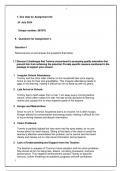
1.1 Distinguishing Science and Technology as Curriculum Subjects
a) Science:
Science is the systematic study of the natural world through observation,
experimentation, and analysis. As a curriculum subject, it focuses on
understanding the fundamental principles governing physical, chemical, and
biological phenomena. The primary goal is to develop a deep comprehension
of the laws of nature and the methods used to investigate these laws. In society,
science plays a crucial role in expanding our knowledge base, driving
innovation, and solving complex problems. It fosters critical thinking, logical
reasoning, and empirical analysis, which are essential for progress in various
fields, including medicine, environmental conservation, and space exploration.
b) Technology:
Technology, on the other hand, is the application of scientific knowledge for
practical purposes. It involves designing, creating, and utilizing tools, machines,
and systems to solve real-world problems and improve human life. As a
curriculum subject, technology education focuses on developing students' skills
in innovation, design, problem-solving, and the practical implementation of
ideas. In society, technology is fundamental in driving economic growth,
improving quality of life, and addressing challenges such as climate change,
healthcare, and communication. It encourages creativity, technical proficiency,
and adaptability in a rapidly changing world.
1.2 How Science Should Be Taught in Schools
Science should be taught through an inquiry-based approach, emphasizing
hands-on experiments, real-world problem solving, and critical thinking.
Students should engage in active learning by forming hypotheses, conducting
experiments, analyzing data, and drawing conclusions. This approach helps
students understand scientific concepts more deeply and develop a scientific
mindset. Collaborative projects, field trips, and integration with technology can
further enhance learning by providing practical experiences and context.
1.3 Suitable Learning Theory for Teaching Science
Constructivism is the learning theory most suitable for teaching science as
described. Constructivism posits that learners construct their own
understanding and knowledge of the world through experiences and reflecting
on those experiences. In the context of science education, constructivism
emphasizes active engagement, where students build on their prior knowledge
through experimentation, discussion, and critical thinking. By involving students
in hands-on activities and encouraging them to explore and question, teachers
can facilitate deeper understanding and retention of scientific concepts. This
QUESTION 1
1.1 Distinguishing Science and
Technology as Curriculum Subjects
a) Science:
Science is the systematic study of the
natural world through observation,
experimentation, and analysis. As a
curriculum subject, it focuses on
understanding the fundamental
principles governing physical,
chemical, and biological phenomena.
The primary goal is to develop a deep
comprehension of the laws of nature
and the methods used to investigate
these laws. In society, science plays a
crucial role in expanding our
knowledge base, driving innovation,
and solving complex problems. It
fosters critical thinking, logical
TMN3705
reasoning, and empirical analysis,
which are essential for progress in
various fields, including medicine,
environmental conservation, and
space exploration
NATALIE FOXX
ASSIGNMENT 2 2024
, QUESTION 1
1.1 Distinguishing Science and Technology as Curriculum Subjects
a) Science:
Science is the systematic study of the natural world through observation,
experimentation, and analysis. As a curriculum subject, it focuses on
understanding the fundamental principles governing physical, chemical, and
biological phenomena. The primary goal is to develop a deep comprehension
of the laws of nature and the methods used to investigate these laws. In society,
science plays a crucial role in expanding our knowledge base, driving
innovation, and solving complex problems. It fosters critical thinking, logical
reasoning, and empirical analysis, which are essential for progress in various
fields, including medicine, environmental conservation, and space exploration.
b) Technology:
Technology, on the other hand, is the application of scientific knowledge for
practical purposes. It involves designing, creating, and utilizing tools, machines,
and systems to solve real-world problems and improve human life. As a
curriculum subject, technology education focuses on developing students' skills
in innovation, design, problem-solving, and the practical implementation of
ideas. In society, technology is fundamental in driving economic growth,
improving quality of life, and addressing challenges such as climate change,
healthcare, and communication. It encourages creativity, technical proficiency,
and adaptability in a rapidly changing world.
1.2 How Science Should Be Taught in Schools
Science should be taught through an inquiry-based approach, emphasizing
hands-on experiments, real-world problem solving, and critical thinking.
Students should engage in active learning by forming hypotheses, conducting
experiments, analyzing data, and drawing conclusions. This approach helps
students understand scientific concepts more deeply and develop a scientific
mindset. Collaborative projects, field trips, and integration with technology can
further enhance learning by providing practical experiences and context.
1.3 Suitable Learning Theory for Teaching Science
Constructivism is the learning theory most suitable for teaching science as
described. Constructivism posits that learners construct their own
understanding and knowledge of the world through experiences and reflecting
on those experiences. In the context of science education, constructivism
emphasizes active engagement, where students build on their prior knowledge
through experimentation, discussion, and critical thinking. By involving students
in hands-on activities and encouraging them to explore and question, teachers
can facilitate deeper understanding and retention of scientific concepts. This