PREVIEW
1.3
a) Assimilation refers to the process by
which individuals or groups adopt the
cultural norms, values, and behaviors of the
dominant or host society, often leading to
the loss or erosion of their own cultural
identity.
b) Society is a group of individuals who
share common interests, values, norms,
and institutions, and who interact with one
another within a specific geographical area
or social structure.
c) Ecology of a school refers to the study of
the school environment and its interactions
with various factors such as students,
teachers, administrators, curriculum,
policies, and community influences. It
examines how these elements interact and
SED2601
affect the educational outcomes and
experiences of students.
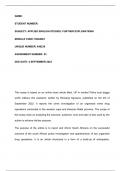
NATALIE FOXX
ASSIGNMENT 2 2024
, 1.1 Sociology is the scientific study of society, social interactions, social
relationships, and social institutions. It seeks to understand how society shapes
individual behavior and how individuals contribute to the construction and
maintenance of society. Sociology examines various aspects of human social
life, including culture, socialization, social stratification, institutions like family,
education, religion, politics, and economic systems.
1.2 Education is the process of facilitating learning, acquiring knowledge, skills,
values, beliefs, and habits. It is a systematic process that occurs formally in
educational institutions like schools, colleges, and universities, as well as
informally through experiences in daily life. Education plays a crucial role in
individual development, societal progress, and cultural transmission.
1.3
a) Assimilation refers to the process by which individuals or groups adopt the
cultural norms, values, and behaviors of the dominant or host society, often
leading to the loss or erosion of their own cultural identity.
b) Society is a group of individuals who share common interests, values, norms,
and institutions, and who interact with one another within a specific
geographical area or social structure.
c) Ecology of a school refers to the study of the school environment and its
interactions with various factors such as students, teachers, administrators,
curriculum, policies, and community influences. It examines how these
elements interact and affect the educational outcomes and experiences of
students.
1.4 In order to teach the activation of constructive and creative forces in the
classroom, educators can:
a) Encourage critical thinking and problem-solving skills through inquiry-
based learning activities.
b) Foster a supportive and inclusive classroom environment that values
diversity of perspectives and encourages collaboration and teamwork.
c) Incorporate creative expression and artistic activities into the curriculum,
such as art projects, music, drama, and storytelling.
d) Provide opportunities for students to engage in community service and civic
engagement projects that address real-world issues and promote social
change.
e) Encourage students to explore their passions and interests through project-
based learning and independent research.
f) Emphasize the importance of resilience, adaptability, and lifelong learning
in navigating and contributing to a rapidly changing world.
1.5 Conflict theory is a sociological perspective that views society as
characterized by conflict and inequality, with power and resources unequally
distributed among different social groups. Proponents of conflict theory include
Karl Marx, Max Weber, and Ralf Dahrendorf. Karl Marx emphasized the role of
economic factors, such as class struggle between the bourgeoisie (capitalist
1.3
a) Assimilation refers to the process by
which individuals or groups adopt the
cultural norms, values, and behaviors of the
dominant or host society, often leading to
the loss or erosion of their own cultural
identity.
b) Society is a group of individuals who
share common interests, values, norms,
and institutions, and who interact with one
another within a specific geographical area
or social structure.
c) Ecology of a school refers to the study of
the school environment and its interactions
with various factors such as students,
teachers, administrators, curriculum,
policies, and community influences. It
examines how these elements interact and
SED2601
affect the educational outcomes and
experiences of students.
NATALIE FOXX
ASSIGNMENT 2 2024
, 1.1 Sociology is the scientific study of society, social interactions, social
relationships, and social institutions. It seeks to understand how society shapes
individual behavior and how individuals contribute to the construction and
maintenance of society. Sociology examines various aspects of human social
life, including culture, socialization, social stratification, institutions like family,
education, religion, politics, and economic systems.
1.2 Education is the process of facilitating learning, acquiring knowledge, skills,
values, beliefs, and habits. It is a systematic process that occurs formally in
educational institutions like schools, colleges, and universities, as well as
informally through experiences in daily life. Education plays a crucial role in
individual development, societal progress, and cultural transmission.
1.3
a) Assimilation refers to the process by which individuals or groups adopt the
cultural norms, values, and behaviors of the dominant or host society, often
leading to the loss or erosion of their own cultural identity.
b) Society is a group of individuals who share common interests, values, norms,
and institutions, and who interact with one another within a specific
geographical area or social structure.
c) Ecology of a school refers to the study of the school environment and its
interactions with various factors such as students, teachers, administrators,
curriculum, policies, and community influences. It examines how these
elements interact and affect the educational outcomes and experiences of
students.
1.4 In order to teach the activation of constructive and creative forces in the
classroom, educators can:
a) Encourage critical thinking and problem-solving skills through inquiry-
based learning activities.
b) Foster a supportive and inclusive classroom environment that values
diversity of perspectives and encourages collaboration and teamwork.
c) Incorporate creative expression and artistic activities into the curriculum,
such as art projects, music, drama, and storytelling.
d) Provide opportunities for students to engage in community service and civic
engagement projects that address real-world issues and promote social
change.
e) Encourage students to explore their passions and interests through project-
based learning and independent research.
f) Emphasize the importance of resilience, adaptability, and lifelong learning
in navigating and contributing to a rapidly changing world.
1.5 Conflict theory is a sociological perspective that views society as
characterized by conflict and inequality, with power and resources unequally
distributed among different social groups. Proponents of conflict theory include
Karl Marx, Max Weber, and Ralf Dahrendorf. Karl Marx emphasized the role of
economic factors, such as class struggle between the bourgeoisie (capitalist