Exam Biochemistry NWI-MOL008A
Friday 18 January 2019
• Write your name and student number on each piece of paper.
• Answer the multiple-choice questions on the appropriate form.
Rating: 50% of the final test grade is the open questions 1-8.
50% of the final test grade is the multiple-choice questions 1-40
Open questions:
1. Proteins are large molecules usually composed of hundreds of amino acids sequentially linked together by
peptide bonds. Below, you find the sequence of a short peptide:
IAKTWPQECAAD
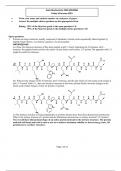
(a) Draw the chemical structure of this short peptide at pH 7, clearly indicating the N-terminus, the C-
terminus, the peptide bonds and the side chains of each amino acid residue. (3.5 points) The appendix table 3.1
might be useful for reference.
(b) What are the charges of the N-terminus, the C-terminus, and the side chains of each amino acid residue at
pH 12? Consult Table 3-1, draw the chemical structure at this basic pH and briefly motivate changes in the
amino acid residue charges, if they are present. (4 points)
(c) The primary structure of large polypeptides or proteins dictates their final three-dimensional architecture.
What is the tertiary structure of a protein and do filamentous proteins have a tertiary structure? (2.5 points)
The overall three-dimensional shape of an entire protein molecule is the tertiary structure. The protein
molecule will bend and twist in such a way as to achieve maximum stability or lowest energy state. All
proteins have a tertiary structure.
Page 1 of 12
, 2. Aspirin is a commonly used drug. In our body, absorption via the oral route normally occurs when the drug is
in the unionized state, as unionized molecules are more lipophilic and can better cross the cell membrane.
Knowing that Aspirin has a pKa of 3.5:
(a) Calculate the ratio of ionized/unionized of the drug in the stomach, where the pH is 1. (4 points)
pKa of aspirin = 3.5; pH of stomach = 1; pH of intestine = 6
Unknown = log [ionized]/[unionized].
Henderson-Hasselbalch equation for stomach:
pH of stomach = pKa of aspirin + log [ionized]/[unionized]
1 = 3.5 + log [ionized]/[unionized]
log [ionized]/[unionized] = 1-3.5
log [ionized]/[unionized] = -2.5
thus, [ionized]/[unionized] = Antilog (-2.5)
[ionized]/[unionized] = 0.00316. This means that for every 3 ionized molecules in the stomach there are
almost 1000 unionized molecules, suggesting that aspirin is largely unionized in the stomach (99.7%
unionized).
(b) Calculate the ratio of ionized/unionized in the intestine, where the pH is 6. (4 points)
pH of the intestine = pKa of aspirin + log [ionized]/[unionized]
6 = 3.5 + log [ionized]/[unionized]
log [ionized]/[unionized]= 6 – 3.5
log [ionized]/[unionized] = 2.5
[ionized]/[unionized] = Antilog (2.5)
[ionized]/[unionized] = 316.2 This means that for 316 ionized molecules of aspirin in the intestine there is
only 1 unionized molecule, suggesting that aspirin is largely ionized in the intestine (99.7% ionized).
(c) Based on these calculations, is aspirin more likely absorbed in the stomach or in the intestine? (2 points)
In the case of aspirin, which is an acidic molecule, based on the above calculations we can see that it is
more unionized in the stomach than in the intestine. Thus majority of the aspirin is absorbed via the
stomach under acidic pH.
3. Mammalian antibodies of the immunoglobulin G type consist of 4 polypeptides, two heavy and two light
chains. Relatively high concentrations of antibodies can be found in the blood. When antibodies are elicited by
immunization of animals with a protein-of-interest, antibodies against this protein can be isolated from the
blood of the immunized animals. If, for example, rabbits are injected with human hemoglobin, antibodies to
human hemoglobin will be produced.
(a) Briefly describe a method that can be applied to separate immunoglobulins from the majority of other
proteins in the blood serum (the blood fraction from which the blood cells have been removed) of an
immunized rabbit. (4 points)
The method should not involve protein reducing agents, because this would disrupt the disulfide bonds
connecting the 4 polypeptides. Possibilities are gel filtration chromatography (separation based on size),
ion-exchange chromatography (separation based on charge), affinity chromatography (separation based
on interaction with a ligand or antibody), or isoelectric focusing (separation based on isoelectric point).
Page 2 of 12
Friday 18 January 2019
• Write your name and student number on each piece of paper.
• Answer the multiple-choice questions on the appropriate form.
Rating: 50% of the final test grade is the open questions 1-8.
50% of the final test grade is the multiple-choice questions 1-40
Open questions:
1. Proteins are large molecules usually composed of hundreds of amino acids sequentially linked together by
peptide bonds. Below, you find the sequence of a short peptide:
IAKTWPQECAAD
(a) Draw the chemical structure of this short peptide at pH 7, clearly indicating the N-terminus, the C-
terminus, the peptide bonds and the side chains of each amino acid residue. (3.5 points) The appendix table 3.1
might be useful for reference.
(b) What are the charges of the N-terminus, the C-terminus, and the side chains of each amino acid residue at
pH 12? Consult Table 3-1, draw the chemical structure at this basic pH and briefly motivate changes in the
amino acid residue charges, if they are present. (4 points)
(c) The primary structure of large polypeptides or proteins dictates their final three-dimensional architecture.
What is the tertiary structure of a protein and do filamentous proteins have a tertiary structure? (2.5 points)
The overall three-dimensional shape of an entire protein molecule is the tertiary structure. The protein
molecule will bend and twist in such a way as to achieve maximum stability or lowest energy state. All
proteins have a tertiary structure.
Page 1 of 12
, 2. Aspirin is a commonly used drug. In our body, absorption via the oral route normally occurs when the drug is
in the unionized state, as unionized molecules are more lipophilic and can better cross the cell membrane.
Knowing that Aspirin has a pKa of 3.5:
(a) Calculate the ratio of ionized/unionized of the drug in the stomach, where the pH is 1. (4 points)
pKa of aspirin = 3.5; pH of stomach = 1; pH of intestine = 6
Unknown = log [ionized]/[unionized].
Henderson-Hasselbalch equation for stomach:
pH of stomach = pKa of aspirin + log [ionized]/[unionized]
1 = 3.5 + log [ionized]/[unionized]
log [ionized]/[unionized] = 1-3.5
log [ionized]/[unionized] = -2.5
thus, [ionized]/[unionized] = Antilog (-2.5)
[ionized]/[unionized] = 0.00316. This means that for every 3 ionized molecules in the stomach there are
almost 1000 unionized molecules, suggesting that aspirin is largely unionized in the stomach (99.7%
unionized).
(b) Calculate the ratio of ionized/unionized in the intestine, where the pH is 6. (4 points)
pH of the intestine = pKa of aspirin + log [ionized]/[unionized]
6 = 3.5 + log [ionized]/[unionized]
log [ionized]/[unionized]= 6 – 3.5
log [ionized]/[unionized] = 2.5
[ionized]/[unionized] = Antilog (2.5)
[ionized]/[unionized] = 316.2 This means that for 316 ionized molecules of aspirin in the intestine there is
only 1 unionized molecule, suggesting that aspirin is largely ionized in the intestine (99.7% ionized).
(c) Based on these calculations, is aspirin more likely absorbed in the stomach or in the intestine? (2 points)
In the case of aspirin, which is an acidic molecule, based on the above calculations we can see that it is
more unionized in the stomach than in the intestine. Thus majority of the aspirin is absorbed via the
stomach under acidic pH.
3. Mammalian antibodies of the immunoglobulin G type consist of 4 polypeptides, two heavy and two light
chains. Relatively high concentrations of antibodies can be found in the blood. When antibodies are elicited by
immunization of animals with a protein-of-interest, antibodies against this protein can be isolated from the
blood of the immunized animals. If, for example, rabbits are injected with human hemoglobin, antibodies to
human hemoglobin will be produced.
(a) Briefly describe a method that can be applied to separate immunoglobulins from the majority of other
proteins in the blood serum (the blood fraction from which the blood cells have been removed) of an
immunized rabbit. (4 points)
The method should not involve protein reducing agents, because this would disrupt the disulfide bonds
connecting the 4 polypeptides. Possibilities are gel filtration chromatography (separation based on size),
ion-exchange chromatography (separation based on charge), affinity chromatography (separation based
on interaction with a ligand or antibody), or isoelectric focusing (separation based on isoelectric point).
Page 2 of 12