Berenice Ings – Democracy and Dictatorships 1919-1963
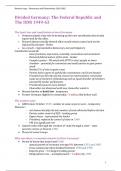
Divided Germany: The Federal Republic and
The DDR 1949-63
The basic law and constitution of west Germany
• Germans played a key role in drawing up the new constitution but closely
supervised by the allies
• Ensured democratically elected elites would retain control and not be
replaced by dictator - Hitler
• As a result - representative democracy, not participatory
Constitution ensured:
- basic freedoms; expression, assembly, association and movement
- Restored federal nature of the state - lander
- Complex system - PR mixed with FPTP to elect people to lower
chamber - potential for extremists and small parties to gain power
small
- Needed 5% of vote to gain a seat
- Parties had to agree to uphold the constitution, and if not banned
- President not directly elected, chosen by representative convention
made up of members of Bundestag and an equal Humber of members
elevated by lander parliaments
- Presidential powers more limited
- Chancellor not dismissed until new chancellor voted in
• Became known as basic law - temporary
• Former Germans eligible for citizenship - 3 million fled before wall
The eastern zone
• GDR former October 1949 - similar in some ways to west – temporary
However:
- not democratically elected, number of seats allocated before election
- Parties under control of SED - leading party
- Upper house - represented the lander
- President, replaced by council of state in 1960
- PM, less significant role
• Gained control through the creation of ‘state through a state’ - state
security service or Stasi in 1950
• Threat of soviet troops
Why was there a economic miracle in West Germany?
• Period of boom that lasted until 1966
- annual growth of economy average 8% between 1951 and 1965
- Gross national product doubled between 1950 and 1955
- Exports grew - 3rd largest trading power
- Employment rose – unemployment = 1 million by 1955
1
, Berenice Ings – Democracy and Dictatorships 1919-1963
- Influx of workers from East Germany
1. West Germany advantages
- large quantities of raw materials
- long term damage wasn’t severe as feared
- did not suffer considerable loss due to reparations
- refuges - regular supply of labour
2. The policies of bizonia
- removal of price controls
- Currency reform 1948
- Removing wage and production controls
- Co-determination law of 1951 and work’s constitution
3. The role of Erhard and the ‘social market economy’
- state regulations ended, but did not lead to unrestrained capitalism
4. Marshall aid
- did have impact, but not as significant as you ,may think
- Only 5% of west german national income
5. Korean War
- increased demand for goods only west Germany could supply -
doubled exports
6. Industrial relations
- growth in economy = rise in wages
- Workers = more disposable income
- Indentation to buy property, growth in demand for consumer goods
- Living standards rose
7. The role of the government
• through Bundesbank - financial stability, inflation controlled
• Government expenditure lower, didn’t have to pay reparations and didn’t
have army
How successful was Adenauer as chancellor of Germany?
• Chancellor of federal republic 1949-1963, success in 4 elections
• Presided over only majority government since WWI when in 1957, his
party, the Christian Democrats won 50% of popular vote.
• Associated with economic miracle, stability and affluent society
• Lack of social change = tensions in 1960s + saw increased support for left
and right
• Foreign policy = integrated west Germany into Europe
• Withdrawal from 1959 presidential campaign and performance In 1961
election indicated decline, sealed by: Der Spiegel affair and reaction to
Berlin Wall
Political stability and elections of 1949, 1953, 1957 and 1961
• Allies allowed formation of political parties in 1945
2
Divided Germany: The Federal Republic and
The DDR 1949-63
The basic law and constitution of west Germany
• Germans played a key role in drawing up the new constitution but closely
supervised by the allies
• Ensured democratically elected elites would retain control and not be
replaced by dictator - Hitler
• As a result - representative democracy, not participatory
Constitution ensured:
- basic freedoms; expression, assembly, association and movement
- Restored federal nature of the state - lander
- Complex system - PR mixed with FPTP to elect people to lower
chamber - potential for extremists and small parties to gain power
small
- Needed 5% of vote to gain a seat
- Parties had to agree to uphold the constitution, and if not banned
- President not directly elected, chosen by representative convention
made up of members of Bundestag and an equal Humber of members
elevated by lander parliaments
- Presidential powers more limited
- Chancellor not dismissed until new chancellor voted in
• Became known as basic law - temporary
• Former Germans eligible for citizenship - 3 million fled before wall
The eastern zone
• GDR former October 1949 - similar in some ways to west – temporary
However:
- not democratically elected, number of seats allocated before election
- Parties under control of SED - leading party
- Upper house - represented the lander
- President, replaced by council of state in 1960
- PM, less significant role
• Gained control through the creation of ‘state through a state’ - state
security service or Stasi in 1950
• Threat of soviet troops
Why was there a economic miracle in West Germany?
• Period of boom that lasted until 1966
- annual growth of economy average 8% between 1951 and 1965
- Gross national product doubled between 1950 and 1955
- Exports grew - 3rd largest trading power
- Employment rose – unemployment = 1 million by 1955
1
, Berenice Ings – Democracy and Dictatorships 1919-1963
- Influx of workers from East Germany
1. West Germany advantages
- large quantities of raw materials
- long term damage wasn’t severe as feared
- did not suffer considerable loss due to reparations
- refuges - regular supply of labour
2. The policies of bizonia
- removal of price controls
- Currency reform 1948
- Removing wage and production controls
- Co-determination law of 1951 and work’s constitution
3. The role of Erhard and the ‘social market economy’
- state regulations ended, but did not lead to unrestrained capitalism
4. Marshall aid
- did have impact, but not as significant as you ,may think
- Only 5% of west german national income
5. Korean War
- increased demand for goods only west Germany could supply -
doubled exports
6. Industrial relations
- growth in economy = rise in wages
- Workers = more disposable income
- Indentation to buy property, growth in demand for consumer goods
- Living standards rose
7. The role of the government
• through Bundesbank - financial stability, inflation controlled
• Government expenditure lower, didn’t have to pay reparations and didn’t
have army
How successful was Adenauer as chancellor of Germany?
• Chancellor of federal republic 1949-1963, success in 4 elections
• Presided over only majority government since WWI when in 1957, his
party, the Christian Democrats won 50% of popular vote.
• Associated with economic miracle, stability and affluent society
• Lack of social change = tensions in 1960s + saw increased support for left
and right
• Foreign policy = integrated west Germany into Europe
• Withdrawal from 1959 presidential campaign and performance In 1961
election indicated decline, sealed by: Der Spiegel affair and reaction to
Berlin Wall
Political stability and elections of 1949, 1953, 1957 and 1961
• Allies allowed formation of political parties in 1945
2