BIO 220 Exam 1 Study Guide GCU Questions & Answers Already Passed!!
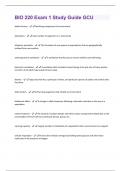
abiotic factors - Nonliving components of environment. abundance - total number of organisms in a community allopatric speciation - The formation of new species in populations that are geographically isolated from one another. anthropocentric worldview - A worldview that focuses on human welfare and well-being. biocentric worldview - A worldview that considers human beings to be just one of many species on Earth, all of which have equal intrinsic value. Biomes - large area that has a particular climate, and particular species of plants and animals that live there biotic factors - All the living organisms that inhabit an environment bottleneck effect - A change in allele frequency following a dramatic reduction in the size of a population carbon footprint - the amount of carbon dioxide and other carbon compounds emitted due to the consumption of fossil fuels by a particular person, group, etc. carrying capacity - Largest number of individuals of a population that a environment can support cellular respiration - Process that releases energy by breaking down glucose and other food molecules in the presence of oxygencellular respiration equation - C6H12O6+6O2-6CO2+6H2O+energy Charles Darwin - -Evolution by "natural selection" (the weaker die out) wrote On the Origin of Species closed system - A system in which no matter is allowed to enter or leave clumped dispersion pattern - a pattern in which the individuals of a population are aggregated in patches Clustered Distribution - for protection, mutual assistance, reproduction, access to resources Community - All the different populations that live together in an area competition - crowded organisms compete with one another for food, water, space, sunlight, & other essentials competitive exclusion - Strong competition can lead to local elimination of one of the species. competitive exclusion principle - Ecological rule that states that no two species can occupy the same exact niche in the same habitat at the same time
Información del documento
- Subido en
- 9 de junio de 2024
- Número de páginas
- 9
- Escrito en
- 2023/2024
- Tipo
- Examen
- Contiene
- Preguntas y respuestas