Literatuur Wetenschapsfilosofie en Methodologie
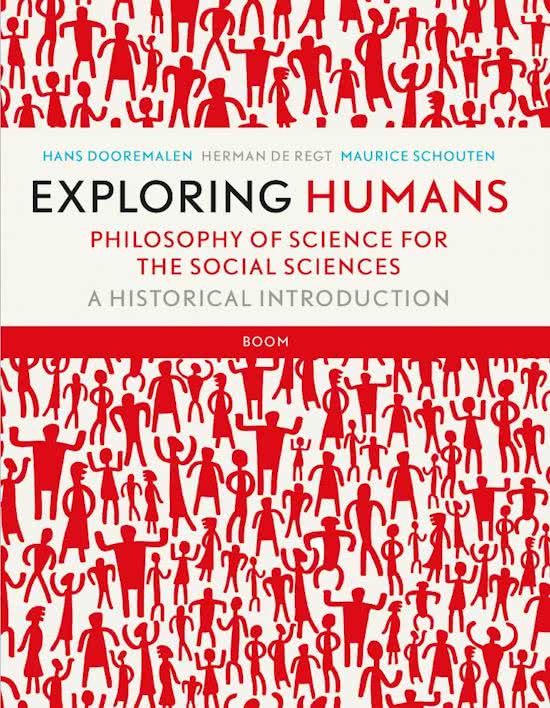
Dooremalen, De Regt & Schouten – Exploring Humans
Chapter 7 – Critical Rationalism: Science on Piles, Above a Swamp (p. 195-231)
With the logical positivists we witnessed a shift from philosophy of knowledge to philosophy of science, and
the question became ‘what is science?’ Logical positivists met with strong resistance: e.g. Karl Popper
(1902 – 1994).
Popper introduced critical rationalism. Popper’s book, published by the Vienna Circle itself, was nothing
less than a Trojan Horse: his conception of science was so different that it would shake the Circle’s
conceptual foundations to the point of collapse. Popper agreed with the logical positivists on the importance
of logic and mathematics for science and he appreciated their emphasis on empirical testing. For Popper,
theory always becomes before observation. His brief encounter with Marxism taught him that humans are
liable to make mistakes (fallible creatures) and that there is a major difference between dogmatic
theories like the Marxist theory of history and critical thinking. He learned that if a theory is able to
explain all the relevant data (supported by an incessant stream of confirmations) it is in fact a vice, not a
virtue. Popper volunteered in a child guidance clinic led by Adler, who had developed a theory called
individualpsychologie, focusing on the differences in environment of the child (e.g. inferiority complex).
Popper’s experiences with Marxism and Adler’s psychology led him to question the scientific value of
theories that are able to explain every possible observation (verification).
According to Popper, a theory cannot be considered scientific when it is always true. The implication of
verification is that some of the best scientific achievements no longer deserve to be called scientific. This is
similar to Hume’s problem of induction: no theory is ever verified. Verification problem: verifiability is
too strong as a demarcation criterion, because even prototypically scientific disciplines like physics cannot
be classified as science, the problem being that no universal claim or law can ever be verified, for it is
impossible to check each and every instance that falls under that law.
Schlik’s response: “Universal laws are neither true nor false; they are mere instruments that can be used
to infer statements about events.”
Carnap’s response: “Verificationism leads to a too narrow restriction of scientific language, excluding not
only metaphysical sentences but also certain scientific sentences having factual meaning.” He proposed a
modification of it: scientists should attempt to increase a statement’s degree of confirmation: a theory must
be in agreement with empirically established facts. Science is characterized as a process of gradually
increasing confirmation. Verification is here replaced by confirmability.
Popper states that verification is too strong, and that confirmation is too weak as a criterion of demarcation.
He asks people to imagine the arch-metaphysical assertion: there exists an omnipotent, omnipresent and
1
,omniscient personal spirit. It is highly conformed because it is a virtual tautology (sentences that are
confirmed all the time but do not qualify as science).
Popper proposed falsifiability as the new demarcation criterion. Any legitimate scientific theory will make
predictions that can in principle be falsified. It does not demand that a theory should actually be falsified, it
is the possibility of falsification that is important. If a theory fails to make predictions that might conceivably
be wrong, it is not a scientific theory. Characteristics:
1. Falsifiability is the criterion of demarcation
We should be able to specify under which conditions the statement or theory would be falsified. A
scientist who is not willing to give up his theory when reality shows the theory is wrong, is not really
a scientist. Popper intended the ‘degree of corroboration’: we can only say that failed attempts to
falsify theories corroborate these theories in the sense that even severe testing has not yet been
able to refute the theory.
2. Basic observation about humans (fallibility)
‘We do not know; we can only guess.’ We can never be sure whether our opinions are true and
therefore every investigation should start with admitting ‘we are seekers for truth, but we are not its
possessors’. Human beings are error-prone, and the limitations of our biological make-up prevent
us from ever attaining certainty. The negative road to truth (via negativa) is that our knowledge
can only grow by trying to locate, remove and correct our mistakes.
3. Only theories that are falsifiable are informative
If falsification is impossible, statements and theories fail to be informative. Popper’s demarcation
criterion is not intended as a double-edged sword (separating scientific from non-scientific and
meaningful statements from meaningless statements) like verification; it only provides a sharp
demarcation line between scientific and non-scientific, not the latter.
4. Only through falsification can scientific knowledge grow
Science does not employ the inductive method, but deductive reasoning, because this is logically
valid. All As are B (universal statement) if this is true, the next individual A will be B this is
valid. Problem is that the first premise cannot be established. The scientific method is one of
conjectures and refutations or trial and error. Testing is an attempt to refute the hypothesis. As
long as we have not refuted the theory, we can accept it as true, so we can pretend it’s true and
work with the theory, but we are never allowed to claim that the theory is actually true. Observing
one more white swan will not teach you anything, whereas observing the first black swan does.
Popper’s critical rationalism
Popper (like Kant) was dissatisfied with Hume’s psychological solution to the induction problem in
terms of custom, habit and association; our sensory capacities cooperate with our reasoning
capacities to form a picture of the world. We do not see the world as it is in itself (an sich) rather we
impose our ideas on the world.
2
, He accepts the view of innate knowledge; our mind is not a tabula rasa. Every organism has inborn
reactions and responses, which we can describe as ‘expectations’ without implying that these
‘expectations' are conscious. We are born with instinctive theories that allow us to find regularity in
the world.
Popper criticizes Kant for his absolutism: the innate theories that are present at birth should not be
understood as a priori valid knowledge. They are not certain. The rational structures we impose on
the world are always tentative and conjectural, never certain. Deductive testing may lead to their
falsification tomorrow.
Theory always precedes and forms observation: a scientist is led by a ‘horizon of expectations’:
there is no firm theory-neutral basis on which our theories can be erected. Good scientists have the
capacity to be critical of their theories and the observations that are obtained with them.
In The Poverty of Historicism, Popper took historicism to be the doctrine according to which history
develops according to fixed patterns, rhythms, laws or trends. The laws of social life are not unchanging but
bound by specific historical and cultural contexts. This means that the experimental methods of the natural
sciences are not applicable in the social sciences. The proper methodology of the social sciences is
therefore not the experimental method but the verstehende method (sympathetic imagination or
understanding intuitively). Social and natural sciences do have in common that they both search for laws
and aim at prediction. Utopian engineering is the endeavor to redesign the whole of society in accordance
with a grand blueprint. The Utopian social scientist will tolerate neither doubt nor debate and will never
admit failure; it takes a shortcut to totalitarianism. Trends are the result of statistical devices and describe a
pattern in available data. They are backward-looking and do not say anything about the future, whereas
laws are universal and hence forward-looking. The only way to solve practical problems is the method of
piecemeal engineering: the method of making small adjustments and readjustments which can be
continually improved upon. This goes hand in hand with critical analysis.
The reason that methodologists often give for arguing for a special method for the social sciences is that
social scientists are in a different position from natural scientists because they study situations which are
much more complex than physical situations; they involve rationality and this makes it possible to construct
relatively simple models of their actions and ways of interaction Rationality Principle: a social scientist
should assume the ‘trivial law that sane persons as a rule act more or less rationally. The behavior of
human beings is explained by reference to their goals or preferences and the information that they have
available and that they consider relevant to the situation. The Rationality Principle seems to be
incompatible with the essentials of critical rationalism: it is not only false, it is ‘clearly an almost empty
principle’. The presence of nearly empirically empty propositions cannot be allowed by falsificationism. If
the Principle has empirical content, then it is false, and the principle should be falsified. If it does not have
empirical content, then it seems inconsistent with Popper’s falsificationism.
Criticizing critical rationalism
Temporary immunization is not a crime
3
Dooremalen, De Regt & Schouten – Exploring Humans
Chapter 7 – Critical Rationalism: Science on Piles, Above a Swamp (p. 195-231)
With the logical positivists we witnessed a shift from philosophy of knowledge to philosophy of science, and
the question became ‘what is science?’ Logical positivists met with strong resistance: e.g. Karl Popper
(1902 – 1994).
Popper introduced critical rationalism. Popper’s book, published by the Vienna Circle itself, was nothing
less than a Trojan Horse: his conception of science was so different that it would shake the Circle’s
conceptual foundations to the point of collapse. Popper agreed with the logical positivists on the importance
of logic and mathematics for science and he appreciated their emphasis on empirical testing. For Popper,
theory always becomes before observation. His brief encounter with Marxism taught him that humans are
liable to make mistakes (fallible creatures) and that there is a major difference between dogmatic
theories like the Marxist theory of history and critical thinking. He learned that if a theory is able to
explain all the relevant data (supported by an incessant stream of confirmations) it is in fact a vice, not a
virtue. Popper volunteered in a child guidance clinic led by Adler, who had developed a theory called
individualpsychologie, focusing on the differences in environment of the child (e.g. inferiority complex).
Popper’s experiences with Marxism and Adler’s psychology led him to question the scientific value of
theories that are able to explain every possible observation (verification).
According to Popper, a theory cannot be considered scientific when it is always true. The implication of
verification is that some of the best scientific achievements no longer deserve to be called scientific. This is
similar to Hume’s problem of induction: no theory is ever verified. Verification problem: verifiability is
too strong as a demarcation criterion, because even prototypically scientific disciplines like physics cannot
be classified as science, the problem being that no universal claim or law can ever be verified, for it is
impossible to check each and every instance that falls under that law.
Schlik’s response: “Universal laws are neither true nor false; they are mere instruments that can be used
to infer statements about events.”
Carnap’s response: “Verificationism leads to a too narrow restriction of scientific language, excluding not
only metaphysical sentences but also certain scientific sentences having factual meaning.” He proposed a
modification of it: scientists should attempt to increase a statement’s degree of confirmation: a theory must
be in agreement with empirically established facts. Science is characterized as a process of gradually
increasing confirmation. Verification is here replaced by confirmability.
Popper states that verification is too strong, and that confirmation is too weak as a criterion of demarcation.
He asks people to imagine the arch-metaphysical assertion: there exists an omnipotent, omnipresent and
1
,omniscient personal spirit. It is highly conformed because it is a virtual tautology (sentences that are
confirmed all the time but do not qualify as science).
Popper proposed falsifiability as the new demarcation criterion. Any legitimate scientific theory will make
predictions that can in principle be falsified. It does not demand that a theory should actually be falsified, it
is the possibility of falsification that is important. If a theory fails to make predictions that might conceivably
be wrong, it is not a scientific theory. Characteristics:
1. Falsifiability is the criterion of demarcation
We should be able to specify under which conditions the statement or theory would be falsified. A
scientist who is not willing to give up his theory when reality shows the theory is wrong, is not really
a scientist. Popper intended the ‘degree of corroboration’: we can only say that failed attempts to
falsify theories corroborate these theories in the sense that even severe testing has not yet been
able to refute the theory.
2. Basic observation about humans (fallibility)
‘We do not know; we can only guess.’ We can never be sure whether our opinions are true and
therefore every investigation should start with admitting ‘we are seekers for truth, but we are not its
possessors’. Human beings are error-prone, and the limitations of our biological make-up prevent
us from ever attaining certainty. The negative road to truth (via negativa) is that our knowledge
can only grow by trying to locate, remove and correct our mistakes.
3. Only theories that are falsifiable are informative
If falsification is impossible, statements and theories fail to be informative. Popper’s demarcation
criterion is not intended as a double-edged sword (separating scientific from non-scientific and
meaningful statements from meaningless statements) like verification; it only provides a sharp
demarcation line between scientific and non-scientific, not the latter.
4. Only through falsification can scientific knowledge grow
Science does not employ the inductive method, but deductive reasoning, because this is logically
valid. All As are B (universal statement) if this is true, the next individual A will be B this is
valid. Problem is that the first premise cannot be established. The scientific method is one of
conjectures and refutations or trial and error. Testing is an attempt to refute the hypothesis. As
long as we have not refuted the theory, we can accept it as true, so we can pretend it’s true and
work with the theory, but we are never allowed to claim that the theory is actually true. Observing
one more white swan will not teach you anything, whereas observing the first black swan does.
Popper’s critical rationalism
Popper (like Kant) was dissatisfied with Hume’s psychological solution to the induction problem in
terms of custom, habit and association; our sensory capacities cooperate with our reasoning
capacities to form a picture of the world. We do not see the world as it is in itself (an sich) rather we
impose our ideas on the world.
2
, He accepts the view of innate knowledge; our mind is not a tabula rasa. Every organism has inborn
reactions and responses, which we can describe as ‘expectations’ without implying that these
‘expectations' are conscious. We are born with instinctive theories that allow us to find regularity in
the world.
Popper criticizes Kant for his absolutism: the innate theories that are present at birth should not be
understood as a priori valid knowledge. They are not certain. The rational structures we impose on
the world are always tentative and conjectural, never certain. Deductive testing may lead to their
falsification tomorrow.
Theory always precedes and forms observation: a scientist is led by a ‘horizon of expectations’:
there is no firm theory-neutral basis on which our theories can be erected. Good scientists have the
capacity to be critical of their theories and the observations that are obtained with them.
In The Poverty of Historicism, Popper took historicism to be the doctrine according to which history
develops according to fixed patterns, rhythms, laws or trends. The laws of social life are not unchanging but
bound by specific historical and cultural contexts. This means that the experimental methods of the natural
sciences are not applicable in the social sciences. The proper methodology of the social sciences is
therefore not the experimental method but the verstehende method (sympathetic imagination or
understanding intuitively). Social and natural sciences do have in common that they both search for laws
and aim at prediction. Utopian engineering is the endeavor to redesign the whole of society in accordance
with a grand blueprint. The Utopian social scientist will tolerate neither doubt nor debate and will never
admit failure; it takes a shortcut to totalitarianism. Trends are the result of statistical devices and describe a
pattern in available data. They are backward-looking and do not say anything about the future, whereas
laws are universal and hence forward-looking. The only way to solve practical problems is the method of
piecemeal engineering: the method of making small adjustments and readjustments which can be
continually improved upon. This goes hand in hand with critical analysis.
The reason that methodologists often give for arguing for a special method for the social sciences is that
social scientists are in a different position from natural scientists because they study situations which are
much more complex than physical situations; they involve rationality and this makes it possible to construct
relatively simple models of their actions and ways of interaction Rationality Principle: a social scientist
should assume the ‘trivial law that sane persons as a rule act more or less rationally. The behavior of
human beings is explained by reference to their goals or preferences and the information that they have
available and that they consider relevant to the situation. The Rationality Principle seems to be
incompatible with the essentials of critical rationalism: it is not only false, it is ‘clearly an almost empty
principle’. The presence of nearly empirically empty propositions cannot be allowed by falsificationism. If
the Principle has empirical content, then it is false, and the principle should be falsified. If it does not have
empirical content, then it seems inconsistent with Popper’s falsificationism.
Criticizing critical rationalism
Temporary immunization is not a crime
3