Literatuur Wetenschapsfilosofie en Methodologie
Watt & Van den Berg (2002) – The Nature and Utility of Scientific Theory
Human consciousness = curiosity and thought; we are interested in understanding how things work, in
finding explanations and predicting outcomes.
Theory = a set of interrelated constructs, definitions, and propositions that present a systematic view of
phenomena by specifying relations among variables, with the purpose of explaining and predicting the
phenomena. It achieves prediction and explanation by stating relationships between concepts which are
defined as variables, in words people understand. We are uncomfortable with unexplained phenomena and
we have a very basic drive to explain things. More evidence can improve the probability that a theory is
true.
Causal relationship = a specific condition of a variable which occurs earlier in time than a corresponding
condition of another variable, combined with some reasonable explanation for the relationship between
these two variables.
Native inquiry (skepticism) Scientific method (scientism)
Development of Selecting a concept because it is Systematic selection of all concepts that
theories appealing; explanation based on own could be possible causes of a
observation of reality; appeal over phenomenon; eliminating irrelevant
relevance concepts through review of published
researched literature
Testing of theories Theory is ‘self-evident’, ‘common Obtaining objective (reproducible)
sense’, ‘what any reasonable person evidence before making judgments
would conclude’, ignoring conflicting about the probable truth or falsehood of
information the theory
Control of Control over other confounding Controlling competing causes to guard
alternative variables is not possible because against confusing one causal
explanations other relevant concepts may not have relationship with another
been identified
Nature of Capitalizing on the joint occurrence of Techniques of research design are used
relationships (null, two phenomena and to assume them to establish covariation and causal
covariance, causal) to be linked in a cause-and-effect relationships
fashion, particularly if it fits
preconceptions or beliefs
Testing theories Not concerned with rules of evidence; Scientist cannot be concerned with that
with observable not required if the truth is obvious to which is not observable; answering
evidence any reasonable person scientific questions demands unbiased
observation and testing; morality is not
objectively observable
Methods of knowing
, Method of tenacity (focus inward) – asserting that something is true simply because it’s commonly
known to be true. Process of formulating beliefs occurs entirely within a given individual and is
entirely subject to that person’s beliefs, values and idiosyncrasies;
Method of authority (focus inward) – truth is established when someone or something for which I
have high regard, states the truth. Relies on testimony of experts, but dangerous when expert is not
knowledgeable or when persons with expertise in one area give advice in an unrelated area;
A priori method/method of reasonable men (focus inward) – propositions submitted are self-evident;
marketplace of ideas; whatever is held to be true will be the product of a social process involving
many authorities rather than the statement of a single authority. Problem: who gets to define what is
reasonable? Test for truth is that statements agree with reason, but not necessarily that they agree
with observable fact or experience;
Method of science (external permanency) – science shifts the locus of truth from single individuals
to groups, by establishing a set of mutually agreed upon rules for establishing truth; demanding
logical consistency that must be tested against an external reality which can be perceived by any
person, and is not just the property of a single individual or group; supporting internal beliefs with
external evidence.
Basic requirements of the scientific method
Seeking to explain phenomena by linking a concept called a cause to another concept called an
effect
Distinguishing between causal relationships and covariance relationships
Theory will not be regarded as probably true until we have had a chance to test it against some
observable reality; withholding judgment
Essential to make very clear what the concept means
Be as explicit and objective as possible in order to replicate studies
Rule out confounding variables by design
Eliminate biases be representative of the greater population
Self-correcting nature of scientific approach; careful scrutiny
Limitations: we cannot employ the scientific method when objective observation is not possible and basic
beliefs are not testable propositions
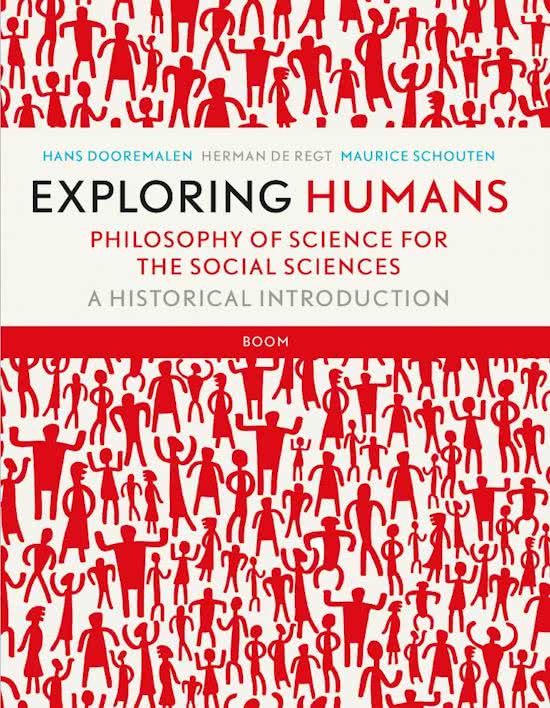
Dooremalen, De Regt & Schouten – Exploring Humans
Introduction (p. 11-14)
Science is often hailed as the crowning achievement of the human mind, but do we indeed live in an age of
certainty? There is a lot we don’t know, and most likely won’t ever know. According to sceptics (or post-
modernists/relativists), scientists are nothing but dogmatic believers. There is no proof whatsoever in
science and it is faith that keeps the building of science standing. They argue that contemporary science is
Watt & Van den Berg (2002) – The Nature and Utility of Scientific Theory
Human consciousness = curiosity and thought; we are interested in understanding how things work, in
finding explanations and predicting outcomes.
Theory = a set of interrelated constructs, definitions, and propositions that present a systematic view of
phenomena by specifying relations among variables, with the purpose of explaining and predicting the
phenomena. It achieves prediction and explanation by stating relationships between concepts which are
defined as variables, in words people understand. We are uncomfortable with unexplained phenomena and
we have a very basic drive to explain things. More evidence can improve the probability that a theory is
true.
Causal relationship = a specific condition of a variable which occurs earlier in time than a corresponding
condition of another variable, combined with some reasonable explanation for the relationship between
these two variables.
Native inquiry (skepticism) Scientific method (scientism)
Development of Selecting a concept because it is Systematic selection of all concepts that
theories appealing; explanation based on own could be possible causes of a
observation of reality; appeal over phenomenon; eliminating irrelevant
relevance concepts through review of published
researched literature
Testing of theories Theory is ‘self-evident’, ‘common Obtaining objective (reproducible)
sense’, ‘what any reasonable person evidence before making judgments
would conclude’, ignoring conflicting about the probable truth or falsehood of
information the theory
Control of Control over other confounding Controlling competing causes to guard
alternative variables is not possible because against confusing one causal
explanations other relevant concepts may not have relationship with another
been identified
Nature of Capitalizing on the joint occurrence of Techniques of research design are used
relationships (null, two phenomena and to assume them to establish covariation and causal
covariance, causal) to be linked in a cause-and-effect relationships
fashion, particularly if it fits
preconceptions or beliefs
Testing theories Not concerned with rules of evidence; Scientist cannot be concerned with that
with observable not required if the truth is obvious to which is not observable; answering
evidence any reasonable person scientific questions demands unbiased
observation and testing; morality is not
objectively observable
Methods of knowing
, Method of tenacity (focus inward) – asserting that something is true simply because it’s commonly
known to be true. Process of formulating beliefs occurs entirely within a given individual and is
entirely subject to that person’s beliefs, values and idiosyncrasies;
Method of authority (focus inward) – truth is established when someone or something for which I
have high regard, states the truth. Relies on testimony of experts, but dangerous when expert is not
knowledgeable or when persons with expertise in one area give advice in an unrelated area;
A priori method/method of reasonable men (focus inward) – propositions submitted are self-evident;
marketplace of ideas; whatever is held to be true will be the product of a social process involving
many authorities rather than the statement of a single authority. Problem: who gets to define what is
reasonable? Test for truth is that statements agree with reason, but not necessarily that they agree
with observable fact or experience;
Method of science (external permanency) – science shifts the locus of truth from single individuals
to groups, by establishing a set of mutually agreed upon rules for establishing truth; demanding
logical consistency that must be tested against an external reality which can be perceived by any
person, and is not just the property of a single individual or group; supporting internal beliefs with
external evidence.
Basic requirements of the scientific method
Seeking to explain phenomena by linking a concept called a cause to another concept called an
effect
Distinguishing between causal relationships and covariance relationships
Theory will not be regarded as probably true until we have had a chance to test it against some
observable reality; withholding judgment
Essential to make very clear what the concept means
Be as explicit and objective as possible in order to replicate studies
Rule out confounding variables by design
Eliminate biases be representative of the greater population
Self-correcting nature of scientific approach; careful scrutiny
Limitations: we cannot employ the scientific method when objective observation is not possible and basic
beliefs are not testable propositions
Dooremalen, De Regt & Schouten – Exploring Humans
Introduction (p. 11-14)
Science is often hailed as the crowning achievement of the human mind, but do we indeed live in an age of
certainty? There is a lot we don’t know, and most likely won’t ever know. According to sceptics (or post-
modernists/relativists), scientists are nothing but dogmatic believers. There is no proof whatsoever in
science and it is faith that keeps the building of science standing. They argue that contemporary science is