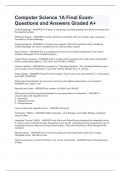
Computer Science 1A Final Exam-Questions and Answers Graded A+
Computer Science 1A Final Exam-Questions and Answers Graded A+ Charles Babbage - ANSWER-The father of computing. Invented/designed the difference engine and the analytical engine. Difference Engine - ANSWER-A wholly mechanical computer with only wheels, cogs, and gears. Invented by Charles Babbage. Analytical Engine - ANSWER-1st mechanical computer. Ran off of punched cards. Created by Charles Babbage, but never completed by him. Ada Lovelace helped. Ada Lovelace - ANSWER-She is considered to be the first computer programmer. She wrote a computer language for the Analytical Engine. Joseph Marie Jacquard - ANSWER-French inventor of the Jacquard loom that could automatically weave complicated patterns () used PUNCH CARDS Herman Hollerith - ANSWER-He invented the "Tabulating Machine." The Tabulating Machine used punch cards to store information. It was later used to tabulate the U.S. Census. Grace Hopper - ANSWER-Found the first computer "bug" found in the Harvard Mark 1=I. Developed the FIRST COMPILER. What three characteristics do consumers look at to note different generations of computers? - ANSWER-size, speed, cost Mauchly and Eckert - ANSWER-the creators of ENIAC and UNIVAC What were the breakthrough technologies for each generation of computers? - ANSWER-1 - vacuum tubes and magnetic drums 2 - transistors 3 - integrated circuits 4 - microprocessor vacuum tubes and magnetic drums - ANSWER-Flemming Transistors (1950's) - ANSWER-William Shockley, John Bardeen, and Walter Brattain. Replaced vacuum tubes. Integrated Circuits (1960's) - ANSWER-Jack Kirby and Robert Noyce designed the integrated circuit. A circuit is a tiny chip that contains thousands of tiny circuits. Integrated circuits are about the size of a fingernail and are made from silicone (hard plastic). They allow electricity to flow throughout the computer. Microprocessor - ANSWER-The central processing unit that is generally made from a single integrated circuit. Ted Hoff of Intel. What do we use to convert from Binary, Oct, or Hex to Decimal? - ANSWER-Sum of the Expansion of Parts
Escuela, estudio y materia
- Institución
- COMPUTER SCIENCE
- Grado
- COMPUTER SCIENCE
Información del documento
- Subido en
- 8 de junio de 2024
- Número de páginas
- 369
- Escrito en
- 2023/2024
- Tipo
- Examen
- Contiene
- Preguntas y respuestas
Temas
-
types of topologies
-
microprocessor
-
bandwidth
-
the processor
-
operating system
-
utility programs
-
general types of programs
-
sampling rate
-
encryption
-
logical record
-
programmin
-
computer science 1a final exam

Documento también disponible en un lote