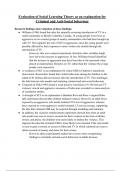
Evaluation of Social Learning Theory as an explanation for
Criminal and Anti-Social behaviour
Research findings and evaluation of those findings:
● Williams (1986) found that after the naturally occurring introduction of TV to a
small community in British Columbia, Canada, 16 young people were twice as
aggressive as two control groups in nearby communities who had been brought up
with TV. This supports the role of SLT in aggression, since the young people were
possibly affected by their exposure to more violent role models through the
introduction of TV.
- However, this was a natural experiment, therefore other variables might
have led to the increase in aggression. In fact, Williams herself identified
that the increase in aggression may have been due to the increased value
placed on materialistic lifestyles on TV, rather than the violence the young
people were exposed to.
● A weakness of SLT as an explanation for crime/ASB in Charlton’s naturalistic
observation. Researchers found that violent behaviour among the children on the
island of St. Helena did not increase after the introduction of TV. This challenges
the link between role models and imitating criminal and anti-social behaviour.
● Comstock & Paik (1994) found a weak positive correlation (+0.19) between TV
violence viewed and aggressive measures of behaviour recorded in a meta-analysis
of correlation studies.
● A strength of SLT as an explanation is Bandura Ross and Ross’s original Bobo
doll experiment showed that children imitated violence shown by an adult. Boys
exposed to an aggressive role model imitated 25.8 acts of aggression, whereas
boys exposed to a non-aggressive model imitated 1.5 acts on average, supporting
the idea that criminal/ASB may be acquired through modelling and imitation.
● In addition, the vicarious reinforcement experiment showed that when an adult
role model was seen to receive rewards for their violence in the form of drinks,
sweets, and praise, the children were more likely to imitate the violence. This
supports the idea that criminal/ASB is more likely to be imitated if the role model
is seen to gain a reward, as occurs in films and TV in which criminals are seen to
obtain rewards of money and status for their crimes.
- However, these experimental studies have issues when extrapolating
findings to criminals and anti-social behaviour in adults because:
Criminal and Anti-Social behaviour
Research findings and evaluation of those findings:
● Williams (1986) found that after the naturally occurring introduction of TV to a
small community in British Columbia, Canada, 16 young people were twice as
aggressive as two control groups in nearby communities who had been brought up
with TV. This supports the role of SLT in aggression, since the young people were
possibly affected by their exposure to more violent role models through the
introduction of TV.
- However, this was a natural experiment, therefore other variables might
have led to the increase in aggression. In fact, Williams herself identified
that the increase in aggression may have been due to the increased value
placed on materialistic lifestyles on TV, rather than the violence the young
people were exposed to.
● A weakness of SLT as an explanation for crime/ASB in Charlton’s naturalistic
observation. Researchers found that violent behaviour among the children on the
island of St. Helena did not increase after the introduction of TV. This challenges
the link between role models and imitating criminal and anti-social behaviour.
● Comstock & Paik (1994) found a weak positive correlation (+0.19) between TV
violence viewed and aggressive measures of behaviour recorded in a meta-analysis
of correlation studies.
● A strength of SLT as an explanation is Bandura Ross and Ross’s original Bobo
doll experiment showed that children imitated violence shown by an adult. Boys
exposed to an aggressive role model imitated 25.8 acts of aggression, whereas
boys exposed to a non-aggressive model imitated 1.5 acts on average, supporting
the idea that criminal/ASB may be acquired through modelling and imitation.
● In addition, the vicarious reinforcement experiment showed that when an adult
role model was seen to receive rewards for their violence in the form of drinks,
sweets, and praise, the children were more likely to imitate the violence. This
supports the idea that criminal/ASB is more likely to be imitated if the role model
is seen to gain a reward, as occurs in films and TV in which criminals are seen to
obtain rewards of money and status for their crimes.
- However, these experimental studies have issues when extrapolating
findings to criminals and anti-social behaviour in adults because: