Information Management
(1) Chapter 1 + 2
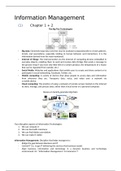
The Big Five Technologies
- Big data: Extremely large data sets that may be analyzed computationally to reveal patterns,
trends, and associations, especially relating to human behavior and interactions. It is the
information derived from the next mentioned.
- Internet of things: The interconnection via the Internet of computing devices embedded in
everyday objects, enabling them to send and receive data (Fridge that sends a message to
the grocery shop if you have only little left of a certain product, the temperature of a house
that can be regulated from outside, etc.)
- Social Media: Websites and applications that enable users to create and share content or to
participate in social networking. Facebook, Twitter, etc.
- Mobile computing: A variety of devices that allow people to access data and information
from wherever they are. Transports data, voice, and video over a network via
a mobile device.
- Cloud computing: The practice of using a network of remote servers hosted on the Internet
to store, manage, and process data, rather than a local server or a personal computer.
Always-on Society generates Big Data:
Four disruptive aspects of Information Technologies:
1. We can compute it
2. We can deal with messiness
3. We can find hidden correlations
4. We can make it visible
Information Management: Discipline that helps managers to:
- Bridge the gap between Business and IT
- Control IT (i.e. to get IT delivering the services that business needs)
- Align business, information and technology in a dynamic business and technology
environment. Or: “Information Management = E-Commerce”?
, Information Management is about how to control technology (and ‘technicians’) to enhance
business value.
Business model:
- A set of planned activities (business processes)
- Designed
- To result in a profit in a marketplace
(CH5 discusses whether a business model is the same as a business strategy)
Web 2.0 technology is a key enabler of e-commerce and allows users to:
- Create and share content, preferences, bookmarks, and online personas.
- Participate in virtual lives.
- Build online communities (e.g. Twitter, YouTube, Facebook, Wikipedia, etc.).
Web 2.0 technology enables Social Media Technology
o Examples: LinkedIn, Apple iPhone, Google, WordPress, etc.
E-commerce is the application of IT in doing business. It is the result of:
- Driver 1: Competition and business changes.
- Driver 2: New enabling IT.
Interaction between drivers 1 + 2: Reshaping the business
environment.
IT affects:
- All business process stages (sales, design, manufacturing, etc.).
- Integration of subsequent steps in the value chain.
- Contracting between firms.
- Connecting value chains (firms) into a dynamic value system.
E-commerce: Impact of IT on business.
- The use of the Internet, the Web, and apps to transact business. More formally, digitally
enabled commercial transactions between and among organizations and individuals .
o Commercial transactions involve the exchange of value (e.g. money) across
organizational or individual boundaries in return for products or services.
- E-business refers primarily to the digital enabling of transactions and processes within a firm,
involving information systems under the control of the firm. For the most part, e-business
does not involve commercial transactions across organizational boundaries where value is
exchanged. However, E-commerce (EC) does have some overlap with e-business (EB).
,1
Unique features of e-commerce technology:
1. Ubiquity (‘IT is everywhere’)
2. Global reach
3. Universal standards
4. Richness (in possibilities, like video, audio, text)
5. Interactivity (of technology with the user)
6. Information density (it reduces information costs and raises quality; Big data analytics)
7. Personalization/customization (allows personalized messages to be delivered to individuals
as well as groups)
8. Social technology (user content generation and social networks)
2
Types of e-commerce:
- Classified by market relationship:
o Business-to-Consumer (B2C)
o Business-to-Business (B2B)
o Consumer-to-Consumer (C2C)
o Government-to-Consumer/Business (G2C, G2B)
- Other:
o Mobile commerce (M-Commerce)
Use of mobile devices to enable online transactions
o Social e-commerce (Facebook, social networks, communities)
E-commerce enabled by social networks and online social relationships
o Local e-commerce (Groupon, activities based on geo-locations)
E-commerce focused on engaging consumer based on the geographic
location
IT entails:
- Reach: Billions of users globally + Connect to millions of products.
- Richness: Detailed product information on > 20 billion pages + Personalized messages for
users
- Range: Single access to complete set of products and services (one stop shopping)
Changing trade-off between richness and reach
B2B B2C
, Origins and growth of e-commerce
- 1980’s precursors:
o Baxter Healthcare (first online selling (bandages etc.) to hospitals)
o American Airlines (first online booking of tickets)
o Electronic Data Interchange (EDI) (Business to Business)
o French Minitel (1980s videotex system)
None of these had functionality of Internet
- 1995: Beginning of e-commerce
o First sales of banner advertisements
- E-commerce fastest growing form of commerce in USA
Early visions of e-commerce
- Computer scientists:
o Inexpensive, universal communications and computing environment accessible by
all.
- Economists:
o Nearly perfect competitive market and friction-free commerce.
o Lowered search costs, disintermediation, price transparency, elimination of unfair
competitive advantage.
- Business:
o Extraordinary opportunity to earn far above normal returns on investment – first
mover advantage.
3
Assessing e-commerce
- Many early visions are not fulfilled:
(1) Chapter 1 + 2
The Big Five Technologies
- Big data: Extremely large data sets that may be analyzed computationally to reveal patterns,
trends, and associations, especially relating to human behavior and interactions. It is the
information derived from the next mentioned.
- Internet of things: The interconnection via the Internet of computing devices embedded in
everyday objects, enabling them to send and receive data (Fridge that sends a message to
the grocery shop if you have only little left of a certain product, the temperature of a house
that can be regulated from outside, etc.)
- Social Media: Websites and applications that enable users to create and share content or to
participate in social networking. Facebook, Twitter, etc.
- Mobile computing: A variety of devices that allow people to access data and information
from wherever they are. Transports data, voice, and video over a network via
a mobile device.
- Cloud computing: The practice of using a network of remote servers hosted on the Internet
to store, manage, and process data, rather than a local server or a personal computer.
Always-on Society generates Big Data:
Four disruptive aspects of Information Technologies:
1. We can compute it
2. We can deal with messiness
3. We can find hidden correlations
4. We can make it visible
Information Management: Discipline that helps managers to:
- Bridge the gap between Business and IT
- Control IT (i.e. to get IT delivering the services that business needs)
- Align business, information and technology in a dynamic business and technology
environment. Or: “Information Management = E-Commerce”?
, Information Management is about how to control technology (and ‘technicians’) to enhance
business value.
Business model:
- A set of planned activities (business processes)
- Designed
- To result in a profit in a marketplace
(CH5 discusses whether a business model is the same as a business strategy)
Web 2.0 technology is a key enabler of e-commerce and allows users to:
- Create and share content, preferences, bookmarks, and online personas.
- Participate in virtual lives.
- Build online communities (e.g. Twitter, YouTube, Facebook, Wikipedia, etc.).
Web 2.0 technology enables Social Media Technology
o Examples: LinkedIn, Apple iPhone, Google, WordPress, etc.
E-commerce is the application of IT in doing business. It is the result of:
- Driver 1: Competition and business changes.
- Driver 2: New enabling IT.
Interaction between drivers 1 + 2: Reshaping the business
environment.
IT affects:
- All business process stages (sales, design, manufacturing, etc.).
- Integration of subsequent steps in the value chain.
- Contracting between firms.
- Connecting value chains (firms) into a dynamic value system.
E-commerce: Impact of IT on business.
- The use of the Internet, the Web, and apps to transact business. More formally, digitally
enabled commercial transactions between and among organizations and individuals .
o Commercial transactions involve the exchange of value (e.g. money) across
organizational or individual boundaries in return for products or services.
- E-business refers primarily to the digital enabling of transactions and processes within a firm,
involving information systems under the control of the firm. For the most part, e-business
does not involve commercial transactions across organizational boundaries where value is
exchanged. However, E-commerce (EC) does have some overlap with e-business (EB).
,1
Unique features of e-commerce technology:
1. Ubiquity (‘IT is everywhere’)
2. Global reach
3. Universal standards
4. Richness (in possibilities, like video, audio, text)
5. Interactivity (of technology with the user)
6. Information density (it reduces information costs and raises quality; Big data analytics)
7. Personalization/customization (allows personalized messages to be delivered to individuals
as well as groups)
8. Social technology (user content generation and social networks)
2
Types of e-commerce:
- Classified by market relationship:
o Business-to-Consumer (B2C)
o Business-to-Business (B2B)
o Consumer-to-Consumer (C2C)
o Government-to-Consumer/Business (G2C, G2B)
- Other:
o Mobile commerce (M-Commerce)
Use of mobile devices to enable online transactions
o Social e-commerce (Facebook, social networks, communities)
E-commerce enabled by social networks and online social relationships
o Local e-commerce (Groupon, activities based on geo-locations)
E-commerce focused on engaging consumer based on the geographic
location
IT entails:
- Reach: Billions of users globally + Connect to millions of products.
- Richness: Detailed product information on > 20 billion pages + Personalized messages for
users
- Range: Single access to complete set of products and services (one stop shopping)
Changing trade-off between richness and reach
B2B B2C
, Origins and growth of e-commerce
- 1980’s precursors:
o Baxter Healthcare (first online selling (bandages etc.) to hospitals)
o American Airlines (first online booking of tickets)
o Electronic Data Interchange (EDI) (Business to Business)
o French Minitel (1980s videotex system)
None of these had functionality of Internet
- 1995: Beginning of e-commerce
o First sales of banner advertisements
- E-commerce fastest growing form of commerce in USA
Early visions of e-commerce
- Computer scientists:
o Inexpensive, universal communications and computing environment accessible by
all.
- Economists:
o Nearly perfect competitive market and friction-free commerce.
o Lowered search costs, disintermediation, price transparency, elimination of unfair
competitive advantage.
- Business:
o Extraordinary opportunity to earn far above normal returns on investment – first
mover advantage.
3
Assessing e-commerce
- Many early visions are not fulfilled: