HEARSAY – REVISION NOTES
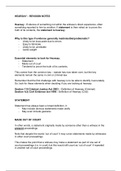
Hearsay - Evidence of something not within the witness’s direct experience, often
something reported to him by another. If statement is then relied on to prove the
truth of its contents, the statement is hearsay.
Why is this type if evidence generally inadmissible/problematic?
- Likely to be inaccurate due to errors
- Easy to fabricate
- Likely to be unreliable
- Lacks weight
Essential elements to look for Hearsay:
- Statement
- Made out of court
- Tendered to prove the truth of its contents.
This comes from the common law – statute has now taken over, but the key
elements remain the same in civil or criminal law.
Remember that the first challenge with hearsay is to be able to identify it accurately.
So, look for these elements when deciding if you are looking at hearsay.
Section 114 Criminal Justice Act 2003 – Definition of Hearsay (Criminal)
Section 1(2) Civil Evidence Act 1995 - Definition of Hearsay (Civil)
STATEMENT
Statement has always been a broad definition, it:
- May include obvious statements made orally
- May even include gestures
MADE OUT OF COURT
In other words, a statement originally made by someone other than a witness in the
present proceedings
Note that despite the words ‘out of court’ it may cover statements made by witnesses
in other court proceedings
This makes the point that a witness may make a statement as part of one set of
court proceedings (i.e. in court) but this would still count as ‘out of court’ if repeated
in another set of court proceedings.
Hearsay - Evidence of something not within the witness’s direct experience, often
something reported to him by another. If statement is then relied on to prove the
truth of its contents, the statement is hearsay.
Why is this type if evidence generally inadmissible/problematic?
- Likely to be inaccurate due to errors
- Easy to fabricate
- Likely to be unreliable
- Lacks weight
Essential elements to look for Hearsay:
- Statement
- Made out of court
- Tendered to prove the truth of its contents.
This comes from the common law – statute has now taken over, but the key
elements remain the same in civil or criminal law.
Remember that the first challenge with hearsay is to be able to identify it accurately.
So, look for these elements when deciding if you are looking at hearsay.
Section 114 Criminal Justice Act 2003 – Definition of Hearsay (Criminal)
Section 1(2) Civil Evidence Act 1995 - Definition of Hearsay (Civil)
STATEMENT
Statement has always been a broad definition, it:
- May include obvious statements made orally
- May even include gestures
MADE OUT OF COURT
In other words, a statement originally made by someone other than a witness in the
present proceedings
Note that despite the words ‘out of court’ it may cover statements made by witnesses
in other court proceedings
This makes the point that a witness may make a statement as part of one set of
court proceedings (i.e. in court) but this would still count as ‘out of court’ if repeated
in another set of court proceedings.