

Piaget's theory Questions And Answers | 100% Correct Answers | Updated Quiz
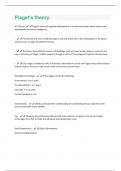
His Theory - Piaget's theory of cognitive development is an extensive theory about nature and development of human intelligence. - He believed that one's childhood plays a vital and active role in their development. His idea is mainly known as stage development theory. - The theory deals with the nature of knowledge itself and how humans acquire, construct and use it. According to Piaget, children progress through a series of 4 key stages of cognitive development. - Each stage is marked by shifts in how kids understand the world and Piaget noticed that children actively explore and try to make sense of the environment around them. Developmental Stages - These stages include the following: Sensorimotor- 0 to 2 years Pre-Operational- 2 to 7 years Concrete- 7 to 12 years Formal Operational- 12+ Sensorimotor - Infants construct their understanding of coordinating sensory experience (list some senses) with motor abilities. E.g. - When an infant first encounters a rattle, their instinct is to grasp it- the noise it makes encourages the infant to shake everything to attempt getting a noise. Key Characteristics - Object Permanence Goal Directed BehaviourObject Permanence - The understanding that objects still exists even if they can not be seen or touched. Before this develops 'out of sight' really means 'out of mind'. Infants from 5-8 months will begin to start for an object that is partially covered. Progression towards understanding is usually achieved by 18 months. - Demonstrating the first signs of object permanence is holding mental images and search for the lost object. Goal Directed Behaviour - Behavior that is carried out with a particular purpose in mind and is developed towards the end of the stage- working out various way to obtain things they want Pre-Operational - The thinking of the pre-operational child is more sophisticated than those in previous stage. It is characterized by the ability to make mental representations of experiences and symbols to solve simple problems. (Symbolic Thought)
Información del documento
- Subido en
- 29 de mayo de 2024
- Número de páginas
- 4
- Escrito en
- 2023/2024
- Tipo
- Examen
- Contiene
- Preguntas y respuestas

