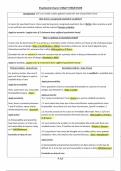
SUMMARY FOR INTELLECTUAL PROPERTY RIGHTS (LAW-32306)
Lecture 2: Introduction to Intellectual Property Rights (IPRs)
Introduction to IPRs
What is Law?
What are IPRs, history?
Some main treaties and organisations
The various IPRs
What is Law?
= the rules and regulations established and enforced by the government of a society to control the
behaviour of the people/entities in that society.
Laws generally reflect/promote societal values
Must not be “fair” or “good” it must be something objective, law is integrated in society
Rules should be known in advance
Rules should be created democratically
Can be written and unwritten
Nobody is above the law
Different types of law – domestic level
Federal law
o Applies to everyone within a country E.g. Dutch law
o Relates to nation-wide issues, e.g. environment, public health, labor relations, civil
rights
State law
o Applies to people who live/work in particular state
o Relates to state-wide issues, e.g. education, transportation, state taxes, marriage
Local law
o Applies to people in particular counties, cities, municipalities, towns, townships and
villages
o Relates to local issues, e.g. land use, parking, schools
Different types of law – international level
International law
o Set of rules, norms, and standards that are binding between sovereign states and
other entities legally recognized as international actors
o Relates to diverse range of topics, e.g. war, diplomacy, economic relations and human
rights
o International vs. universal law
o Difference to domestic law:
Primarily binding between states, rather than individuals
Operates largely through consent
Regional international law
o Set of rules, norms, and standards developed and applied in specific regional area
among a group of nations
o EU specialty: Directives and Regulations
, World Trade Organization (WTO) Agreement on Trade-Related Aspects of
Intellectual Property Rights (TRIPS-Agreement),
1994
European Union Directive 98/44/EC of the European Parliament
and the Council of 6 July 1998 on the legal
protection of biotechnological inventions
German Biopatentgesetz (Act implementing the
Biotechnology Directive), 2004
Legal personality
Natural person
o Person with their own legal personality, who has rights and responsibilities and can
engage in various legal activities
Legal Person
o Entities that the law recognizes as having legal rights and duties. Examples include
corporations, government bodies, and organizations. They can own property, enter
contracts, and sue or be sued
To apply for an IPR you have to have a certain legal personality, that’s why this differentiation
is important
Public vs. private law
Aspect Public law Private law
Nature of Involves relationship between state Concerned with relationship between
relationship and individuals/ entities private individuals or entities
Parties Typically government or its agencies Private individuals, organizations, or
involved are one of the parties entities are the parties involved
Objective Primarily public interest, maintaining Primarily resolving disputes between
order, and protecting the rights of private parties and compensating
individuals in society individuals wrongs
Enforcement Government enforces public laws Private parties must initiate legal action,
(e.g. criminal sanction, e.g. civil lawsuits
administrative action)
Balance of Implies hierarchal relationship Implies more equal relationship between
power between state and individual private parties; state serves as neutral
arbiter
Examples Constitutional law, administrative Contract law, tort law, property law, family
lam criminal law, tax law, and law, and business law
environmental law
Public law: relates to the system as a whole
Private law: relates to all the natural and legal people within the system
IPRs fall into private law because they deal with the relations between natural and legal
persons (legal person = entity, corporation etc.)
Knowledge is a Public Good
Public Good has two characteristics:
Non-rivalrous: The consumption of the good by one individual does not reduce the
availability of the good for consumption by others;
Non-excludable: Others may not easily be stopped from consuming the product
,Pure Public Good = for example the air we breath
We live in knowledge economy = Knowledge is power
Knowledge is scarce
Knowledge has value
Shared knowledge = reduced value
Balancing disclosure with exclusivity
It is in the interest of society that knowledge is shared (e.g. in order to advance science)
It is in the interest of society that knowledge is protected (e.g. in order to stimulate
investments in research and product development) IPRs
What is Intellectual Property?
“Intellectual Property (IP) refers to creations of the mind: inventions, literary and artistic
works, and symbols, names, images, and designs used in commerce” (WIPO)
What are the two oldest ways in which people have tried to protect their Intellectual
Property? Keep it a (trade)secret!
History of legal protection of knowledge
First ‘IP rights’ provided a public grant of exclusive rights to reward favoured citizens
o Skill to make coloured church windows, rights provided by the sovereign
o Venetian patent decree of 1474
IPR laws are used by countries to further their own economic interests (until 1883)
o Discrimination against foreigners
o Not implementing (strong) patent laws (in certain industry sectors)
International Exhibition of Inventions in Vienna, 1873
o Enactment of a special Austrian law providing temporary IP protection to exhibitors
o Congress of Vienna for Patent Reform, 1873
1883 Paris Convention! for the Protection of Industrial Property
o Streamlining patents, (trade)marks, industrial designs, geographical indications
o National Treatment; Right of Priority; Mutual Independence
o 1886 Berne Convention for the Protection of Literary and Artistic Works
o 1891 Madrid Agreement for the Protection of Trademarks
, The World Intellectual Property Organisations (1893/1970, Geneva)
UN Agency “to promote innovation and creativity for the economic, social and cultural
development of all countries, through a balanced and effective international intellectual
property system”
o Administers 26 international IP treaties
o Facilitates IP protection internationally for patents, trademarks, designs and GI’s
o Capacity building, awareness raising and research
Patent Cooperation Treaty (1970) → One application for filing a patent application in 157
countries There is no such thing as a global patent BUT the application process has been
streamlined!
Can WIPO provide for global patent protection?
Trade-related Aspects of Intellectual Property Rights (TRIPs, 1995)
Part of the negotiations establishing the World Trade Organisation
Establishes minimum standards for several IPRs
IPRs go global
The carrot and the stick
The world of IPRs is growing and growing
Expansion of IPR laws around the world: TRIPS Agreement, 1995
Increasing number of bilateral and regional trade agreements with TRIPs PLUS provisions
Expansion in the scope of protection: Living matter
Expansion of IPRs issues in commerce: Lawsuits
Growing social controversies about IPRs and Access to: Medicine / Seeds / Climate Change
technologies / etc.
Growing number of bottom-up responses to traditional IP systems, e.g. Creative Commons;
Open Source movement; Open Access
Different IPRs
Copyrights
Industrial Property
o Patents
o Industrial designs
o Trademarks
o Geographical indications
o Trade Secrets
o Sui Generis systems
Plant Variety Protection (Plant Breeders’ Rights)
Database rights
‘Semi IP rights’ (Employee rights; Biological Materials; Biosafety Dossiers)
Copyrights
Protection of literary and artistic works
No registration (automatic protection)
Lifetime + until 50 years after author’s death
Lecture 2: Introduction to Intellectual Property Rights (IPRs)
Introduction to IPRs
What is Law?
What are IPRs, history?
Some main treaties and organisations
The various IPRs
What is Law?
= the rules and regulations established and enforced by the government of a society to control the
behaviour of the people/entities in that society.
Laws generally reflect/promote societal values
Must not be “fair” or “good” it must be something objective, law is integrated in society
Rules should be known in advance
Rules should be created democratically
Can be written and unwritten
Nobody is above the law
Different types of law – domestic level
Federal law
o Applies to everyone within a country E.g. Dutch law
o Relates to nation-wide issues, e.g. environment, public health, labor relations, civil
rights
State law
o Applies to people who live/work in particular state
o Relates to state-wide issues, e.g. education, transportation, state taxes, marriage
Local law
o Applies to people in particular counties, cities, municipalities, towns, townships and
villages
o Relates to local issues, e.g. land use, parking, schools
Different types of law – international level
International law
o Set of rules, norms, and standards that are binding between sovereign states and
other entities legally recognized as international actors
o Relates to diverse range of topics, e.g. war, diplomacy, economic relations and human
rights
o International vs. universal law
o Difference to domestic law:
Primarily binding between states, rather than individuals
Operates largely through consent
Regional international law
o Set of rules, norms, and standards developed and applied in specific regional area
among a group of nations
o EU specialty: Directives and Regulations
, World Trade Organization (WTO) Agreement on Trade-Related Aspects of
Intellectual Property Rights (TRIPS-Agreement),
1994
European Union Directive 98/44/EC of the European Parliament
and the Council of 6 July 1998 on the legal
protection of biotechnological inventions
German Biopatentgesetz (Act implementing the
Biotechnology Directive), 2004
Legal personality
Natural person
o Person with their own legal personality, who has rights and responsibilities and can
engage in various legal activities
Legal Person
o Entities that the law recognizes as having legal rights and duties. Examples include
corporations, government bodies, and organizations. They can own property, enter
contracts, and sue or be sued
To apply for an IPR you have to have a certain legal personality, that’s why this differentiation
is important
Public vs. private law
Aspect Public law Private law
Nature of Involves relationship between state Concerned with relationship between
relationship and individuals/ entities private individuals or entities
Parties Typically government or its agencies Private individuals, organizations, or
involved are one of the parties entities are the parties involved
Objective Primarily public interest, maintaining Primarily resolving disputes between
order, and protecting the rights of private parties and compensating
individuals in society individuals wrongs
Enforcement Government enforces public laws Private parties must initiate legal action,
(e.g. criminal sanction, e.g. civil lawsuits
administrative action)
Balance of Implies hierarchal relationship Implies more equal relationship between
power between state and individual private parties; state serves as neutral
arbiter
Examples Constitutional law, administrative Contract law, tort law, property law, family
lam criminal law, tax law, and law, and business law
environmental law
Public law: relates to the system as a whole
Private law: relates to all the natural and legal people within the system
IPRs fall into private law because they deal with the relations between natural and legal
persons (legal person = entity, corporation etc.)
Knowledge is a Public Good
Public Good has two characteristics:
Non-rivalrous: The consumption of the good by one individual does not reduce the
availability of the good for consumption by others;
Non-excludable: Others may not easily be stopped from consuming the product
,Pure Public Good = for example the air we breath
We live in knowledge economy = Knowledge is power
Knowledge is scarce
Knowledge has value
Shared knowledge = reduced value
Balancing disclosure with exclusivity
It is in the interest of society that knowledge is shared (e.g. in order to advance science)
It is in the interest of society that knowledge is protected (e.g. in order to stimulate
investments in research and product development) IPRs
What is Intellectual Property?
“Intellectual Property (IP) refers to creations of the mind: inventions, literary and artistic
works, and symbols, names, images, and designs used in commerce” (WIPO)
What are the two oldest ways in which people have tried to protect their Intellectual
Property? Keep it a (trade)secret!
History of legal protection of knowledge
First ‘IP rights’ provided a public grant of exclusive rights to reward favoured citizens
o Skill to make coloured church windows, rights provided by the sovereign
o Venetian patent decree of 1474
IPR laws are used by countries to further their own economic interests (until 1883)
o Discrimination against foreigners
o Not implementing (strong) patent laws (in certain industry sectors)
International Exhibition of Inventions in Vienna, 1873
o Enactment of a special Austrian law providing temporary IP protection to exhibitors
o Congress of Vienna for Patent Reform, 1873
1883 Paris Convention! for the Protection of Industrial Property
o Streamlining patents, (trade)marks, industrial designs, geographical indications
o National Treatment; Right of Priority; Mutual Independence
o 1886 Berne Convention for the Protection of Literary and Artistic Works
o 1891 Madrid Agreement for the Protection of Trademarks
, The World Intellectual Property Organisations (1893/1970, Geneva)
UN Agency “to promote innovation and creativity for the economic, social and cultural
development of all countries, through a balanced and effective international intellectual
property system”
o Administers 26 international IP treaties
o Facilitates IP protection internationally for patents, trademarks, designs and GI’s
o Capacity building, awareness raising and research
Patent Cooperation Treaty (1970) → One application for filing a patent application in 157
countries There is no such thing as a global patent BUT the application process has been
streamlined!
Can WIPO provide for global patent protection?
Trade-related Aspects of Intellectual Property Rights (TRIPs, 1995)
Part of the negotiations establishing the World Trade Organisation
Establishes minimum standards for several IPRs
IPRs go global
The carrot and the stick
The world of IPRs is growing and growing
Expansion of IPR laws around the world: TRIPS Agreement, 1995
Increasing number of bilateral and regional trade agreements with TRIPs PLUS provisions
Expansion in the scope of protection: Living matter
Expansion of IPRs issues in commerce: Lawsuits
Growing social controversies about IPRs and Access to: Medicine / Seeds / Climate Change
technologies / etc.
Growing number of bottom-up responses to traditional IP systems, e.g. Creative Commons;
Open Source movement; Open Access
Different IPRs
Copyrights
Industrial Property
o Patents
o Industrial designs
o Trademarks
o Geographical indications
o Trade Secrets
o Sui Generis systems
Plant Variety Protection (Plant Breeders’ Rights)
Database rights
‘Semi IP rights’ (Employee rights; Biological Materials; Biosafety Dossiers)
Copyrights
Protection of literary and artistic works
No registration (automatic protection)
Lifetime + until 50 years after author’s death