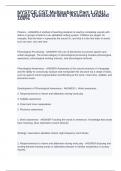
NYSTCE CST Multisubject Part 1 (241) Exam Questions With Answers Graded 100%
Phonics - ANSWER-A method of teaching students to read by correlating sounds with letters or groups of letters in an alphabetic writing system. Children are taught, for example, that the letter n represents the sound /n/, and that it is the first letter in words such as nose, nice and new. Phonological Processing - ANSWER-The use of phonemes to process spoken and written language. The broad category of phonological processing includes phonological awareness, phonological working memory, and phonological retrieval. Phonological Awareness - ANSWER-Awareness of the sound structure of a language and the ability to consciously analyze and manipulate this structure via a range of tasks, such as speech sound segmentation and blending at the word, onset-rime, syllable, and phonemic levels. Development of Phonological Awareness - ANSWER-1. Word awareness 2. Responsiveness to rhyme and alliteration during word play 3. Syllable awareness 4. Onset and rime manipulation 5. Phoneme awareness 1. Word awareness - ANSWER-Tracking the words in sentences. Knowledge that words have meaning. (less important to teach directly) Strategy: read-aloud, alphabet chants, high-frequency word books 2. Responsiveness to rhyme and alliteration during word play - ANSWER-Enjoying and reciting learned rhyming words or alliterative phrases in familiar storybooks or nursery rhymes. Strategy: poetry books, alphabet chants, picture flashcards w/ objects whose names rhyme. (Flashcards can be used in sorting and classifying activities.) 3. Syllable awareness - ANSWER-Counting, tapping, blending, or segmenting a word into syllables. Strategy: Flashcards w/ objects whose names contain different numbers of syllables. (Flashcards can be used in sorting activity.) 4. Onset and rime manipulation - ANSWER-Onset is the initial consonant in a one-syllable word. Rime includes the remaining sounds, including the vowel and any sounds that follow. The ability to produce a rhyming word depends on understanding that rhyming words have the same rime. Recognizing a rhyme is much easier than producing a rhyme.
Escuela, estudio y materia
- Institución
- NYSTCE CST Multisubject Part 1
- Grado
- NYSTCE CST Multisubject Part 1
Información del documento
- Subido en
- 28 de mayo de 2024
- Número de páginas
- 31
- Escrito en
- 2023/2024
- Tipo
- Examen
- Contiene
- Preguntas y respuestas
Temas
-
nystce cst multisubject part 1 241 exam question
-
nystce cst multisubject part 1 241 exam stuvia
-
phonics answer a method of teaching students to

Documento también disponible en un lote