WGU D265 Terms, Questions answered correctly 2024.
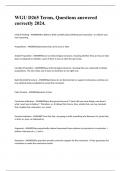
Critical Thinking - ANSWERSthe ability to think carefully about thinking and reasoning—to criticize your own reasoning. Propositions - ANSWERSstatements that can be true or false Simple Proposition - ANSWERShave no internal logical structure, meaning whether they are true or false does not depend on whether a part of them is true or false The sky is blue. Complex Proposition - ANSWERShave internal logical structure, meaning they are composed of simple propositions. The sky is blue, but it does not look blue to me right now. Bad Inferential Structure - ANSWERSpremises do not demonstrate or support conclusions, premises are true without being compelled to accept the conclusion False Premise - ANSWERSpremise is false Conclusion Indicators - ANSWERSHave the general sense of "I have told you some things, now here is what I want you to believe". Therefore, so, it follows that, hence, thus, entails that, we may conclude that, implies that, wherefore, as a result Premise Indicators - ANSWERS"from this fact I am going to infer something else Because, for, given that, in that, as, since, as indicated by Argument - ANSWERSany purportedly rational movement from evidence or premises to a conclusion. I believe x because of y, z, and w. Deductive - ANSWERSthe premises provide conclusive support for the conclusion - if they guarantee the conclusion or make the conclusion certain. Induction - ANSWERSarguments where the premises make the conclusion probable Abduction - ANSWERSarguments where the best available explanation is chosen as the correct explanation Soundness - ANSWERSboth about structure and truth. Must have good structure and true premises. Truth - ANSWERSproposition makes a statement about that world and the world either is or is not the way the proposition describes it to be. Validity - ANSWERSproperty of an argument structure, "this structure is such that if the premises of any argument are true, then the conclusion must be true. Cogent - ANSWERSall true premises, and the premises give strong inductive support for the conclusion. Strength - ANSWERSin the inductive argument, true premises make the conclusion probably true. Formal - ANSWERSrefers to the structure of things Formal fallacy of affirming the consequent - ANSWERSyou have made an argument with bad structure Informal fallacy of straw figure - ANSWERSstructure of your argument is not what is at issue Affirming the consequent - ANSWERSHas a structure that is analogous to the following argument: If I am in New York, then I am in the United States. I am in the United States. Therefore, I am in New York. Antecedent - ANSWERSthe part of the statement after the word "if" Consequent - ANSWERSthe part of the statement after the word "then" Modus Ponens - ANSWERSIf X, then Y. X. Therefore, Y Modus Tollens - ANSWERSIf X, then Y. Not Y. Therefore, not X. The Fallacy Fallacy - ANSWERSargument is bad, but conclusion is correct Fallacy - ANSWERScommon mistake in reasoning Bias - ANSWERSpeople are predisposed to arrive at a conclusion Principle of Charity - ANSWERSbefore attributing bias to someone, try to interpret their reasoning in the best possible light Confirmation Bias - ANSWERSThe natural tendency to seek out evidence supporting our beliefs and ignoring evidence in the way of our beliefs Cognitive Bias - ANSWERSquirks about the way we naturally categorize and make sense of the world around us. Tendencies to deviate from rational belief-forming practices Alief - ANSWERSautomatic belief like attitudes that can explain how our instinctual responses can conflict with our reasoned-out beliefs. Heuristic - ANSWERSa rule of thumb, a ready strategy, or a shortcut. A rule that does not always work but gets us where we need to go most of the time. Anchors - ANSWERStend to keep us tethered around a particular range of answers Availability - ANSWERSWhat I see is all there is Representative Bias - ANSWERSoccurs when the similarity of objects or events confuses people's thinking regarding the probability of an outcome. Ad Hominem - ANSWERSWhen someone attacks the arguer instead of the argument Genetic Fallacy - ANSWERSArguer critiques the origin of a claim or argument rather than the claim or argument itself Straw Figure - ANSWERSwhen someone misinterprets someone else's argument or position Red Herring - ANSWERSintroducing an irrelevant topic and discussing that instead of the topic at hand Appeal to Unqualified Authority - ANSWERStrusting an authority on one subject to speak on another subject Appeal to Force - ANSWERSif you don't believe this, then you will suffer bad consequences. Appeal to Consequences - ANSWERSan argument that concludes a hypothesis (typically a belief) to be either true or false based on whether the premise leads to desirable or undesirable consequences. Equivocation - ANSWERSa word used in two different senses. Children are a headache, aspirin makes headaches go away, therefore aspirin will make children go away. Appeal to Ignorance - ANSWERSasserts that a proposition is true because it has not yet been proven as false. Slippery Slope - ANSWERSargument, in logic, critical thinking, political rhetoric, and caselaw, is an argument in which a party asserts that a relatively small first step leads to a chain of related events culminating in some significant effect Texas Sharpshooter - ANSWERSsomeone already knows which conclusion they'd like to prove and then selects evidence which supports that conclusion Post Hoc - ANSWERSmistaking correlation for causation Hasty Generalization - ANSWERSwhen one generalizes about a group of people or things too quickly and without enough evidence Burden of Proof shifting - ANSWERSone decides that someone else must prove them wrong
Escuela, estudio y materia
- Institución
- CRITICAL THINKING
- Grado
- CRITICAL THINKING
Información del documento
- Subido en
- 27 de mayo de 2024
- Número de páginas
- 5
- Escrito en
- 2023/2024
- Tipo
- Examen
- Contiene
- Preguntas y respuestas
Temas
-
wgu d265 terms questions answered correctly 2024

Documento también disponible en un lote