Key words Notes questions
Atmosphere and weather
Weather The day to day condition of the atmosphere
Climate Average weather conditions of the atmosphere
over 30-year period
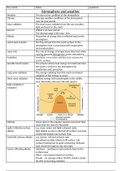
Solar radiation The short-wave radiation from the sun, provides
light and heat for the earth
Diurnal Within a 24-hour period
The diurnal range is the max - min
Albedo Proportion of energy that is reflected back to the
atmosphere
Latent heat transfer The flux of heat from the earth surface to the
atmosphere that is associated with evaporation
and condensation
Lapse rate The rate of change of temperature observed while
moving upwards through the earths atmosphere
insolation Insolation is the solar radiation that reaches the
earth's surface.
Sensible heat transfer The process where heat energy is transferred from
the earth’s surface to the atmosphere by
conduction and convection
Long wave radiation The energy radiating from the earth as infrared
radiation at low energy to space.
Short wave radiation Radiant energy with wavelengths in the visible,
near ultraviolet and near-infrared spectra
Daily variation in
insolation
latitude Areas close to the equator receive more heat than
areas that are closer to the poles
Light/ reflective surface e.g. snow, water and light-coloured rocks
albedo high albedo as more reflected off surface, less heat
conducted deeply only surface heat.
Dark/dull surfaces albedo e.g. tarmac, soil and volcanic rock
low albedo as little reflected off surface. Sub
surface heating due to good conducting. Releases
heat slowly throughout day and night
Factors affecting albedo Moisture – moisture in soil conducts heat to the
surface layer
Wind – can remove heat from surface
Clouds – on average reflect 30-40%, thicker clouds
50-70% of incoming radiation
Atmosphere and weather
Weather The day to day condition of the atmosphere
Climate Average weather conditions of the atmosphere
over 30-year period
Solar radiation The short-wave radiation from the sun, provides
light and heat for the earth
Diurnal Within a 24-hour period
The diurnal range is the max - min
Albedo Proportion of energy that is reflected back to the
atmosphere
Latent heat transfer The flux of heat from the earth surface to the
atmosphere that is associated with evaporation
and condensation
Lapse rate The rate of change of temperature observed while
moving upwards through the earths atmosphere
insolation Insolation is the solar radiation that reaches the
earth's surface.
Sensible heat transfer The process where heat energy is transferred from
the earth’s surface to the atmosphere by
conduction and convection
Long wave radiation The energy radiating from the earth as infrared
radiation at low energy to space.
Short wave radiation Radiant energy with wavelengths in the visible,
near ultraviolet and near-infrared spectra
Daily variation in
insolation
latitude Areas close to the equator receive more heat than
areas that are closer to the poles
Light/ reflective surface e.g. snow, water and light-coloured rocks
albedo high albedo as more reflected off surface, less heat
conducted deeply only surface heat.
Dark/dull surfaces albedo e.g. tarmac, soil and volcanic rock
low albedo as little reflected off surface. Sub
surface heating due to good conducting. Releases
heat slowly throughout day and night
Factors affecting albedo Moisture – moisture in soil conducts heat to the
surface layer
Wind – can remove heat from surface
Clouds – on average reflect 30-40%, thicker clouds
50-70% of incoming radiation