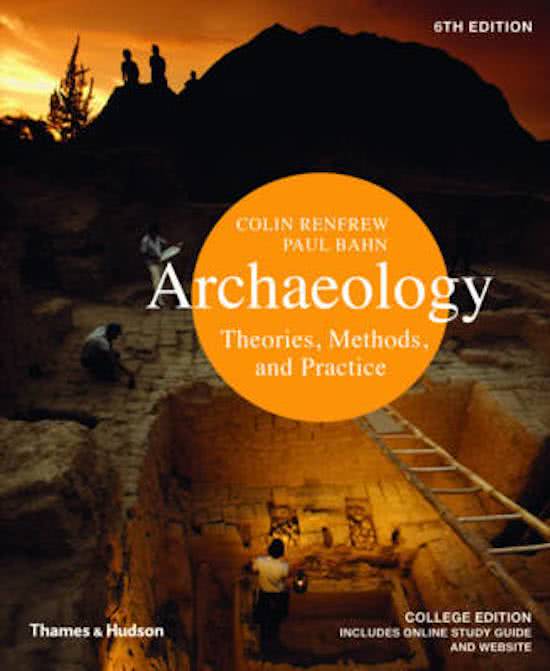
Chapter 1 Questions
1. Who is considered to be the first person to have conducted a scientific excavation
of an ancient site?
a) Thomas Jefferson
b) General Pitt-Rivers
c) Sir William Flinders Petrie
d) Willard Libby
e) Charles Darwin
2. According to Renfrew & Bahn, there are now a number of “archaeologies,”
including
a) environmental archaeology
b) underwater archaeology
c) historical archaeology
d) ethnoarchaeology
e) all of the above
3. Renfrew & Bahn argue that archaeology is
a) a science
b) a humanity
c) history
d) all of the above
e) none of the above
,4. James Hutton, author of Theory of the Earth (1785), studied the stratification of
rocks and concluded that
a) the same processes were continuing in the formation of the earth as in the past
b) multiple catastrophes were responsible for the formation of the earth
c) pressures of weight and gravity were solely responsible for earth’s formation
d) human activity (fires, forest depletion, dams, etc.) were responsible for the
earth’s formation
e) none of the above
5. Who formed the first cabinets of curiosities?
a) Sigmund Freud
b) Renaissance princes
c) Sir John Soane
d) the Aztecs
e) none of the above
6. One of the first to argue that the “Moundbuilders” were in fact ancestral to the
living Native Americans was
a) Ephraim Squier
b) Caleb Atwater
c) Samuel Haven
d) Charles Darwin
e) C. J. Thomsen
7. Credited with meticulous excavations and description, Sir William Flinders Petrie
was also responsible for devising the technique of
,a) seriation (sequence dating)
b) radiocarbon dating (C14)
c) grid-square excavation methods
d) regional survey
e) all of the above
8. A 19th-century pioneer in organized, precise excavation and recording methods
was
a) Oscar Montelius
b) Charles Darwin
c) C.J. Thomsen
d) Augustus Lane-Fox Pitt Rivers
e) James Hutton
9. The Rosetta Stone was found to be the key to
a) deciphering Aramaic
b) deciphering ancient Hebrew
c) deciphering Egyptian hieroglyphs
d) deciphering Linear A
e) deciphering the location of the Holy Grail
10. The account of the Trojan war in the Iliad inspired the search for Troy by
a) Thomas Jefferson
b) Augustus Lane-Fox Pitt Rivers
c) Sir Mortimer Wheeler
, d) Heinrich Schliemann
e) Ephraim Squier
11. Many of the principal features of modern archaeology, particularly chronology
and description, were established in the 19th century and continued to develop
through the first half of the 20th century; this initial approach to archaeology is
described by Gordon Willey and Jeremy Sabloff as
a) processual
b) classificatory-historical
c) “New Archaeology”
d) postprocessual
e) environmental determinism
12. In North America, the influential anthropologist Julian Steward emphasized the
importance of environmental adaptation in cultural change. This approach was
termed
a) environmentalism
b) cultural ecology
c) eco-archaeology
d) diffusionism
e) processualism
13. A key breakthrough in scientific methods applied to archaeological questions
was the invention by Willard Libby of
a) neutron activation analysis
b) dendrochronology
c) radiocarbon dating
1. Who is considered to be the first person to have conducted a scientific excavation
of an ancient site?
a) Thomas Jefferson
b) General Pitt-Rivers
c) Sir William Flinders Petrie
d) Willard Libby
e) Charles Darwin
2. According to Renfrew & Bahn, there are now a number of “archaeologies,”
including
a) environmental archaeology
b) underwater archaeology
c) historical archaeology
d) ethnoarchaeology
e) all of the above
3. Renfrew & Bahn argue that archaeology is
a) a science
b) a humanity
c) history
d) all of the above
e) none of the above
,4. James Hutton, author of Theory of the Earth (1785), studied the stratification of
rocks and concluded that
a) the same processes were continuing in the formation of the earth as in the past
b) multiple catastrophes were responsible for the formation of the earth
c) pressures of weight and gravity were solely responsible for earth’s formation
d) human activity (fires, forest depletion, dams, etc.) were responsible for the
earth’s formation
e) none of the above
5. Who formed the first cabinets of curiosities?
a) Sigmund Freud
b) Renaissance princes
c) Sir John Soane
d) the Aztecs
e) none of the above
6. One of the first to argue that the “Moundbuilders” were in fact ancestral to the
living Native Americans was
a) Ephraim Squier
b) Caleb Atwater
c) Samuel Haven
d) Charles Darwin
e) C. J. Thomsen
7. Credited with meticulous excavations and description, Sir William Flinders Petrie
was also responsible for devising the technique of
,a) seriation (sequence dating)
b) radiocarbon dating (C14)
c) grid-square excavation methods
d) regional survey
e) all of the above
8. A 19th-century pioneer in organized, precise excavation and recording methods
was
a) Oscar Montelius
b) Charles Darwin
c) C.J. Thomsen
d) Augustus Lane-Fox Pitt Rivers
e) James Hutton
9. The Rosetta Stone was found to be the key to
a) deciphering Aramaic
b) deciphering ancient Hebrew
c) deciphering Egyptian hieroglyphs
d) deciphering Linear A
e) deciphering the location of the Holy Grail
10. The account of the Trojan war in the Iliad inspired the search for Troy by
a) Thomas Jefferson
b) Augustus Lane-Fox Pitt Rivers
c) Sir Mortimer Wheeler
, d) Heinrich Schliemann
e) Ephraim Squier
11. Many of the principal features of modern archaeology, particularly chronology
and description, were established in the 19th century and continued to develop
through the first half of the 20th century; this initial approach to archaeology is
described by Gordon Willey and Jeremy Sabloff as
a) processual
b) classificatory-historical
c) “New Archaeology”
d) postprocessual
e) environmental determinism
12. In North America, the influential anthropologist Julian Steward emphasized the
importance of environmental adaptation in cultural change. This approach was
termed
a) environmentalism
b) cultural ecology
c) eco-archaeology
d) diffusionism
e) processualism
13. A key breakthrough in scientific methods applied to archaeological questions
was the invention by Willard Libby of
a) neutron activation analysis
b) dendrochronology
c) radiocarbon dating