

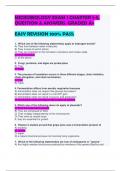
MICROBIOLOGY EXAM 1 CHAPTER 1-5, QUESTION & ANSWERS. GRADED A+
MICROBIOLOGY EXAM 1 CHAPTER 1-5, QUESTION & ANSWERS. GRADED A+ EASY REVISION 100% PASS: 1. Which one of the following statement(s) apply to hydrogen bonds? A) They form between water molecules. B) They involve H and O atoms. C) They are important in the formation of proteins and nucleic acids. D) All of the above D. all the above 2. Fungi, protozoa, and algae are prokaryotes A) True B) False 3. The process of translation occurs in three different stages, chain initiation, chain elongation, and chain termination. A) True B) False 4. Fermentation differs from aerobic respiration because A) fermentation does not require that glucose be present. B) fermentation does not result in a net ATP gain. C) fermentation does not result in pyruvic acid production. D) fermentation does not require that oxygen be present. 5. Which one of the following does not apply to plasmids? A) They are essential for growth B) They are composed of DNA C) They multiply independently of the chromosome D) They exist as closed loops A. they are essential for growth 6. Pasteur's studies proved that grape juice was a fermentation product of A) bacteria. B) yeasts. C) algae. D) a natural chemical process not involving living organisms. 7. Which of the following statement(s) are true of endospores or "spores" A) Are highly resistant structures produced by members of the genera Bacillus and Clostridium. B) Gram positive bacteria only have spores. C) These structures act as a dormant stage in the life of the bacteria when environmental conditions are not favorable for growth D) All of the above 8. The total ATP yield from one glucose going through glycolysis and the Krebs cycle is A) 2 B) 10 C) 24 D) 38 9. Prokaryotes and eukaryotes differ primarily with regard to the absence or presence of a cell A) membrane. B) wall. C) spore. D) nucleus. 10. Proteins that bring about chemical changes while remaining essentially unchanged are referred to as A) enzymes. B) vitamins. C) coenzymes. D) cofactors. 11. All the following are components of an atom except A) electrons. B) neutrons. C) lipids. D) protons. 12.All the following are characteristics of prokaryotes except A) prokaryotes have organelles. B) prokaryotes have ribosomes. C) prokaryotes lack a nucleus. D) prokaryotes have genes. 13. Alexander Fleming discovered A) Viruses. B) Penicillin. C) Cell wall. D) streptomycin
Información del documento
- Subido en
- 25 de mayo de 2024
- Número de páginas
- 8
- Escrito en
- 2023/2024
- Tipo
- Examen
- Contiene
- Preguntas y respuestas

