

DUNPHY FINAL CLINICAL EXAM NURS 671 QUESTIONS AND ANSWERS
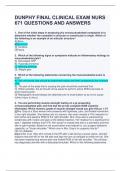
are true concerning shoulder dislocation? A] Posterior dislocations are more common than anterior dislocations B]. There is a risk of neurovascular and neurosensory trauma, so the clinician should check for distal pulses C]. Recurrent dislocations are uncommon and would require great force to result in injury. D]. Surgery is most commonly the treatment of choice 5. Mrs. Anderson is a 35year old woman who has been recently diagnosed with carpal tunnel syndrome. She has 2 young children and asks the clinician what the chances are that they also will develop carpal tunnel syndrome. Which of the following responses would be correct regarding the risk of developing carpal tunnel syndrome? A] Carpal tunnel syndrome commonly occurs in families. Genetic factors are thought to account for about one-half the risk of developing carpal tunnel. B].Only people w/occupations that require repeated flexion extension of the wrist, use of hand tools that require forceful gripping, or use of hand tools that vibrate are at risk for developing carpal tunnel. C]. An underlying musculoskeletal disorder must be present for a person to develop carpal tunnel. D].Carpal tunnel syndrome only occurs in the presence of a hormonal imbalance. 6. Which of the following statements is true regarding the treatment of carpal tunnel syndrome? A]. The goal of treatment is to prevent flexion and extension movements of the wrist. B]. Splints are used in carpal tunnel syndrome, because they allow for free movement of the fingers and thumb while maintaining the wrist in a neutral position. C]. Corticosteroid injections are discouraged in the treatment of carpal tunnel syndrome because of the risks for median nerve damage, scarring, and infection. D. All of the above 7. Sam is a 25 year old man who has been diagnosed with low back strain based on his h/o localized low back pain and muscle spasm along with a normal neurological examination. As the clinician, you explain to Sam that low back pain is a diagnosis of exclusion. Which of the following symptoms would alert the clinician to the more serious finding of a herniated nucleus pulposus or ruptured disc? A]. Morning stiffness and limited mobility of the lumbar spine B]. Unilateral radicular pain symptoms that extend below the knee and are equal to or greater than the back pain. C]. Fever, chills, and elevated erythrocyte sedimentation rate D]. Pathologic fractures, severe night pain, weight loss, and fatigue 8. The clinician has instructed Sam, a 25 year old man pt with low back strain, to use NSAIDs to manage his symptoms of pain and discomfort. Which of the
Información del documento
- Subido en
- 24 de mayo de 2024
- Número de páginas
- 33
- Escrito en
- 2023/2024
- Tipo
- Examen
- Contiene
- Preguntas y respuestas

