Instructor’s Solutions
Manual
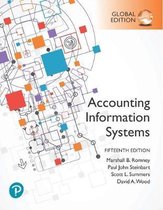
Accounting Information
Systems
15th Edition
Marshall B. Romney
Professor Emeritus, Brigham Young University
Paul John Steinbart
Professor Emeritus, Arizona State University
, Scott L. Summers
Brigham Young University
David A. Wood
Brigham Young University
This work is protected by United States copyright laws and is provided solely for the use
of instructors in teaching their courses and assessing student learning. Dissemination
or sale of any part of this work (including on the World Wide Web) will destroy the
integrity of the work and is not permitted. The work and materials from it should never
be made available to students except by instructors using the accompanying text in their
classes. All recipients of this work are expected to abide by these restrictions and to
honor the intended pedagogical purposes and the needs of other instructors who rely on
these materials.
,Copyright © 2021 by Pearson Education, Inc. or its affiliates. All Rights Reserved. Manufactured in the
United States of America. This publication is protected by copyright, and permission should be obtained
from the publisher prior to any prohibited reproduction, storage in a retrieval system, or transmission in
any form or by any means, electronic, mechanical, photocopying, recording, or otherwise. For
information regarding permissions, request forms, and the appropriate contacts within the Pearson
Education Global Rights and Permissions department, please visit www.pearsoned.com/permissions/.
PEARSON, ALWAYS LEARNING, and REVEL are exclusive trademarks owned by Pearson Education,
Inc. or its affiliates in the U.S. and/or other countries.
Unless otherwise indicated herein, any third-party trademarks, logos, or icons that may appear in this
work are the property of their respective owners, and any references to third-party trademarks, logos,
icons, or other trade dress are for demonstrative or descriptive purposes only. Such references are not
intended to imply any sponsorship, endorsement, authorization, or promotion of Pearson’s products by
the owners of such marks, or any relationship between the owner and Pearson Education, Inc., or its
affiliates, authors, licensees, or distributors.
chapter 1
, accounting information systems: An overview
Suggested Answers to Discussion Questions
1.1 The value of information is the difference between the benefits realized from using that
information and the costs of producing it. Would you, or any organization, ever
produce information if its expected costs exceeded its benefits? If so, provide some
examples. If not, why?
Most organizations produce information only if its value exceeds its cost. However, there are
two situations where information may be produced even if its cost exceeds its value.
a. It is often difficult to estimate accurately the value of information and the cost of
producing it. Therefore, organizations may produce information that they expect will
produce benefits in excess of its costs, only to be disappointed after the fact.
b. Production of the information may be mandated by either a government agency or a
private organization. Examples include the tax reports required by the IRS and
disclosure requirements for financial reporting.
1.2 Can the characteristics of useful information listed in Table 1-1 be met simultaneously?
Or does achieving one mean sacrificing another?
Several of the criteria in Table 1.1 can be met simultaneously. For example, more timely
information is also likely to be more relevant. Verifiable information is likely to be more
accurate.
However, achieving one objective may require sacrificing another. For example, ensuring that
information is more complete may reduce its timeliness. Similarly, increased verifiability and
accuracy may reduce its timeliness.
The decision maker must decide which trade-offs are warranted in each situation.
Manual
Accounting Information
Systems
15th Edition
Marshall B. Romney
Professor Emeritus, Brigham Young University
Paul John Steinbart
Professor Emeritus, Arizona State University
, Scott L. Summers
Brigham Young University
David A. Wood
Brigham Young University
This work is protected by United States copyright laws and is provided solely for the use
of instructors in teaching their courses and assessing student learning. Dissemination
or sale of any part of this work (including on the World Wide Web) will destroy the
integrity of the work and is not permitted. The work and materials from it should never
be made available to students except by instructors using the accompanying text in their
classes. All recipients of this work are expected to abide by these restrictions and to
honor the intended pedagogical purposes and the needs of other instructors who rely on
these materials.
,Copyright © 2021 by Pearson Education, Inc. or its affiliates. All Rights Reserved. Manufactured in the
United States of America. This publication is protected by copyright, and permission should be obtained
from the publisher prior to any prohibited reproduction, storage in a retrieval system, or transmission in
any form or by any means, electronic, mechanical, photocopying, recording, or otherwise. For
information regarding permissions, request forms, and the appropriate contacts within the Pearson
Education Global Rights and Permissions department, please visit www.pearsoned.com/permissions/.
PEARSON, ALWAYS LEARNING, and REVEL are exclusive trademarks owned by Pearson Education,
Inc. or its affiliates in the U.S. and/or other countries.
Unless otherwise indicated herein, any third-party trademarks, logos, or icons that may appear in this
work are the property of their respective owners, and any references to third-party trademarks, logos,
icons, or other trade dress are for demonstrative or descriptive purposes only. Such references are not
intended to imply any sponsorship, endorsement, authorization, or promotion of Pearson’s products by
the owners of such marks, or any relationship between the owner and Pearson Education, Inc., or its
affiliates, authors, licensees, or distributors.
chapter 1
, accounting information systems: An overview
Suggested Answers to Discussion Questions
1.1 The value of information is the difference between the benefits realized from using that
information and the costs of producing it. Would you, or any organization, ever
produce information if its expected costs exceeded its benefits? If so, provide some
examples. If not, why?
Most organizations produce information only if its value exceeds its cost. However, there are
two situations where information may be produced even if its cost exceeds its value.
a. It is often difficult to estimate accurately the value of information and the cost of
producing it. Therefore, organizations may produce information that they expect will
produce benefits in excess of its costs, only to be disappointed after the fact.
b. Production of the information may be mandated by either a government agency or a
private organization. Examples include the tax reports required by the IRS and
disclosure requirements for financial reporting.
1.2 Can the characteristics of useful information listed in Table 1-1 be met simultaneously?
Or does achieving one mean sacrificing another?
Several of the criteria in Table 1.1 can be met simultaneously. For example, more timely
information is also likely to be more relevant. Verifiable information is likely to be more
accurate.
However, achieving one objective may require sacrificing another. For example, ensuring that
information is more complete may reduce its timeliness. Similarly, increased verifiability and
accuracy may reduce its timeliness.
The decision maker must decide which trade-offs are warranted in each situation.