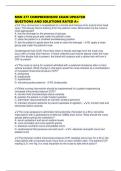
AIR METHODS CC Paramedic Flight Operations General Questions and Answers 100% Updated and A+ Graded
AIR METHODS CC Paramedic Flight Operations General Questions and Answers 100% Updated and A+ Graded Chapter 2: Flight operations General - ANS-The following are Operational control Air methods utilizes a two-tier system of operational control. What are the two tiers - ANS-Tier 1: managers and directors, 4 1 1 pilot computer system, flight followers and operational control center. Tier 2: The pilot in command exercises operational control and final authority over the operation of the aircraft What system validates the pilots requirements, crew rest, and currency? It also issues an electronic flight release valid for the duration of the pilot's shift - ANS-4 1 1 pilot computer system What are the two types of offsite communication centers for flight following utilized by air methods? - ANS-1. H B S - hospital based system, located near their own base and staffed by non-air methods employees. 2. Community based system - staffed with air method employees and centralized in Omaha Nebraska, called Aircom, and Arch which is located in St. Louis Missouri Examples of when the pilot may fly into knowing icing conditions under V F R or into knowing forecast icing conditions under I F R - ANS-V F R - The forecast or report for icing in clouds or precipitation would allow a V F R flight so long as the pilot could operate clear of clouds and precipitation. I F R - only if the aircraft being operated is equipped and certified for flight into known icing conditions Temperature and Cold weather considerations for protecting medical equipment supplies, avionics, and other interior furnishings from the cold. - ANS-50°F or less. This heater should only be operated during ground, non-operating conditions What do you do when forecast winds reach or exceed the starting limits of the aircraft? - ANS-The main and tail rotor blades will be restrained and secured to the deck. When must the aircraft be Hangard due to wind considerations - ANS-When forecast winds reach 40 knots What are your precipitation considerations when dealing with adverse weather? - ANS-When forecast contains freezing rain, hail, or heavy snow, the aircraft will be safely relocated prior to the occurrence of forecast conditions What are the proximity and movement considerations in regards to adverse weather - ANS-When a weather systems movement or proximity of the hazardous weather requires an exercise of caution to protect the aircraft from potential damage, the P I C shall safely relocate the aircraft to a safe location as outlined in the local procedures. What is the procedure for requesting additional training? - ANS-Request shall be coordinated through the appropriate chain of command with final approval from the chief pilot As P I C you have not flown in the specific make, model or series aircraft in the last 60 days what must you accomplish? - ANS-As a minimum you must accomplish one start and three takeoffs and landings As P I C you have not flown on your specific make, model, or series aircraft in the last 90 days. What must you do? - ANS-You must notify the Regional Aviation Manager to determine if any training is needed for the pilot to perform competently and safely in that aircraft. If you have not fallen over a route and into an airport/heliport within the preceding 90 days what must you do? - ANS-Study the appropriate I F R enroute or V F R aeronautical charts, destination airport/heliport diagrams, appropriate I F R approach charts for destination and alternate, if applicable What are the three requirements for night operations in regards to airport requirements? - ANS-1. Determine the wind direction prior to take off and landing. 2. Boundary or runway lights clearly show limits of landing and takeoff area. 3. Night is defined as the period from end of evening civil twilight to the beginning of morning civil twilight. Prior to start and lift off what must each pilot do in regards to the confirmation checks - ANS-Each pilot will verbally challenged him or herself and respond verbally to each item on the confirmation checklist to ensure that each item is complete Who are the only authorized individuals to carry weapons on Air Methods aircraft? What weapons are included and prohibited? - ANS-Local, state, or federal employees I.e. Law-enforcement officers are authorized to carry weapons. including fire arms and tasers. Pepper spray, mace or other aerosol products are prohibited PIC shall not allow cell phones or portable electronic devices to be used during what modes of flight - ANS-taxi, takeoff, enroute, approach or landing When can electronic devices be used in CRUISE flight? - ANS-When an E M I, R F I flight test profile, developed by Air Methods has been conducted What is the zero tolerance policy in the interest of safety in regards to cell phone & electronic devices? - ANS-No verbal communications, sending or receiving texts, email or instant message while in flight and aboard an aircraft What does a RED cyclic warning cover mean and when should it be installed - ANS-It means the aircraft is out of service and should be installed prior to rendering out of service Who can install and/or remove a RED cyclic warning cover? - ANS-Any Pilot or Mechanic can install a RED cover. Only a mechanic or an authorized pilot can remove it after the aircraft has been returned to service. When do pilots utilize a YELLOW cyclic warning cover - ANS-Anytime the aircraft is restrained from flight. I E, tie downs in place, ground power connected, required documentation removed from aircraft What paper work shall be carried on the helicopter for ALL flights - ANS-The Dailey Flight Log Weights for takeoff and max weight will be entered for all flights. What are the exceptions? - ANS-1. Maintenance flight, 2. training, 3. Ferry, 4. Reposition with only air method employees aboard What kinds of flights are conducted under Part 91? - ANS-1. Maintenance flight, 2. training, 3. Ferry, 4. Reposition with only air method employees aboard Entry of C G data, the forward limit, actual C G and aft limit are required for what type of helicopters? - ANS-Multi engine helicopters Medical personnel or pacs shall not depart the aircraft until when? - ANS-Pilot verbally notifies "landed, clear to deplane". A pilot shall not take off until when? - ANS-Pilot receives a verbal confirmation that crew, passengers and doors are closed and secured What are 5 procedure options to follow for deteriorating weather enroute? - ANS-1. Divert to alternate airport / heliport or suitable area for patient transfer to other means of transport.
Escuela, estudio y materia
- Institución
- Air Methods Critical Care
- Grado
- Air Methods Critical Care
Información del documento
- Subido en
- 23 de mayo de 2024
- Número de páginas
- 32
- Escrito en
- 2023/2024
- Tipo
- Examen
- Contiene
- Preguntas y respuestas
Temas
-
air methods cc paramedic flight operations general