Research methods for BE: notes
1. Chapter 1
1.1. Business research
A. What is research?
o Process of finding answers or solutions to a problem after study and analysis of a
specific phenomenon
o Phenomenon can be: job search
o Most research is data based
o Objective investigation: not your own opinion
B. Research comes in many forms
o A theory can identify as a casual relationship
o A casual relationship: element can be correlated to other element
o Research methods:
Surveys (quantitative: numbers)
Interviews (qualitative: words)
C. Applied and basic research
o Applied
Driven by practice
Will try to find an immediate answer
Within reasonable time finding a solution
It’s not because you have an answer on a certain problem, that you can
generalize
o Basic research
Driven by curiosity without immediately finding solutions to the problem
Result only after a “long” time
D. Managers and research
o Managers should know what research is about
E. The hallmarks of scientific research
o Example: what explains employees’ commitment to an organization
Purposiveness
▫ What is the purpose? Increase commitment
▫ Good researchers ask: why bother?
Rigor:
Assume: researcher asks 10-12 employees to indicate what would increase their
level of commitment.
▫ High degree of exactness
▫ Is the approach scientific? Not really, sample is too small
▫ Literature review: who already did this research?
▫ Good theoretical base: are you sure it is relevant?
Testability
Hypothesis – an example: “Employees who actively participate in decision
making will have a higher level of commitment than employees who do not
actively participate”
▫ Exploratory: you don’t know what to expect
▫ Hypothesis: derived from theory
, ▫ Identify the variables in hypothesis: participants and decision making
Replicability
▫ Other researcher is able to find similar results with the same methods but
with different data
Precision and confidence
Objectivity
▫ Resulting your analysis on data collection and facts
Generalizing
▫ The more generalizable your results, the more universal the approach could
be
▫ The broader the scope the more generated your results will be
Parsimony (simplicity)
▫ Ockham’s razor
♦ If you want to explain something, do it in the most simple way
♦ Better a few important things increase a lot, than many non-important
things increase a little bit
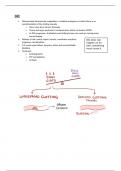
1.2. The different steps of the writing process
1.3. Method and methodology
A. Method explains how to do it
B. Methodology: why do we do it like this?
2. Lecture 2: scientific approach
2.1. The hypotheticodeductive approach
A seven-step process
Hypotheticodeductive approach: very important approach!
01 An area where a problem is pointed out
▫ Lack of innovation succes
▫ = good opportunity to do research
02 Your research questions are translated into a question
▫ What explains the succes or the lack of it
▫ Can be more than 1, but not overdue
▫ Personal experience may help
▫ It does not mean that the research is done a lot already that you
shouldn’t/can’t do it: eg. Maybe it hasn’t been done as much in Europe but
mostly in America
▫ Research aims to help creating conceptual framework
▫ Conceptual framework represents the relationship
03 Have to make hypotheses that are testable
▫ Are hypotheses true or false?
♦ if false: restruct it
▫ Testable: we can measure certain things
▫ Creativity can be measured
▫ Something subjective is not measurable
▫ Trying to be as objective as possible, if not possible you can use subjective
measurements but they take way more time
▫ Likert scale, working more than 1 question to measure creativity
04 Choose measures for the variables in the hypothesis
▫ Consistently keep track of measurements
1. Chapter 1
1.1. Business research
A. What is research?
o Process of finding answers or solutions to a problem after study and analysis of a
specific phenomenon
o Phenomenon can be: job search
o Most research is data based
o Objective investigation: not your own opinion
B. Research comes in many forms
o A theory can identify as a casual relationship
o A casual relationship: element can be correlated to other element
o Research methods:
Surveys (quantitative: numbers)
Interviews (qualitative: words)
C. Applied and basic research
o Applied
Driven by practice
Will try to find an immediate answer
Within reasonable time finding a solution
It’s not because you have an answer on a certain problem, that you can
generalize
o Basic research
Driven by curiosity without immediately finding solutions to the problem
Result only after a “long” time
D. Managers and research
o Managers should know what research is about
E. The hallmarks of scientific research
o Example: what explains employees’ commitment to an organization
Purposiveness
▫ What is the purpose? Increase commitment
▫ Good researchers ask: why bother?
Rigor:
Assume: researcher asks 10-12 employees to indicate what would increase their
level of commitment.
▫ High degree of exactness
▫ Is the approach scientific? Not really, sample is too small
▫ Literature review: who already did this research?
▫ Good theoretical base: are you sure it is relevant?
Testability
Hypothesis – an example: “Employees who actively participate in decision
making will have a higher level of commitment than employees who do not
actively participate”
▫ Exploratory: you don’t know what to expect
▫ Hypothesis: derived from theory
, ▫ Identify the variables in hypothesis: participants and decision making
Replicability
▫ Other researcher is able to find similar results with the same methods but
with different data
Precision and confidence
Objectivity
▫ Resulting your analysis on data collection and facts
Generalizing
▫ The more generalizable your results, the more universal the approach could
be
▫ The broader the scope the more generated your results will be
Parsimony (simplicity)
▫ Ockham’s razor
♦ If you want to explain something, do it in the most simple way
♦ Better a few important things increase a lot, than many non-important
things increase a little bit
1.2. The different steps of the writing process
1.3. Method and methodology
A. Method explains how to do it
B. Methodology: why do we do it like this?
2. Lecture 2: scientific approach
2.1. The hypotheticodeductive approach
A seven-step process
Hypotheticodeductive approach: very important approach!
01 An area where a problem is pointed out
▫ Lack of innovation succes
▫ = good opportunity to do research
02 Your research questions are translated into a question
▫ What explains the succes or the lack of it
▫ Can be more than 1, but not overdue
▫ Personal experience may help
▫ It does not mean that the research is done a lot already that you
shouldn’t/can’t do it: eg. Maybe it hasn’t been done as much in Europe but
mostly in America
▫ Research aims to help creating conceptual framework
▫ Conceptual framework represents the relationship
03 Have to make hypotheses that are testable
▫ Are hypotheses true or false?
♦ if false: restruct it
▫ Testable: we can measure certain things
▫ Creativity can be measured
▫ Something subjective is not measurable
▫ Trying to be as objective as possible, if not possible you can use subjective
measurements but they take way more time
▫ Likert scale, working more than 1 question to measure creativity
04 Choose measures for the variables in the hypothesis
▫ Consistently keep track of measurements